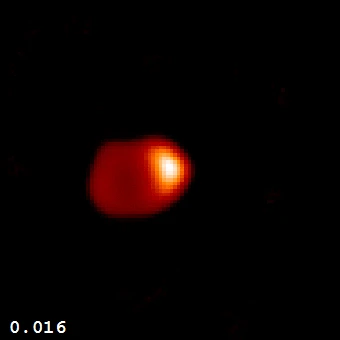
Beta Leonis Minoris
Binary star in Leo Minor, second brightest in its constellation.

Beta Leonis Minoris (β Leonis Minoris) is a binary star system located in the northern constellation Leo Minor. Its combined apparent visual magnitude is roughly 4.2. Despite being the only star in Leo Minor to carry a Bayer designation, it is actually the constellation's second-brightest star—the brightest being 46 Leonis Minoris—which aligns with the convention that the label "beta" typically marks the second most luminous star.
The two stars in this system can be separated visually during only part of each orbit. When they are too close to distinguish, the system appears as a single G9 giant star, though hints of a second set of spectral lines are present. An orbit derived from double-lined spectroscopic data is unreliable; a better orbit has been determined using only the primary's spectral lines, supplemented by visual observations. The orbital period is nearly 39 years, with a high eccentricity of 0.683. The semi-major axis measures 0.36 arcseconds, but the separation between the components varies from 0.1 to 0.6 arcseconds.
The primary star is a late G-class red clump giant—a star that has begun fusing helium in its core and sits at the cool end of the horizontal branch. The secondary star's properties can only be estimated from its relative brightness and spectral type: it is an F8 subgiant, hotter than the Sun and just starting to evolve away from the main sequence.
- Apparent visual magnitude
- approximately 4.2
- Orbital period
- nearly 39 years
- Eccentricity
- 0.683
- Semi major axis
- 0.36″
- Separation range
- 0.1 to 0.6″
- Primary spectral class
- late G-class red clump giant
- Secondary spectral class
- F8 subgiant
Lore & Background
Beta Leonis Minoris is a binary star system that can be resolved for a portion of each orbit. When the two components are too close to resolve, it appears as a single G9 giant star with some indications of a second set of spectral lines. The orbit derived as a double-lined spectroscopic binary is poor, and a better orbit has been calculated using only the spectral lines of the primary, plus input from the known visual observations. The orbital period is nearly 39 years and the eccentricity is high at 0.683. The semi-major axis of the orbit is 0.36″, but the separation varies from 0.1 to 0.6″.
The primary star is a late G-class red clump giant, a star that is fusing helium in its core and lies at the cool end of the horizontal branch. The properties of the secondary star can only be estimated from its relative brightness and its spectral class. It is an F8 subgiant, hotter than the sun and starting to evolve away from the main sequence.
Reader's Guide
Beta Leonis Minoris is notable as the only star in Leo Minor with a Bayer designation, yet it is only the second brightest star in the constellation, consistent with the convention that 'beta' typically designates the second-brightest star. Its binary nature is complex: the orbit derived as a double-lined spectroscopic binary is poor, so a better orbit was calculated using only the spectral lines of the primary, combined with visual observations. This highlights the challenges in resolving close binary systems. The primary is a red clump giant fusing helium in its core, placing it on the horizontal branch, while the secondary is an F8 subgiant, hotter than the Sun and beginning to evolve off the main sequence. The system's high eccentricity of 0.683 and varying separation (0.1 to 0.6″) over a nearly 39-year orbit make it a valuable object for studying binary dynamics and stellar evolution.
More in Binary and Multiple Stars, Part 3 1-24
Spotted an error? Know more?
Reader corrections go straight into our review queue. Suggest an edit · How this site is sourced