Beta Herculis
Binary star and brightest star in Hercules.

Beta Herculis, also known by its Bayer designation β Herculis and the formal name Kornephoros, is the brightest star in the northern constellation Hercules. It shines with a typical apparent visual magnitude of 2.81, though it is a suspected variable star that can brighten to magnitude 2.76. Parallax measurements place it about 139 light-years (43 parsecs) from the Sun. To the naked eye, it appears as a single point of light, but in July 1899, American astronomer W. W. Campbell detected variations in its radial velocity through spectroscopy, revealing it to be a binary system.
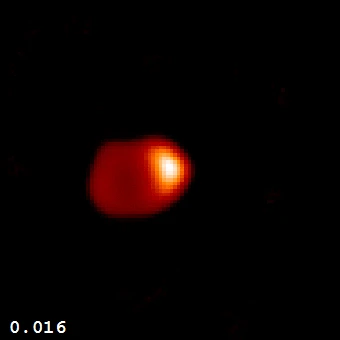
The binary nature was confirmed in 1977 when Antoine Labeyrie and colleagues used speckle interferometry with the Hale Telescope at Palomar Observatory to resolve the two components. Later, the Hipparcos satellite tracked the primary star's orbital motion relative to other stars, and in 2005, an orbit was calculated by combining these data with spectroscopic measurements. The two stars orbit each other with a period of roughly 410 days, a high eccentricity of 0.55, and an orbital plane inclined 53.8° relative to Earth's line of sight.
The primary star is classified as G7 IIIa, a giant that has exhausted hydrogen in its core and evolved away from the main sequence. It is likely now fusing helium into carbon and oxygen, placing it on the horizontal branch. With a mass nearly three times that of the Sun, it was probably a B-type main-sequence star (similar to Beta Librae) before leaving the main sequence. At an age of about 420 million years, it has expanded to 16 times the Sun's radius and shines with 150 times the Sun's luminosity. Its effective temperature of roughly 5,100 K gives it the yellow hue typical of a G-type star. The companion star, by contrast, has only 90% of the Sun's mass. Lacking enough mass to explode as a supernova, Beta Herculis will ultimately become a white dwarf, similar to but less massive than Sirius B.
The star's traditional name, Kornephoros, comes from Greek for "club bearer." It also bore the name Rutilicus, a corruption of the Latin *titillicus*, meaning "armpit." In 2016, the International Astronomical Union's Working Group on Star Names approved Kornephoros for component β Herculis A, and it is now listed in the IAU Catalog of Star Names.
- Bayer designation
- β Herculis
- Formal name
- Kornephoros
- Apparent magnitude
- 2.81 (base), may rise to 2.76
- Distance
- 139 light-years (43 parsecs)
- Spectral type primary
- G7 IIIa
- Orbital period
- ~410 days
- Orbital eccentricity
- 0.55
- Orbital inclination
- 53.8°
Lore & Background
Beta Herculis bears the traditional names Kornephoros, a Greek word meaning 'club bearer', and Rutilicus, a corruption of the Latin word titillicus, meaning 'armpit'. In 2016, the International Astronomical Union organized a Working Group on Star Names (WGSN) to catalogue and standardize proper names for stars. The WGSN approved the name Kornephoros for Component β Herculis A on 21 August 2016, and it is now so entered in the IAU Catalog of Star Names. It was a member of the indigenous Arabic asterism al-Nasaq al-Shāmī, 'the Northern Line' of al-Nasaqān 'the Two Lines', along with Gamma Herculis, Gamma Serpentis and Beta Serpentis. Though, according to a 1971 NASA catalog, al-Nasaq al-Sha'āmī or Nasak Shamiya was the title for three other stars: Beta Serpentis as Nasak Shamiya I, Gamma Serpentis as Nasak Shamiya II and Gamma Herculis as Nasak Shamiya III. In Chinese, 天市右垣 (Tiān Shì Yòu Yuán), meaning Right Wall of Heavenly Market Enclosure, refers to an asterism which represents eleven old states in China and which is marking the right borderline of the enclosure, consisting of Beta Herculis, Gamma Herculis, Kappa Herculis, Gamma Serpentis, Beta Serpentis, Delta Serpentis, Alpha Serpentis, Epsilon Serpentis, Delta Ophiuchi, Epsilon Ophiuchi and Zeta Ophiuchi. Consequently, the Chinese name for Beta Herculis itself is 天市右垣一 (Tiān Shì Zuǒ Yòu yī, English: the First Star of Right Wall of Heavenly Market Enclosure), represent Hézhōng (河中), possibly Hezhong Municipality or Hezhong Circuit. Hézhōng (河中) was westernized into Ho Chung by R.H. Allen, which means 'in the river'.
Reader's Guide
Beta Herculis is notable as the brightest star in Hercules and as a binary system discovered spectroscopically by W. W. Campbell in July 1899. Its binary nature was later resolved visually in 1977 at Palomar Observatory by Antoine Labeyrie and others using speckle interferometry with the Hale Telescope. The Hipparcos satellite observed the orbital motion of the primary relative to other stars, and an orbit was computed in 2005 using spectroscopic data together with these measurements. The system has a period of around 410 days, a high orbital eccentricity of 0.55, and an orbital plane inclined 53.8° to the line of sight from Earth. The primary star is a G7 IIIa giant, most likely fusing helium into carbon and oxygen in its core, qualifying it as a horizontal branch star. With a mass nearly three times that of the Sun, it was most likely a B-type main-sequence star similar to Beta Librae prior to core hydrogen exhaustion. It is comparable to the main component of Capella, albeit warmer and brighter. Being 420 million years old, it has expanded to 16 times the Sun's radius and is radiating 150 times its luminosity. The effective temperature of the star's outer envelope is about 5,100 K, giving it the yellow hue of a G-type star. The secondary star has a mass only 90% that of the Sun. With insufficient mass to explode as a supernova, Beta Herculis will most likely become a white dwarf similar to Sirius B, but less massive. Its legacy includes the naming of the U.S. Navy cargo ship USS Rutilicus (AK-113) after the star.
Did You Know?
- Beta Herculis is a suspected variable star with an apparent magnitude that may rise as high as 2.76.
- The binary nature was discovered in July 1899 by American astronomer W. W. Campbell via spectroscopic radial velocity variations.
- The system was resolved visually in 1977 using speckle interferometry at Palomar Observatory with the Hale Telescope.
- The primary star is 420 million years old and has expanded to 16 times the Sun's radius.
More in Binary and Multiple Stars, Part 3 1-24
Spotted an error? Know more?
Reader corrections go straight into our review queue. Suggest an edit · How this site is sourced