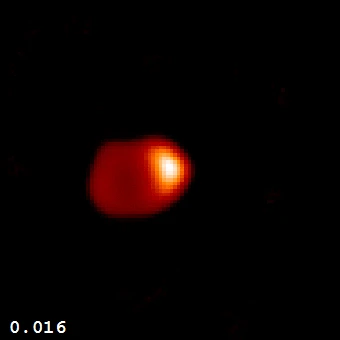
Beta Cancri
Brightest star in Cancer, an orange giant with a barium-rich spectrum.

Beta Cancri is the brightest star in the zodiacal constellation of Cancer, visible to the naked eye with an apparent visual magnitude of +3.5. It bears the proper name Tarf, approved by the IAU Working Group on Star Names in 2018, and is notable for hosting an exoplanet, Beta Cancri b, discovered via radial velocity observations.
- Bayer designation
- β Cancri
- Apparent visual magnitude
- +3.5
- Absolute magnitude
- −1.2
- Distance
- 303 light-years
- Spectral type
- K4III Ba1
- Mass
- 1.7 solar masses
- Radius
- 52 solar radii
- Luminosity
- 677 solar luminosities
- Effective temperature
- 4,094 K
- Age
- 1.9 billion years
Lore & Background
Beta Cancri has the traditional name Al Tarf, meaning 'end' or 'edge' in Arabic, later anglicized as Altarf and then shortened to Tarf by the IAU in 2018. Its Bayer designation is β Cancri, Latinized from the Greek. The star is an orange K-type giant with a stellar classification of K4III Ba1, indicating it is a Barium star with enhanced abundances of barium. At an estimated age of 1.9 billion years, it has 1.7 times the mass of the Sun and has expanded to 52 times the Sun's radius, radiating 677 times the Sun's luminosity from a photosphere at 4,094 K. It is drifting further away from the Solar System with a line-of-sight velocity of 23 km/s.
Reader's Guide
Beta Cancri is significant as the brightest star in Cancer and as a host to an exoplanet, Beta Cancri b, discovered in 2014. The planet has a minimum mass of 7.8 Jupiter masses and an orbital period of 605 days, detected through radial velocity measurements. The star also has a visual companion, WDS J08165+0911B, a fourteenth-magnitude red dwarf separated by 29.5 arcseconds (at least 2,740 AU), though it is uncertain whether the pair is gravitationally bound. If bound, their orbital period would be at least 76,000 years. Beta Cancri is suspected to vary slightly in brightness; analysis of Hipparcos data found an amplitude of 0.0054 magnitudes over a period of 6.00565 days. Its legacy includes its traditional Arabic name and its classification as a barium giant, a type of cool giant with unusual chemical abundances.
Did You Know?
- Beta Cancri is a barium star, showing enhanced abundances of barium in its spectrum.
- Its exoplanet, Beta Cancri b, has a minimum mass of 7.8 Jupiter masses and orbits every 605 days.
- The companion star, if bound, would have an orbital period of at least 76,000 years.
Frequently Asked Questions
What is Beta Cancri?
Beta Cancri is the brightest star in the zodiacal constellation Cancer, shining at an apparent visual magnitude of +3.5 so that it is readily visible to the unaided eye. It lies approximately 303 light-years from Earth.
What is the proper name of Beta Cancri?
The IAU Working Group on Star Names gave the official approval for the name "Tarf" in 2018. Prior to that designation, the star was identified mainly by its Bayer label, β Cancri.
What type of star is Beta Cancri?
It is classified as a K4III Ba1, meaning an orange giant whose spectrum shows an unusually strong barium signature. With a mass of roughly 1.7 solar masses and an absolute magnitude of −1.2, it is considerably more luminous than the Sun.
Does Beta Cancri host a planet?
Yes, the exoplanet Beta Cancri b was identified through radial-velocity observations. Its orbit around a barium-rich evolved giant makes the system a useful case for studying planets in the vicinity of stars past the main sequence.
Why do astronomers care about Beta Cancri?
As the anchor star of Cancer, it provides a simple naked-eye landmark for locating that zodiacal constellation. Beyond navigation, its distinctive barium-rich spectrum and confirmed exoplanet make it a valuable target for research into stellar evolution and planetary systems around giant stars.
More in Binary and Multiple Stars, Part 3 1-24
Spotted an error? Know more?
Reader corrections go straight into our review queue. Suggest an edit · How this site is sourced