Altair
Altair is a rapidly rotating, oblate A-type star in Aquila.

Altair, the leading light of the equatorial constellation Aquila, ranks as the twelfth-brightest star visible in Earth’s night sky. Known formally as Alpha Aquilae (or α Aql), it is an A-type main-sequence star with an apparent visual magnitude of 0.77. Together with Deneb and Vega, Altair forms the prominent Summer Triangle asterism. From the Sun, it lies 16.7 light-years (5.1 parsecs) away and currently resides within the G-cloud, a nearby interstellar accumulation of gas and dust.
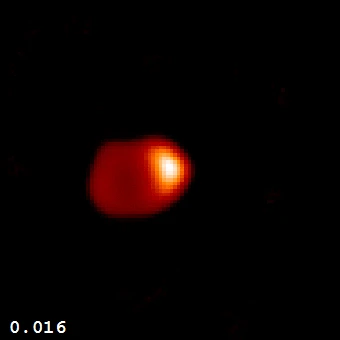
This star spins at an equatorial velocity of roughly 286 km/s—a substantial fraction of its estimated breakup speed of 400 km/s. Observations with the Palomar Testbed Interferometer revealed that Altair is not spherical; its rapid rotation flattens it at the poles. Additional interferometric studies, using multiple telescopes in the infrared, have imaged and confirmed this oblate shape.
**Nomenclature**
The Bayer designation for the star is α Aquilae, Latinised as Alpha Aquilae. Its traditional name, Altair, has been in use since medieval times and derives from the Arabic phrase *Al-Nasr Al-Ṭā'ir*, meaning “the flying eagle.” In 2016, the International Astronomical Union’s Working Group on Star Names (WGSN) approved Altair as the star’s official proper name, and it is now listed in the IAU Catalog of Star Names.
**Physical Characteristics**
Altair, along with β Aquilae and γ Aquilae, forms the line of stars known as the Family of Aquila or Shaft of Aquila. It is an A-type main-sequence star with about 1.8 times the mass of the Sun and 11 times its luminosity. Thought to be a young star near the zero-age main sequence, its age is estimated at roughly 100 million years, though earlier estimates placed it closer to one billion years. Altair rotates with a period of under eight hours—the Sun’s equator, by contrast, takes more than 25 days to complete one rotation. This spin is similar to, and slightly faster than, those of Jupiter and Saturn. Like those planets, the rapid rotation makes Altair oblate: its equatorial diameter is more than 20 percent greater than its polar diameter.
Satellite measurements from 1999, using the Wide Field Infrared Explorer, showed that Altair’s brightness fluctuates by just a few thousandths of a magnitude, with several periods shorter than two hours. As a result, it was identified in 2005 as a Delta Scuti variable star.
- Bayer designation
- Alpha Aquilae
- Apparent visual magnitude
- 0.77
- Distance from sun
- 16.7 light-years (5.1 parsecs)
- Spectral type
- A-type main-sequence star
- Mass
- about 1.8 times the mass of the Sun
- Luminosity
- 11 times that of the Sun
- Equatorial rotation velocity
- approximately 286 km/s
- Estimated breakup speed
- 400 km/s
Lore & Background
The traditional name Altair has been used since medieval times. It is an abbreviation of the Arabic phrase النسر الطائر Al-Nasr Al-Ṭā'ir, 'the flying eagle'. In 2016, the International Astronomical Union organized a Working Group on Star Names (WGSN) to catalog and standardize proper names for stars. The WGSN's first bulletin of July 2016 included a table of the first two batches of names approved by the WGSN, which included Altair for this star. It is now so entered in the IAU Catalog of Star Names. Along with β Aquilae and γ Aquilae, Altair forms the well-known line of stars sometimes referred to as the Family of Aquila or Shaft of Aquila. Altair is a type-A main-sequence star with about 1.8 times the mass of the Sun and 11 times its luminosity. It is thought to be a young star close to the zero age main sequence at about 100 million years old, although previous estimates gave an age closer to one billion years old. Altair rotates rapidly, with a rotational period of under eight hours; for comparison, the equator of the Sun makes a complete rotation in a little more than 25 days. Altair's rotation is similar to, and slightly faster than, those of Jupiter and Saturn. Like those two planets, its rapid rotation causes the star to be oblate; its equatorial diameter is over 20 percent greater than its polar diameter. Satellite measurements made in 1999 with the Wide Field Infrared Explorer showed that the brightness of Altair fluctuates slightly, varying by just a few thousandths of a magnitude with several different periods less than 2 hours. As a result, it was identified in 2005 as a Delta Scuti variable star. Its light curve can be approximated by adding together a number of sine waves, with periods that range between 0.8 and 1.5 hours. It is a weak source of coronal X-ray emission, with the most active sources of emission being located near the star's equator. This activity may be due to convection cells forming at the cooler equator.
Reader's Guide
Altair's significance stems from its rapid rotation, which makes it one of the few stars for which a resolved image has been obtained. The angular diameter of Altair was measured interferometrically by R. Hanbury Brown and his co-workers at Narrabri Observatory in the 1960s. They found a diameter of 3 milliarcseconds. Although Hanbury Brown et al. realized that Altair would be rotationally flattened, they had insufficient data to experimentally observe its oblateness. Later, using infrared interferometric measurements made by the Palomar Testbed Interferometer in 1999 and 2000, Altair was found to be flattened. This work was published by G. T. van Belle, David R. Ciardi and their co-authors in 2001. Theory predicts that, owing to Altair's rapid rotation, its surface gravity and effective temperature should be lower at the equator, making the equator less luminous than the poles. This phenomenon, known as gravity darkening or the von Zeipel effect, was confirmed for Altair by measurements made by the Navy Precision Optical Interferometer in 2001, and analyzed by Ohishi et al. (2004) and Peterson et al. (2006). Also, A. Domiciano de Souza et al. (2005) verified gravity darkening using the measurements made by the Palomar and Navy interferometers, together with new measurements made by the VINCI instrument at the VLTI. In 2006 and 2007, J. D. Monnier and his coworkers produced an image of Altair's surface from 2006 infrared observations made with the MIRC instrument on the CHARA array interferometer; this was the first time the surface of any main-sequence star, apart from the Sun, had been imaged. The false-color image was published in 2007. The equatorial radius of the star was estimated to be 2.03 solar radii, and the polar radius 1.63 solar radii—a 25% increase of the stellar radius from pole to equator, versus 19% for Vega, 11% for Saturn, and 9% for Jupiter. The polar axis is inclined by about 60° to the line of sight from the Earth. Altair is also notable for its cultural roles, including in Chinese astronomy as part of the asterism Hé Gǔ (河鼓; lit. 'river drum'), and in the love story of The Cowherd and the Weaver Girl, where Altair represents Niulang (the cowherd).
Did You Know?
- Altair was identified in 2005 as a Delta Scuti variable star, with brightness fluctuations of a few thousandths of a magnitude.
- In 2007, Altair became the first main-sequence star (other than the Sun) to have its surface imaged, using the CHARA array interferometer.
More in Binary and Multiple Stars, Part 3 1-24
Spotted an error? Know more?
Reader corrections go straight into our review queue. Suggest an edit · How this site is sourced