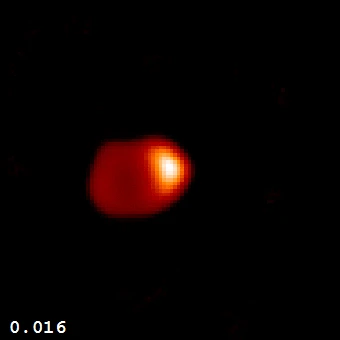
54 Piscium
K-dwarf with a planet and a directly imaged brown dwarf.

54 Piscium is an orange dwarf star located about 36 light-years away in the constellation Pisces. It is known for hosting two confirmed companions: an extrasolar planet discovered in 2003 and a brown dwarf found in 2006. This was the first instance of a brown dwarf being directly imaged around a star that already had a known planet detected through radial velocity surveys.
The star itself is a K0V main-sequence star, fusing hydrogen into helium in its core. It has an apparent magnitude of 5.86, making it visible to the naked eye under good conditions. Its surface temperature is around 5,267 K, giving it the orange color typical of K-type stars. Compared to the Sun, 54 Piscium is smaller and dimmer, with about 85% of the Sun's mass, half its luminosity, and 86.4% of its radius (measured directly using the CHARA interferometer). It rotates once every 40.2 days and is inclined about 83 degrees relative to Earth. The star's age is estimated at 6.4 billion years from chromospheric activity and isochronal analysis, though another study suggests it could be 10 billion years old. Its metallicity—the ratio of heavy elements to hydrogen—is uncertain: one measurement gives an iron-to-hydrogen ratio of 0.12 dex, while another gives –0.15 dex. Long-term observations indicate the star is entering a Maunder minimum phase, with a declining activity cycle; the most recent peak activity occurred between 1992 and 1996, weaker than the previous peak from 1976 to 1980.
The brown dwarf, designated 54 Piscium B, is a methane brown dwarf of spectral type T7.5V, with a mass about 50 times that of Jupiter—below the 75-Jupiter-mass threshold for hydrogen fusion. Despite its mass, it is smaller than Jupiter, with only 80% of its radius. Its surface temperature is roughly 810 K (537 °C). Imaged by NASA's Spitzer Space Telescope in 2006, it lies at a projected separation of about 476 astronomical units from the primary star.
The planet, 54 Piscium b, was announced on January 16, 2003, by a team led by Geoff Marcy. It has a mass about 20% that of Jupiter, similar to Saturn, and orbits at 0.28 AU—inside Mercury's orbit—completing a revolution every 62 days. Its orbit is highly eccentric (eccentricity 0.65), which initially suggested the gravitational pull of an unseen distant object; this was later confirmed with the discovery of the brown dwarf.
- Flamsteed designation
- 54 Piscium
- Apparent magnitude
- 5.86
- Spectral type
- K0V
- Distance
- approximately 36 light-years
- Mass
- 85% of the Sun's mass
- Radius
- 86.4% of the Sun's radius
- Age
- about 6.4 billion years (with uncertainty up to ten billion years)
Lore & Background
The Flamsteed designation 54 Piscium originated in the star catalogue of the British astronomer John Flamsteed, first published in 1712. The star has an apparent magnitude of 5.86, allowing it to be seen with the unaided eye under suitable viewing conditions. It has a classification of K0V, with the luminosity class V indicating this is a main sequence star generating energy through thermonuclear fusion of hydrogen into helium. The effective temperature of the photosphere is about 5,267 K, giving it the characteristic orange hue of a K-type star. As a typical K-type dwarf, 54 Piscium is smaller and fainter than the Sun, at 85% of the Sun's mass and half of the luminosity. The angular diameter has been directly determined by interferometry using the CHARA array, yielding a radius 86.4% of the Sun's radius. The rotational period is about 40.2 days. The age is about 6.4 billion years based on chromospheric activity and isochronal analysis, though another study suggests a higher age of ten billion years. There is uncertainty in the scientific press concerning the metallicity: Santos et al. (2004) report [Fe/H] = 0.12 dex, whereas Cenarro et al. (2007) published –0.15 dex. Long-term observation of magnetic activity suggests the star is entering a Maunder minimum period, with a Sun-like activity cycle decreasing in magnitude; the most recent peak activity was 1992–1996, lower than the previous peak in 1976–1980. The star rotates at an inclination of 83+7−56 degrees relative to Earth.
Reader's Guide
54 Piscium is significant as the first star with a known extrasolar planet (discovered in 2003) to also have a directly imaged brown dwarf companion, detected in 2006. The brown dwarf, 54 Piscium B, is a methane brown dwarf of spectral type T7.5V with a mass about 50 times that of Jupiter, below the hydrogen-burning limit of about 75 Jupiter masses. Despite its large mass, it is smaller than Jupiter, with just 80% its radius, and has a surface temperature of about 810 K. It was imaged by NASA's Spitzer Space Telescope at a projected separation of about 476 astronomical units from the primary star. The planet 54 Piscium b has a mass of only 20% that of Jupiter (similar to Saturn) and orbits at 0.28 AU with a period of about 62 days. Its high eccentricity of about 0.65 suggested the gravitational influence of an unseen object, later verified as the brown dwarf. Simulations show that the planet's orbit sweeps clean most test particles within 0.5 AU, leaving only asteroids in low-eccentricity orbits near the planet's apastron distance. Observations have ruled out Neptune-class or heavier planets with a period of one year or less, but still allow Earth-sized planets at 0.6 AU or more. A two-planet fit with circular orbits in a 2:1 resonance is possible but does not significantly improve the solution.
Did You Know?
- 54 Piscium B was the first brown dwarf detected around a star with an already known extrasolar planet.
- The brown dwarf has a mass about 50 times that of Jupiter but is smaller than Jupiter, with only 80% its radius.
- The planet 54 Piscium b has a high orbital eccentricity of about 0.65, which was explained by the gravity of the brown dwarf.
- The star's age is uncertain, with estimates of about 6.4 billion years and up to ten billion years.
More in Binary and Multiple Stars, Part 3 1-24
Spotted an error? Know more?
Reader corrections go straight into our review queue. Suggest an edit · How this site is sourced