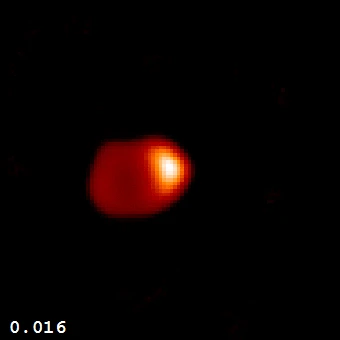
54 Piscium B
First brown dwarf imaged around a star with a known planet.

54 Piscium B is a brown dwarf companion to the orange dwarf star 54 Piscium, located approximately 36 light-years away in the constellation of Pisces. It was directly imaged in 2006, making it the first brown dwarf detected around a star that already had a known extrasolar planet discovered via radial velocity surveys.
- Discovery method
- direct imaging
- Spectral type
- T7.5V
- Mass
- about 50 times the mass of Jupiter
- Radius
- 80% of Jupiter's radius
- Surface temperature
- about 810 K (537 °C)
- Projected separation
- about 476 astronomical units from the primary star
- Classification
- methane brown dwarf
Lore & Background
In 2006, a direct image of 54 Piscium revealed the presence of a brown dwarf companion, designated 54 Piscium B. It is classified as a methane brown dwarf of spectral type T7.5V, with a mass of about 50 times that of Jupiter—below the hydrogen-burning limit of about 75 Jupiter masses. Despite its large mass, the brown dwarf is smaller than Jupiter, having only 80% of its radius, and its surface temperature is estimated at about 810 K (537 °C). The object was directly imaged by NASA's Spitzer Space Telescope, showing a projected separation of roughly 476 astronomical units from the primary star.
Reader's Guide
The discovery of 54 Piscium B was notable because it was the first brown dwarf detected around a star that already had a known extrasolar planet (54 Piscium b) discovered via radial velocity surveys. The presence of this brown dwarf helped explain the high eccentricity (about 0.65) of the inner planet's orbit, as the gravity of the unseen brown dwarf was pulling the planet outward. The brown dwarf's orbit also influences the system's architecture: simulations show that 54 Piscium b's orbit 'sweeps clean' most test particles within 0.5 AU, leaving only asteroids in low-eccentricity orbits near the planet's apastron distance and near the 1:2 mean-motion resonance. This system provides a clear example of how a distant, massive companion can shape the orbital dynamics of an inner planetary system.
Did You Know?
- 54 Piscium B was the first brown dwarf to be detected around a star with an already known extrasolar planet.
- Despite having about 50 times the mass of Jupiter, 54 Piscium B is smaller than Jupiter, with only 80% of its radius.
- The brown dwarf has a surface temperature of about 810 K (537 °C) and is classified as a methane brown dwarf of spectral type T7.5V.
- Its projected separation from the primary star is about 476 astronomical units.
More in Binary and Multiple Stars, Part 3 1-24
Spotted an error? Know more?
Reader corrections go straight into our review queue. Suggest an edit · How this site is sourced