4 Camelopardalis
A probable multiple star in Camelopardalis with an Am primary.

4 Camelopardalis is a likely multiple star system in the northern constellation Camelopardalis, roughly 177 light-years from Earth based on parallax measurements. Its combined apparent visual magnitude of 5.29 makes it faintly visible to the naked eye as a white-hued star. The system moves across the sky at a relatively high proper motion of 0.158 arcseconds per year, which suggests it may belong to the IC 2391 supercluster. It is receding from Earth at a heliocentric radial velocity of 22.5 km/s.
The brighter component, designated A, is an Am star—its spectrum shows unusual abundances of certain elements. Estimated at 560 million years old, it rotates with a projected rotational velocity of 75 km/s. This star has 2.01 times the Sun’s mass and 2.57 times its radius, and it radiates 18 times the Sun’s luminosity from a photosphere with an effective temperature of 7,700 K.
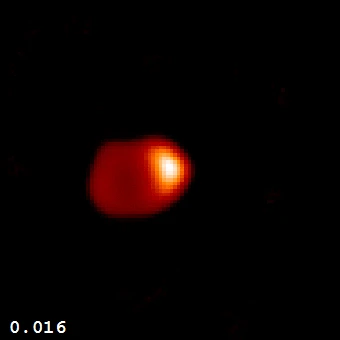
A fainter companion, component B, has a magnitude of 9.49 and lies at an angular separation of 0.610 arcseconds; the two likely form a binary system with an orbital period of about 90 years. A 13th-magnitude visual companion is located 13 arcseconds away and shares the system’s proper motion and parallax. Another listed companion, a 12th-magnitude star nearly 2 arcminutes away, is probably unrelated.
- Constellation
- Camelopardalis
- Distance
- 177 light years
- Combined apparent visual magnitude
- 5.29
- Proper motion
- 0.158″ per year
- Heliocentric radial velocity
- 22.5 km/s
- Component a spectral type
- Am star
- Component a mass
- 2.01 solar masses
- Component a radius
- 2.57 solar radii
- Component a luminosity
- 18 solar luminosities
- Component a effective temperature
- 7,700 K
Lore & Background
4 Camelopardalis is a probable multiple star system in the northern constellation of Camelopardalis. Based on parallax, it lies 177 light years from the Sun. With a combined apparent visual magnitude of 5.29, it is visible to the naked eye as a faint, white-hued star. The pair have a relatively high proper motion, traversing the celestial sphere at an angular rate of 0.158″ per year, and this proper motion makes the system a candidate for membership in the IC 2391 supercluster. The system is moving away from Earth with a heliocentric radial velocity of 22.5 km/s.
The brighter member, designated component A, is classified as an Am star, indicating that its spectrum shows abnormalities of certain elements. It is an estimated 560 million years old and is spinning with a projected rotational velocity of 75 km/s. The star has 2.01 times the mass of the Sun and 2.57 times the Sun's radius, radiating 18 times the Sun's luminosity from its photosphere at an effective temperature of 7,700 K. There is a faint, magnitude 9.49 companion at an angular separation of 0.610″ – component B; the pair most likely form a binary system with a period of about 90 years.
Reader's Guide
4 Camelopardalis is significant as a probable multiple star system that includes an Am star primary, a class of chemically peculiar stars whose spectra show enhanced lines of certain metals. Its binary nature, with a faint companion at a close separation of 0.610″ and an estimated orbital period of about 90 years, provides a case study for stellar evolution in binary systems. The system's relatively high proper motion and candidacy for membership in the IC 2391 supercluster suggest a possible shared origin with other stars in that moving group. Additionally, the presence of a 13th-magnitude visual companion 13″ away that shares common proper motion and parallax indicates a possible wider physical association, while a 12th-magnitude star nearly 2′ away is probably unrelated. The system's measured parameters—mass, radius, luminosity, temperature, and age—offer concrete data for modeling Am star properties and binary star dynamics. Its visibility to the naked eye as a faint white-hued star makes it accessible for amateur observation, while its radial velocity of 22.5 km/s away from Earth contributes to kinematic studies of the local stellar neighborhood.
Did You Know?
- 4 Camelopardalis has a combined apparent visual magnitude of 5.29, making it visible to the naked eye as a faint, white-hued star.
- The primary component A is an Am star, showing spectral abnormalities of certain elements.
- The system has a proper motion of 0.158″ per year, making it a candidate for membership in the IC 2391 supercluster.
More in Binary and Multiple Stars, Part 3 1-24
Spotted an error? Know more?
Reader corrections go straight into our review queue. Suggest an edit · How this site is sourced