3 Piscis Austrini
Astrometric binary red giant approaching the Solar System.

3 Piscis Austrini (3 PsA, HD 201901) is an astrometric binary system located in the southern constellation Microscopium, formerly part of Piscis Austrinus. It is notable for its 100% probability of being an astrometric binary, with a combined apparent magnitude of 5.39 making it faintly visible to the naked eye under ideal conditions.
- Constellation
- Microscopium
- Combined apparent magnitude
- 5.39
- Distance
- 404 light years
- Heliocentric radial velocity
- −46.2 km/s
- Absolute magnitude
- +0.19
- Stellar classification
- K3 III
- Mass
- 1.58 M☉
- Radius
- 31.3 R☉
- Luminosity
- 184 L☉
- Effective temperature
- 4,225 K
Lore & Background
3 Piscis Austrini is an astrometric binary with a 100% chance of being such, located in the southern constellation Microscopium. It was once part of Piscis Austrinus, the southern fish. The system has a combined apparent magnitude of 5.39, making it faintly visible to the naked eye under ideal conditions. Gaia DR3 parallax measurements imply a distance of 404 light years, and it is currently approaching the Solar System with a heliocentric radial velocity of −46.2 km/s. At its current distance, its brightness is diminished by 0.12 magnitudes due to interstellar dust extinction, and it has an absolute magnitude of +0.19.
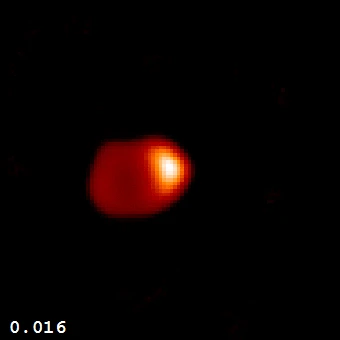
The visible component is an evolved red giant with a stellar classification of K3 III. Interferometry measurements give an angular diameter of 2.03±0.04 mas after correcting for limb darkening, which at its estimated distance equates to a physical radius of about 20 R☉. However, its actual empirical radius is 31.3 R☉. It has 1.58 times the mass of the Sun and radiates 184 times the solar luminosity from its enlarged photosphere at an effective temperature of 4,225 K. The star is metal deficient, with an iron abundance 68% that of the Sun ([Fe/H] = −0.17), and it spins too slowly for its projected rotational velocity to be measured accurately. It is estimated to be 2.59 billion years old based on Gaia DR3 models.
Reader's Guide
3 Piscis Austrini is significant as an astrometric binary system with a 100% probability of being such, confirmed by Gaia DR3 data. Its status as an evolved red giant of spectral type K3 III provides insights into the late stages of stellar evolution for stars of about 1.58 solar masses. The discrepancy between the interferometry-derived radius (about 20 R☉) and the empirical radius (31.3 R☉) highlights the challenges in measuring stellar sizes and the importance of multiple observational methods. The system's approach toward the Solar System at −46.2 km/s and its metal deficiency ([Fe/H] = −0.17) offer clues about its formation history and galactic orbit. Its age of 2.59 billion years, derived from Gaia DR3 models, places it in a middle-aged stellar population. The star's slow rotation and low iron abundance contribute to understanding the chemical evolution of the Milky Way. As a naked-eye object under ideal conditions, it serves as a target for amateur astronomers interested in binary systems and red giants.
Did You Know?
- 3 Piscis Austrini has a 100% chance of being an astrometric binary.
- Its empirical radius is 31.3 R☉, while interferometry suggests about 20 R☉.
- The system is approaching the Solar System at −46.2 km/s.
More in Binary and Multiple Stars, Part 3 1-24
Spotted an error? Know more?
Reader corrections go straight into our review queue. Suggest an edit · How this site is sourced