16 Lyrae
Suspected astrometric binary with disputed subgiant status.

16 Lyrae, a star system in the constellation Lyra, is thought to be an astrometric binary. Based on parallax measurements, it lies 126 light-years from the Sun. To the naked eye, it appears as a faint, white point of light with a combined apparent visual magnitude of 5.00. The system is moving away from Earth at a heliocentric radial velocity of +4.36 km/s, and it may belong to the Ursa Major Moving Group stream.
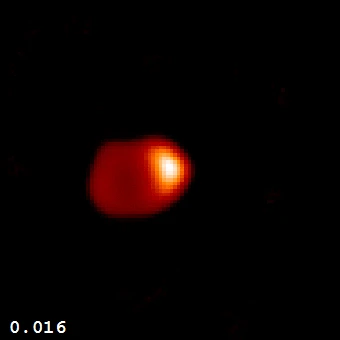
The visible component’s evolutionary stage is debated. In 1969, Cowley and colleagues classified it as A7 V, indicating an A-type main-sequence star fusing hydrogen in its core. However, Abt and Morrell in 1995 gave it a class of A6 IV, suggesting it has already left the main sequence and become a subgiant. Regardless, the star is 72% more massive than the Sun and shines with 10.5 times the Sun’s luminosity. At an age of 401 million years, it spins rapidly, with a projected rotational velocity of 85 km/s. This fast rotation makes the star slightly oblate: its equatorial radius is 1.644 R☉, while its polar radius is 1.622 R☉. The spin also causes its effective temperature to vary across the surface, from 8,200 K at the poles down to 8,000 K at the equator.
The system emits X-rays with a luminosity of 105.3×10²⁰ W, a signal most likely originating from the unseen companion star.
- Constellation
- Lyra
- Distance
- 126 light years
- Apparent magnitude
- 5.00
- Spectral classification
- A7 V (Cowley et al. 1969) or A6 IV (Abt and Morrell 1995)
- Radial velocity
- +4.36 km/s
- Mass
- 1.72 M☉
- Luminosity
- 10.5 L☉
- Age
- 401 million years
- Projected rotational velocity
- 85 km/s
- Equatorial radius
- 1.644 R☉
Lore & Background
16 Lyrae is a suspected astrometric binary star system, meaning the presence of an unseen companion is inferred from positional measurements. The visible component has been classified differently by two studies: Cowley et al. (1969) found a stellar classification of A7 V, matching an A-type main-sequence star that is generating energy through hydrogen fusion at its core, while Abt and Morrell (1995) instead listed a class of A6 IV, suggesting it has left the main sequence and become a subgiant star. The system is moving further away from Earth with a heliocentric radial velocity of +4.36 km/s and is a suspected member of the Ursa Major Moving Group stream.
The star is 72% more massive than the Sun and irradiates 10.5 times the Sun's luminosity. It is 401 million years old with a high rate of spin, showing a projected rotational velocity of 85 km/s. The fast rotation makes this star slightly oblate, with an equatorial radius of 1.644 R☉ and a polar radius of 1.622 R☉. Its effective temperature also varies across its surface due to rotation, from 8,200 K at the poles to 8,000 K at the equator.
This system is a source for X-ray emission with a luminosity of 105.3×10^20 W, which is most likely coming from the unseen companion rather than the visible star.
Reader's Guide
The significance of 16 Lyrae lies in its dual nature as both a suspected astrometric binary and a star with an uncertain evolutionary stage. The discrepancy between the A7 V classification (main-sequence) and the A6 IV classification (subgiant) highlights the challenges in precisely determining the evolutionary status of rapidly rotating stars. Its fast rotation, which causes measurable oblateness and temperature variation across its surface, makes it a useful object for studying the effects of rotation on stellar structure and spectral appearance. The detection of X-ray emission, attributed to the unseen companion, provides indirect evidence for the binary nature of the system and suggests the companion may be magnetically active. Additionally, its suspected membership in the Ursa Major Moving Group stream ties it to a larger kinematic association of stars with similar space motions, offering context for its age and origin. The system's legacy is as an example of how multiple observational techniques—astrometry, spectroscopy, and X-ray astronomy—combine to reveal the complexities of a seemingly ordinary naked-eye star.
Did You Know?
- 16 Lyrae is a suspected astrometric binary, meaning its companion is inferred from positional changes rather than direct imaging.
- The star's rapid rotation of 85 km/s makes it slightly oblate, with an equatorial radius 0.022 R☉ larger than its polar radius.
- Its effective temperature varies by 200 K from poles to equator due to rotation.
- The X-ray emission from the system, with a luminosity of 105.3×10^20 W, is most likely coming from the unseen companion.
More in Binary and Multiple Stars, Part 3 1-24
Spotted an error? Know more?
Reader corrections go straight into our review queue. Suggest an edit · How this site is sourced