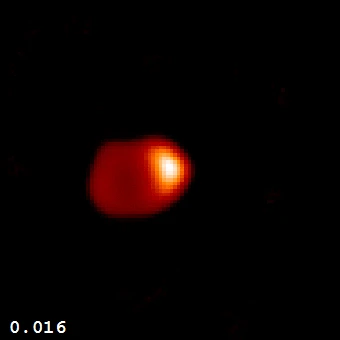
12 Hydrae
A probable astrometric binary with a spectroscopic binary primary.

12 Hydrae, also known by the Bayer designation D Hydrae, is a star system in the equatorial constellation Hydra, about 205 light-years from the Sun. With a combined apparent visual magnitude of 4.32, it is faintly visible to the naked eye as a yellow-hued star. The system is moving toward Earth at a heliocentric radial velocity of −8.5 km/s.
In 1953, R. A. Rossiter identified it as a double star. As of 2016, the fainter companion, of magnitude 13.7, lies at an angular separation of 26.8″ along a position angle of 266°. The brighter component, designated component A and of magnitude 4.32, is itself a spectroscopic binary. A 2009 orbital solution for this pair is of low quality, suggesting a period of roughly four years and an orbital eccentricity of about 0.4.
The primary star is an aging giant with a stellar classification of G8 IIIb CN-1, indicating an underabundance of the cyanogen molecule. It is 410 million years old and has 1.8 times the Sun’s mass. Having exhausted its core hydrogen and evolved off the main sequence, it has expanded to 11 times the Sun’s radius. Its enlarged photosphere radiates 71 times the Sun’s luminosity at an effective temperature of 5,105 K.
- Distance
- 205 light years
- Combined apparent visual magnitude
- 4.32
- Heliocentric radial velocity
- −8.5 km/s
- Angular separation (2016)
- 26.8″
- Position angle (2016)
- 266°
- Stellar classification (primary)
- G8 IIIb CN-1
- Age (primary)
- 410 million years
- Mass (primary)
- 1.8 solar masses
- Radius (primary)
- 11 solar radii
- Luminosity (primary)
- 71 solar luminosities
Lore & Background
12 Hydrae was found to be a double star by R. A. Rossiter in 1953, with a magnitude 13.7 companion having an angular separation of 26.8″ along a position angle of 266°, as of 2016. The brighter, magnitude 4.32 component A is a spectroscopic binary. As of 2009, the orbital solution for this pair is of low quality, giving a period of roughly 4 years and an eccentricity of around 0.4.
The primary component is an aging giant star with a stellar classification of G8 IIIb CN-1, where the suffix notation indicates an underabundance of the cyanogen molecule. It is 410 million years old with 1.8 times the mass of the Sun. After exhausting the hydrogen at its core and evolving off the main sequence, the star has swollen to 11 times the Sun's radius. It is radiating 71 times the luminosity of the Sun from its enlarged photosphere at an effective temperature of 5,105 K.
Reader's Guide
12 Hydrae is significant as a multiple-star system that illustrates the complexity of binary star studies. Its discovery as a double star by R. A. Rossiter in 1953, with a faint magnitude 13.7 companion, adds to the historical record of visual binary detections. The brighter component A is itself a spectroscopic binary, making the system a hierarchical triple. The orbital solution for the spectroscopic pair, though of low quality as of 2009, suggests a period of roughly 4 years and an eccentricity of around 0.4, highlighting the challenges in determining precise orbits for such systems. The primary star's classification as an aging giant (G8 IIIb CN-1) with an underabundance of cyanogen provides insight into its chemical peculiarity and evolutionary state. Its parameters—mass 1.8 solar masses, radius 11 solar radii, luminosity 71 solar luminosities, and effective temperature 5,105 K—are consistent with a post-main-sequence giant. The system's heliocentric radial velocity of −8.5 km/s indicates it is moving closer to Earth, and its combined apparent visual magnitude of 4.32 makes it visible to the naked eye as a faint, yellow-hued star.
Did You Know?
- 12 Hydrae is a probable astrometric binary star system located 205 light years away.
- The brighter component A is a spectroscopic binary with a low-quality orbital solution from 2009 giving a period of roughly 4 years and eccentricity around 0.4.
- The primary star is an aging giant with a G8 IIIb CN-1 classification, indicating an underabundance of cyanogen.
- The system is moving closer to Earth with a heliocentric radial velocity of −8.5 km/s.
More in Binary and Multiple Stars, Part 3 1-24
Spotted an error? Know more?
Reader corrections go straight into our review queue. Suggest an edit · How this site is sourced