Pilsner
A pale lager originating from Plzeň, first brewed in 1842.

Pilsner, also known as pilsener or pils, is a variety of pale lager. Its name comes from the Bohemian city of Plzeň, where the Pilsner Urquell Brewery first produced this type of beer in 1842.
The earliest recorded mention of a brewery in Plzeň dates to 1307. Until the 1840s, most Bohemian beers were top-fermented. Brewers had started aging beer made with cool-fermenting yeasts in caves—a process called lagering, meaning "stored"—which gave the beer better clarity and a longer shelf life. This work drew on knowledge from a book written by a Czech brewer from Brno, published in German in 1794 and in Czech in 1799.
The Plzeň brewery hired Bavarian brewer Josef Groll, who used local ingredients to create the first batch of pale lager on 5 October 1842. The combination of Plzeň’s very soft water, Saaz noble hops from nearby Žatec, low-protein Moravian barley malt dried with indirect heat, and Bavarian-style lagering resulted in a clear, golden beer.
By 1853, the beer was sold at 35 pubs in Prague. It reached Vienna in 1856 and Paris in 1862. In 1859, a brand name was registered at the Chamber of Commerce and Trade in Plzeň. In 1898, the Pilsner Urquell trademark was created to emphasize that this was the original brewery—Urquell meaning "original source." Some beers are labeled Urtyp Pilsener, indicating they follow the original process, though many breweries use this term for their top beer.
Modern refrigeration, introduced to Germany by Carl von Linde in the late 1800s, removed the need for caves to store beer, allowing cool-fermenting beer to be brewed and stored in many new places. Until 1993, the Pilsner Urquell brewery fermented its beer in open barrels in cellars beneath the brewery. That year, it switched to large cylindrical tanks, though small batches are still made traditionally for taste comparisons.
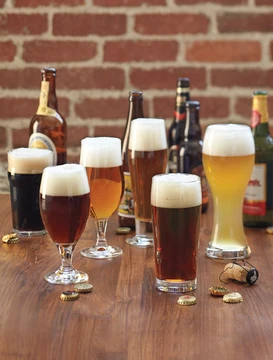
A modern pilsner is a pale lager with a very light, clear color ranging from pale to golden yellow, and varying levels of hop aroma and flavor. Alcohol content typically falls around 4.5% to 5% by volume. Beer competitions like the World Beer Cup include categories such as "European-Style Pilsner." Pilsner-style lagers are marketed worldwide by both small brewers and large conglomerates.
Several regional styles exist. Czech-style Pilsner is bright golden, moderately bitter, with a distinct aroma from malt and Saaz hops.
- Origin city
- Plzeň, Bohemia
- First brewed
- 5 October 1842
- Brewer
- Josef Groll (1813–1887)
- Typical alcohol strength
- 4.5%–5% by volume
- Key ingredients
- Soft water, Saaz noble hops, low-protein Moravian barley malt
- Original brand registered
- 1859
- Pilsner urquell trademark created
- 1898
Lore & Background
The oldest written mention about a brewery in Plzeň is from 1307. Until the mid-1840s, most Bohemian beers were top-fermented. Brewers had begun aging beer made with cool fermenting yeasts in caves (lager, meaning 'stored'), which improved the beer's clarity and shelf-life. Part of this research benefited from knowledge expounded in a book written by Czech brewer from Brno. The Plzeň brewery recruited the Bavarian brewer Josef Groll, who used local ingredients to produce the first batch of pale lager on 5 October 1842. The combination of Plzeň's remarkably soft water, local Saaz noble hops from nearby Žatec, low-protein Moravian barley malt prepared by indirectly heated kilning, and Bavaria-style lagering produced a clear, golden beer.
By 1853, the beer was available at 35 pubs in Prague. In 1856, it came to Vienna and in 1862 to Paris. In 1859, a brand name was registered at the Chamber of Commerce and Trade in Plzeň. In 1898, the Pilsner Urquell trademark was created to emphasize being the original brewery (Urquell, meaning 'original source'). Some beers are labeled Urtyp Pilsener (UP), meaning they are brewed according to the original process, although many breweries use this accolade for their top beer.
Modern pale lagers termed pilsner may have a very light, clear colour from pale to golden yellow, with varying levels of hop aroma and flavour. Styles include Czech-style Pilsner (bright golden, moderately bitter, brewed with malt and Saaz hops), German-style Pilsner (light straw to golden, more bitter or earthy), European-style Pilsner (slightly sweet, can use grains other than barley malt), American-style Pilsner (may contain up to 25% corn and/or rice), West Coast-style Pilsner (light to golden, brewed with American or southern hemisphere hops, possibly dry-hopped), and Australian-style Pilsner (light straw to golden, crisp, clean earthy taste).
Reader's Guide
Pilsner's significance lies in its role as the first pale lager, establishing a style that became globally influential. The introduction of modern refrigeration by Carl von Linde in the late 19th century eliminated the need for caves for beer storage, enabling the brewing and storing of cool fermenting beer in many new locations. Until 1993, the Pilsner Urquell brewery fermented its beer using open barrels in the cellars beneath their brewery; this changed in 1993 with the use of large cylindrical tanks, though small samples are still brewed in a traditional way for taste comparisons. The style is marketed internationally by numerous small brewers and larger conglomerates, with categories such as 'European-Style Pilsner' at competitions like the World Beer Cup. In the Czech Republic, only Pilsner Urquell is named as 'pilsner', but outside the Czech Republic, Czech-style Pilsner is synonymous with any such lager beers, including brands like Budweiser Budvar, Gambrinus, Kozel, Radegast, Staropramen, Starobrno, and Krušovice. German immigrants brought pilsner style beers to the United States in the mid-19th century, and American pilsners today remain closer to the German style.
Did You Know?
- The world's first pale lager was produced on 5 October 1842 by brewer Josef Groll in Plzeň.
- Pilsner Urquell's trademark, created in 1898, means 'original source'.
- Until 1993, Pilsner Urquell was fermented using open barrels in cellars beneath the brewery.
- Some beers are labeled Urtyp Pilsener (UP) to indicate they are brewed according to the original process.
More in Beer Styles 1-24
Spotted an error? Know more?
Reader corrections go straight into our review queue. Suggest an edit · How this site is sourced