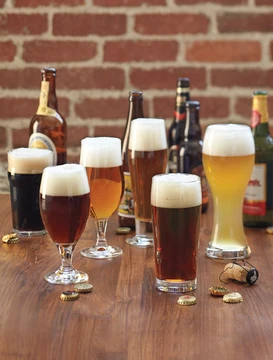
Beer style
A system for categorising beers by origin, ingredients, and character.

Silar · CC BY-SA 4.0
Beer styles are a way of sorting and describing beers based on traits like color, flavor, strength, ingredients, how they're made, their recipe, history, or where they come from. The way we think about beer styles today mostly comes from writer Michael Jackson's 1977 book *The World Guide To Beer*. Fred Eckhardt built on that work in 1989 with *The Essentials of Beer Style*. Even though studying beer styles in a systematic way is fairly new, people have been telling different types of beer apart for a very long time—at least since 2000 BC.
- Earliest known differentiation
- at least 2000 BC
- Key modern work
- The World Guide To Beer (1977) by Michael Jackson
- Subsequent work
- The Essentials of Beer Style (1989) by Fred Eckhardt
- Main types
- ales and lagers
- Ale fermentation temperature range
- 15.5–24 °C
- Lager fermentation temperature
- around 10 °C
Lore & Background
Styles of beer go back at least to Mesopotamia. The Alulu Tablet, a Sumerian receipt for 'best' ale written in Cuneiform found in Ur, suggests that even in 2050 BC there was a differentiation between at least two different types or qualities of ale. The work of Bedřich Hrozný on translating Assyrian merchants' tablets found in Hattusa revealed that approximately 500 years later the Hittites had over 15 different types of beer. Documents reveal comments on different local brewing methods or ingredients. Pliny the Elder in his Naturalis Historia wrote about Celts brewing ale 'in Gaul and Spain in a number of different ways, and under a number of different names; although the principle is the same.' Anglo-Saxon laws reveal they identified three different ales, while the Normans mention cervisae (ale) and plena cervisia (full bodied ale) in the Domesday Book.
By the 15th century brewers in Germany and the Low Countries were using hops to flavour and preserve their ale; this new style of ale was called beer. When this trend came to Britain and brewers of beer in Southwark, London, started to take sales away from the traditional brewers of unhopped ale, there were complaints and protests. Laws were passed favouring either beer or ale for a number of years, until hopped beer became the standard style throughout Europe. At the same time, brewers in Bavaria were storing beer in cool caves during the summer months to stop it from spoiling. The type of beer they stored in this manner became known as lager from the German word lagern, meaning 'to store'.
Although beers using naturally dried malt would have been pale-coloured, by the 17th century most malts in Europe would have been dried over a fire, resulting in a dark-coloured beer. When coke started to be used for roasting malt in 1642, the resulting lighter coloured beers became very popular. By 1703 the term pale ale was starting to be used, though the beer it described was a lightly hopped ale, very different from more bitter modern versions.
Reader's Guide
The modern concept of beer styles, though rooted in ancient practice, was formalised largely through the work of Michael Jackson in his 1977 book The World Guide To Beer, which attempted to group and compare beers from around the world. Jackson's book had a particular influence in North America where the writer Fred Eckhardt was also starting to explore the nature of beer styles. The wine importing company Merchant du Vin switched to importing beers mentioned in Jackson's book. Small brewers started up, producing copies and interpretations of the beer styles Jackson described. While North America developed beer styles into a serious study with fixed parameters of bitterness, colour, aroma, yeast, ingredients and strength, other countries continued to mainly categorise beers loosely by strength and colour, with much overlapping of naming conventions. The legacy of this system is that beer styles now serve as a framework for brewers and consumers to understand and communicate about beer, though the boundaries between styles can be fluid and subject to interpretation.
Did You Know?
- The Alulu Tablet from Ur (c. 2050 BC) is a Sumerian receipt for 'best' ale, indicating differentiation of ale types.
- The Hittites had over 15 different types of beer approximately 500 years after the Alulu Tablet.
- The term 'lager' comes from the German word lagern, meaning 'to store', referring to Bavarian brewers storing beer in cool caves.
- The term 'imperial' originally applied to imperial stouts brewed in England for export to Imperial Russia.
Gallery
Frequently Asked Questions
What exactly is a beer style and how is it defined?
A beer style is a category used to group and describe beers according to shared characteristics such as color, flavor, strength, ingredients, brewing method, recipe, history, or geographic origin. It serves as a shorthand so brewers, drinkers, and writers can talk about a beer without listing every individual detail.
Who is credited with creating the modern beer-style classification system?
Writer Michael Jackson is widely regarded as the person who shaped the way we think about beer styles today through his 1977 book *The World Guide To Beer*. Fred Eckhardt later expanded and refined that framework in his 1989 book *The Essentials of Beer Style*.
How far back does the idea of distinguishing one beer from another actually go?
Although systematic, written classification of beer styles is a relatively recent development, people have been telling different beers apart for thousands of years. Evidence shows that some form of beer differentiation existed at least as far back as 2000 BC.
What are the two primary families of beer styles?
All beer styles ultimately fall into one of two broad categories: ales and lagers. The distinction hinges largely on the type of yeast used and the temperature at which fermentation takes place.
How do ale and lager styles differ in their actual brewing process?
Ales are fermented with top-fermenting yeast at warmer temperatures, typically between 15.5 and 24 °C. Lagers, by contrast, use bottom-fermenting yeast at a cooler temperature of roughly 10 °C, giving them a cleaner, crisper profile.
More in Beer Styles 1-24
Spotted an error? Know more?
Reader corrections go straight into our review queue. Suggest an edit · How this site is sourced