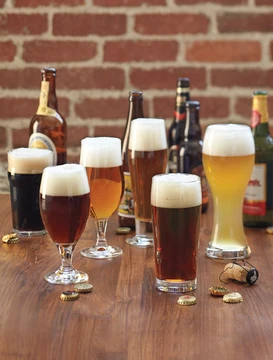
Brown ale
A dark amber to brown ale with caramel and chocolate flavours.

Brown ale gets its dark amber or brown colour from the malt used to brew it. London brewers first used the name in the late 1600s for a lightly hopped ale made entirely from brown malt.
During the 1700s, British brown ales varied widely in strength, with original gravities between roughly 1.060 and 1.090. Around 1800, brewers largely stopped making these beers because they switched from brown malt to cheaper pale malt as a base ingredient, which also became standard for porter and stout.
The name "brown ale" came back at the end of the 1800s when London brewer Mann released a beer under that label. But the style didn't become common until the 1920s. Those early 20th-century brown ales were much stronger than most modern English versions. For example, in 1926 Manns Brown Ale had an original gravity of 1.043 and about 4% ABV, while Whitbread Double Brown was stronger still at 1.054 OG and over 5% ABV. These stronger beers appeared at a time when bottled beer demand was surging in the UK. In the 1930s, some breweries like Whitbread introduced a second, weaker and cheaper brown ale—sometimes just a sweetened version of dark Mild—with an original gravity around 1.037. After World War II, most breweries stopped making the stronger brown ales, except for a few in northeast England. The majority settled at an OG of 1.030–1.035, or roughly 3% ABV, similar to today’s Manns Brown Ale.
North American brown ales trace back to American homebrewers adapting certain northern English beers, as well as the English influence on Colonial Ales.
English brown ales range from sweet, low-alcohol examples like Manns Original Brown Ale to stronger, maltier northeastern ones such as Newcastle Brown Ale, Double Maxim, and Samuel Smith’s Nut Brown Ale. North American versions include Sam Adams Brown Ale and Brooklyn Brown Ale. The colour spans deep amber to brown, with caramel and chocolate flavours. Northeastern English brown ales tend to be strong, malty, and often nutty, while southern English ones are usually darker, sweeter, and lower in alcohol. North American brown ales are typically drier than their English counterparts, with a slight citrus note and an aroma, bitterness, and medium body from American hop varieties. Fruity esters are subdued, and some haziness may appear when the beer is chilled.
- First use of term
- late 17th century
- Original gravity range 18th century
- 1.060–1.090
- Manns brown ale og 1926
- 1.043
- Manns brown ale abv 1926
- around 4%
- Whitbread double brown og
- 1.054
- Whitbread double brown abv
- more than 5%
- Weaker brown ale og 1930s
- around 1.037
- Post wwii og range
- 1.030–1.035
- Post wwii abv
- around 3%
Lore & Background
In the 18th century, British brown ales were brewed to a variety of strengths, with original gravities ranging from around 1.060 to 1.090. Around 1800, brewers stopped producing these types of beers as they moved away from using brown malt as a base. Pale malt, being cheaper because of its higher yield, was used as a base for most beers, including porter and stout. The term "brown ale" was revived at the end of the 19th century when London brewer Mann introduced a beer with that name. However, the style only became widely brewed in the 1920s. The brown ales of this period were considerably stronger than most modern English versions. In 1926, Manns Brown Ale had an original gravity of 1.043 and an ABV of around 4%. Whitbread Double Brown was even stronger, an OG of 1.054 and more than 5% ABV. The introduction of these beers coincided with a big increase in demand for bottled beer in the UK. In the 1930s some breweries, such as Whitbread, introduced a second weaker and cheaper brown ale that was sometimes just a sweetened version of dark Mild. These beers had an original gravity of around 1.037. After World War II, most breweries stopped producing these stronger brown ales, with the exception of some breweries in the northeast of England. The majority had an OG in the range 1.030–1.035, or around 3% ABV, much like Manns Brown Ale today. North American brown ales trace their heritage to American home brewing adaptations of certain northern English beers, and the English influence on American Colonial Ales.
Reader's Guide
English brown ales range from beers such as Manns Original Brown Ale, which is quite sweet and low in alcohol, to northeastern brown ale such as Newcastle Brown Ale, Double Maxim and Samuel Smith's Nut Brown Ale. North American examples include Sam Adams Brown Ale and Brooklyn Brown Ale. They range from deep amber to brown in colour. Caramel and chocolate flavours are evident. Brown ales from northeastern England tend to be strong and malty, often nutty, while those from southern England are usually darker, sweeter and lower in alcohol. North American brown ales are usually drier than their English counterparts, with a slight citrus accent and an aroma, bitterness, and medium body due to American hop varieties. Fruitiness from esters are subdued. When chilled to cold temperatures, some haziness may be noticed. The style's significance lies in its long history, revival in the 20th century, and its adaptation across regions, from the sweeter southern English versions to the stronger northeastern ones and the drier North American interpretations.
Did You Know?
- The term 'brown ale' was first used by London brewers in the late 17th century.
- After World War II, most breweries stopped producing stronger brown ales except in northeast England.
Frequently Asked Questions
Who is Brown ale?
Brown ale is a dark amber-to-brown ale whose colour comes straight from the malts chosen for the brew. The name was first put to use by London brewers in the late 1600s to label a lightly hopped ale made entirely from brown malt.
What are Brown ale's powers/role?
The style's signature flavour profile leans on caramel and chocolate notes, giving it a rounded, malty character. It occupies a middle-ground slot in the British ale family, sitting between lighter pale ales and the heavier stouts.
Why is Brown ale important?
It is one of the earliest named categories in British brewing history, predating the pale-malt standardisation that defines most modern beer. Eighteenth-century examples ranged from roughly 1.060 to 1.090 original gravity, showing how broad and variable the style was before it became a fixed label.
How strong is Brown ale?
Modern interpretations tend toward session strength; Mann's 1926 release sat at about 4% ABV with an original gravity of 1.043. The style can stretch further, as Whitbread's Double Brown pushed past 5% ABV at an OG of 1.054.
More in Beer Styles 1-24
Spotted an error? Know more?
Reader corrections go straight into our review queue. Suggest an edit · How this site is sourced