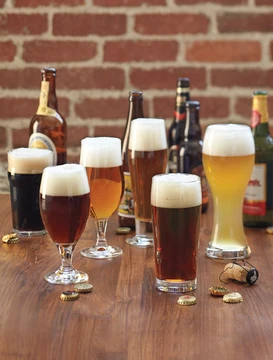
Experimental beer
Beer that does not fit existing style definitions.

David Hiser · Public domain
Experimental beer is any beer made as a new style, using an untested recipe, or that doesn’t fit existing style guidelines. It also includes minor styles not listed in Beer Judge Certification Program categories, except for Belgian beers. These minor styles can act as a testing ground for potential new categories, and if enough public interest builds, they may gain official recognition. Both the Great American Beer Festival and the World Beer Cup offer awards in an experimental beer category.
Production methods often follow craft brewing techniques. Homebrewers sometimes create experimental beers to develop unique or flavorful styles. Commercial breweries and microbreweries also produce and sell experimental beers. The Boston Beer Company, for instance, has made several experimental beers at its Jamaica Plain research facility, using a ten-gallon brewery. Its Samuel Adams Triple Bock, released only in 1994, 1995, and 1997, is considered an experimental beer. BrewDog in Ellon, Scotland, has produced experimental beers. Dogfish Head Brewery in Milton, Delaware, made Bitches Brew, an experimental beer named after the Miles Davis album, using unfiltered raw Ethiopian honey, Mauritian brown sugar, and dark, roasty grains. Founders Brewing Company in Grand Rapids, Michigan, has released experimental beers under its Backstage Series, including Blushing Monk, a Belgian-style raspberry ale re-released in December 2014. Kuhnhenn Brewing Company in Warren, Michigan, makes small-batch experimental beers like K12 Experimental IPA, brewed with experimental hops from Leonard, Michigan. Matilda Bay Brewing Company in Dandenong South, Australia, has produced experimental beers. Short's Brewing Company has made OMGWTFBBQ, a barbecue-themed experimental beer with tomatoes, brown sugar, molasses, spices, and smoked hops. In 2011, Vanberg & DeWulf's Lambrucha won gold in the experimental beer category at the U.S. Open Beer Championships.
Some experimental beers use unusual ingredients, like hemp seeds. Lexington Brewing Company in Kentucky has produced a hemp beer. Hilliard's Beer in Seattle and Redhook Ale Brewery in Woodinville, Washington, jointly made Joint Effort, a hemp beer created after marijuana was legalized for personal use in Washington state.
Experimental beers often build on existing styles.
- Competitions with experimental beer cate
- Great American Beer Festival, World Beer Cup
- Notable experimental beer
- Joint Effort (Hilliard's Beer and Redhook Ale Brewery, hemp beer)
Lore & Background
Experimental beer may be produced using preparation methods used in craft brewing. Some homebrewers produce experimental beers in efforts to devise unique or flavorful new styles. Some commercial breweries and microbreweries produce experimental beer and offer it to consumers. The Boston Beer Company has produced several experimental beers at their research and development facility in Jamaica Plain, Boston, operating a unique ten-gallon brewery for their production. BrewDog in Ellon, Aberdeenshire, Scotland, and Matilda Bay Brewing Company in Dandenong South, Victoria, Australia have also produced experimental beers.
Experimental beers may use unique ingredients not traditionally used in beer production, such as hemp seeds. The Lexington Brewing Company in Kentucky has produced a hemp beer. Hilliard's Beer and Redhook Ale Brewery jointly produced a beer named Joint Effort after marijuana was legalized for personal use in Washington state. Experimental beers may also expound upon existing beer styles, including ales, India pale ales, lagers, and wheat beers. Experimental IPA styles include Belgian-style IPA, Session IPA, Wild IPA, red IPA, herbed/spiced IPA, and white IPA. Wild IPA production may utilize brettanomyces yeast during primary or secondary fermentation, producing a tropical flavor with pineapple notes.
In 1773, during the voyage of James Cook's HMS Resolution, crew members referred to the beer on board prepared from malt as 'experimental beer.' They also used the term 'experimental' for other items and people they considered 'not to be quite in the common way of a man of war,' including 'experimental beef,' 'experimental water,' and 'experimental gentleman.'
Reader's Guide
Experimental beer occupies a unique position in the brewing world as a category that exists outside established style guidelines. It serves as an incubator for new potential beer categories, allowing brewers to test novel recipes and ingredients without being constrained by traditional definitions. The inclusion of experimental beer categories at major competitions like the Great American Beer Festival and World Beer Cup provides formal recognition and validation for these innovative brews. The category's flexibility has encouraged breweries of all sizes—from homebrewers to large commercial operations—to experiment with unusual ingredients such as hemp seeds, honey, brown sugar, and spices. Some experimental beers, like Dogfish Head's Bitches Brew and Founders' Blushing Monk, have gained notable attention. The historical use of the term 'experimental beer' aboard HMS Resolution in 1773 shows that the concept of beer outside the ordinary has long existed. As minor experimental styles gain public interest, they may eventually become official style categories, demonstrating how experimental beer drives the evolution of brewing.
Did You Know?
- The Great American Beer Festival and World Beer Cup both have awards for experimental beer.
- Dogfish Head's Bitches Brew experimental beer is named after the Miles Davis album Bitches Brew.
- In 1773, crew members of HMS Resolution referred to their malt beer as 'experimental beer.'
Roots in Antiquity: How Beer Styles Emerged
The practice of distinguishing one beer from another stretches back further than most people realize. A Sumerian clay tablet known as the Alulu Tablet, discovered at Ur and written in cuneiform around 2050 BC, records a receipt for what was considered the best ale, implying that at least two tiers of quality already existed. Bedřich Hrozný's translation of Assyrian merchant tablets unearthed at Hattusa revealed that roughly five centuries later the Hittites had catalogued more than fifteen distinct beer types. Pliny the Elder, writing in his Naturalis Historia, noted that Celtic peoples across Gaul and Spain brewed ale in numerous ways under various names. Anglo-Saxon legal codes identified three separate ales, while the Norman Domesday Book distinguished between cervisae and plena cervisia. By the fifteenth century, German and Low Country brewers began using hops for flavour and preservation, coining the word beer for this hopped ale. When Southwark brewers in London started undercutting traditional unhopped ale producers, public outcry led to competing legislation. Meanwhile in Bavaria, storing beer in cool caves during summer gave rise to the term lager, from the German lagern, meaning to store.
The Jackson Revolution and the Birth of Modern Style
For millennia, brewers, lawmakers, and commentators recognized that beers differed from one another, yet no one attempted to systematically group and compare them on a global scale. That changed in 1977 when writer Michael Jackson published The World Guide To Beer, the first serious effort to catalogue and juxtapose beers from around the world. His work proved especially influential in North America, where writer Fred Eckhardt built upon Jackson's framework with his 1989 book The Essentials of Beer Style. The impact was immediate and commercial: the wine-importing firm Merchant du Vin pivoted to bringing in the very beers Jackson had described, and a wave of small breweries sprang up producing their own interpretations of those styles. North America went on to develop beer style into a rigorous discipline with fixed parameters covering bitterness, colour, aroma, yeast type, ingredients, and alcohol strength. Elsewhere in the world, brewers largely continued to sort beers loosely by strength and colour, with naming conventions overlapping considerably. The contrast between these two approaches—systematic taxonomy versus tradition-based naming—remains a defining feature of how different cultures understand and discuss beer.
Fermentation, Alcohol Tiers, and the Experimental Edge
The fundamental split in beer taxonomy rests on yeast behaviour. Ale yeasts ferment at warmer temperatures, typically between 15.5 and 24 degrees Celsius, and rise to form a foam layer on the surface, earning the label top-fermenting. Lager yeasts work at much cooler temperatures around 10 degrees Celsius, settle at the bottom of the vessel, and possess the ability to metabolize raffinose, a complex sugar produced during fermentation. Lagers now account for the majority of beer produced worldwide. Beyond these two main categories, some beers—most famously Belgian lambics—are spontaneously fermented using wild yeasts rather than cultivated strains. A whole vocabulary of alcohol-tier descriptors layers on top: imperial (originally tied to high-alcohol stouts brewed in England for export to Imperial Russia) and double (from the nineteenth-century Trappist dubbel) both signal a stronger version of a base style, while triple and quadrupel push even higher. At the opposite end, session denotes a lower-alcohol variant, as in a session India pale ale sitting below five percent compared to the standard six to seven. Barrel-aging in wood and souring with microorganisms like Brettanomyces or Lactobacillus add further experimental dimensions to the palette.
Reading the Glass: Appearance, Flavour, and Sensory Language
What makes a beer a particular style is never a single trait but a constellation of sensory and production factors: provenance, local tradition, ingredients, aroma, appearance, flavour, and mouthfeel all contribute to the definition. Visually, colour is the most immediately obvious marker, typically imparted by the malts used, with adjunct malts pushing darker styles toward deeper tones and fruit additions shifting the hue in fruit beers. Colour intensity can be quantified through systems like EBC, SRM, or Lovibond, though these figures are rarely displayed for the general public. Clarity ranges from fully transparent to the cloudy translucency of a hefeweizen, where suspended yeast gives the beer its characteristic haze, all the way to the near-opaque darkness of stouts, porters, and schwarzbiers. The head—its thickness, how long it lingers, and the lace it leaves on the glass—adds another layer of visual identity. On the palate, bitterness from hops, roasted barley, or herbs is balanced against the sweetness of residual sugar, creating the flavour profile that ultimately distinguishes one experimental style from another.
Gallery
Frequently Asked Questions
What counts as an Experimental beer?
It's any brew that doesn't fit neatly into a recognized style category—whether it's a brand-new recipe, an untested ingredient combination, or a minor style the BJCP hasn't yet formalized (Belgian styles being the one exception).
Where can Experimental beers compete for awards?
Both the Great American Beer Festival and the World Beer Cup set aside a dedicated Experimental beer category so brewers can showcase unconventional creations alongside established styles.
What's a well-known example of an Experimental beer?
Joint Effort, a hemp-based beer brewed by Hilliard's Beer in collaboration with Redhook Ale Brewery, is frequently cited as a standout experimental entry.
Can an Experimental beer eventually become its own official style?
Yes—minor unlisted styles act as a testing ground, and if public interest and brewing activity grow enough, the BJCP may promote them into a full, recognized category.
How is Experimental beer typically produced?
It generally follows standard craft-brewing techniques but applies them to novel ingredients, processes, or combinations that don't yet have a defined style guideline to follow.
More in Beer Styles 1-24
Spotted an error? Know more?
Reader corrections go straight into our review queue. Suggest an edit · How this site is sourced