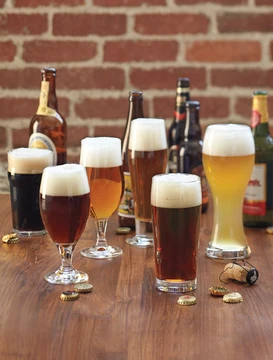
Pale lager
A crisp, dry lager that became the world's most common beer style.

Pale lager is a type of beer that ranges from pale to golden in color. It has a well-attenuated body, meaning most of the sugars have been fermented out, and it can feature varying levels of bitterness from noble hops. These beers are typically dry, lean, clean-tasting, and crisp, with subtle flavors where no single ingredient stands out. The hop character can be almost absent or provide a dry bitterness. Water, Pilsner malt, and noble hops are the main ingredients, though some brewers add rice or corn to make the body lighter. Alcohol by volume usually falls between 4% and 6%, depending on the specific style.
Quick Facts
- Origin
- Germany, Austria
- Yeast
- Bottom-fermenting
Facts from the source article.
Lore & Background
In the mid-19th century, Gabriel Sedlmayr took British pale ale brewing and malt making techniques back to the Spaten Brewery in Germany and applied them to existing lagering methods. The resulting beers gradually spread around the globe to become the most common form of beer consumed in the world today. In the period 1820–1830, Sedlmayr went around Europe to improve his brewing skills; when he returned, he used what he had learned to get a more stable and consistent lager beer. The Bavarian lager was still different from the widely known modern lager; due to the use of dark malts it was quite dark, representing what is now called Dunkel beer or the stronger variety, bock beer. This technique was applied by Josef Groll in the city of Pilsen, Bohemia, using less-roasted grains, resulting in the first pale lager Pilsner Urquell in 1842.
Pale lager was developed in the mid-19th century, when Sedlmayr took some British pale ale brewing techniques back to the Spaten Brewery in Germany and started to modernize continental brewing methods. In 1842, a new modern lager brewery was built in Plzeň, and the first known example of a golden lager, Pilsner Urquell, was brewed there by Josef Groll. This beer proved so successful that other breweries followed the trend, using the name Pilsner. Breweries now use the terms 'lager' and 'Pilsner' interchangeably, though pale lagers from the Czech Republic and Germany categorized as pilsner tend to have more evident noble hop aroma and dry finish than other pale lagers.
Reader's Guide
Pale lager's significance lies in its transformation of global beer culture. Originating from the innovations of Gabriel Sedlmayr and Josef Groll in the mid-19th century, it introduced a clean, golden beer that contrasted sharply with the dark, maltier brews of earlier eras. The style's adaptability allowed it to spread worldwide, becoming the most common form of beer consumed. Its variations—Pilsner, Dortmunder Export, Helles, American lager, Australian lager, dry beer, and strong lager—demonstrate its versatility. In Germany, Helles emerged as a pale alternative to darker regional beers, while American lagers often use adjuncts like rice or corn for lightness. The dry beer subcategory, first developed in 1967 and later marketed in Japan and the US, emphasizes full attenuation. Strong pale lagers include bock, malt liquor, and Oktoberfestbier/Märzen, the latter protected as a trademark by Munich breweries. Pale lager's legacy is its role as a global standard, influencing brewing techniques and consumer preferences across continents.
Did You Know?
- The first known golden lager, Pilsner Urquell, was brewed in 1842 by Josef Groll in Plzeň.
- Gabriel Sedlmayr brought British pale ale techniques to the Spaten Brewery in Germany in the mid-19th century.
- The term 'dry beer' was first used in Japan by Asahi Breweries in 1987.
- Oktoberfestbier is a registered trademark of the six Munich breweries known as the Club of Munich Brewers.
More in Beer Styles 1-24
Spotted an error? Know more?
Reader corrections go straight into our review queue. Suggest an edit · How this site is sourced