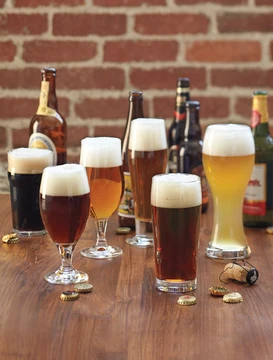
Irish red ale
A malt-forward Irish ale with caramel sweetness and dry finish.

Irish red ale, sometimes called red ale or Irish ale, is a type of pale ale. Its red color comes from using a moderate amount of kilned malts and roasted barley. Alcohol by volume usually falls between 3.8% and 4.8%, though some craft versions can go up to 6%. The beer is known for a malt-forward character with caramel or toffee-like sweetness, a dry finish, and low to moderate bitterness, typically between 15 and 30 IBU. Its color measures between 11 and 18 on the Standard Reference Method scale.
The true beginnings of Irish red ale are unclear. Ale has been brewed at St. Francis Abbey in Kilkenny since the 1300s. By the 1700s, commercial brewing, distilling, malting, and milling were active in the city, led by Catholic merchant families including Archdeakin, Brennan, Cormick, Connell, Dullard, Hyland, Kinchella, McCreary, Meighan, Smithwick, Sullivan, and Watters. Kilkenny offered ideal conditions for brewing and distilling, and by 1782 the city had eight distilleries. The surrounding farmland, helped by County Kilkenny’s favorable climate, produced abundant corn, wheat, and barley. Additionally, as noted by MP and brewer Richard Sullivan in 1834, the nearby Castlecomer Plateau supplied brewers and distillers with plentiful coal.
The best-known Irish red ale is Smithwick’s, which traces its roots to 1710 when John Smithwick set up a brewery at St. Francis Abbey. That venture did not last, and the family sold the brewery—a common outcome in Kilkenny due to political instability and periodic famine in the 1700s and 1800s. John’s grandson, Edmond Smithwick, bought the St. Francis Abbey brewery back from the Brennans in 1827 and greatly expanded it. Guinness acquired the company in 1965 and launched the current Smithwick’s brand, replacing discontinued beers like Time Ale and Time Barley Wine. In 1987, Guinness created an export-only version called Kilkenny, which later became its own distinct style with a redder color, more bitterness, and a foamier head.
Although ale had been brewed in Ireland for centuries, the term “Irish red ale” was rarely used there. It became popular in the United States to describe reddish-amber ales with Irish roots. In 1981, Coors licensed Killian’s Irish Red from Heineken France, and it became one of the top-selling specialty beer brands in the U.S.
Quick Facts
- Origin
- Ireland
- Yeast
- Ale
- Alcohol
- 3.8% - 6%
- Bitterness
- 15 - 30
- Originalgravity
- 1036-1065
- Finalgravity
- 1010-1016
- Maltpercentage
- 90-100
Facts from the source article.
Lore & Background
The true origins of Irish red ale are unknown. Ale has been brewed in Kilkenny city at St. Francis Abbey since the 14th century. Commercial brewing, distilling, malting, and milling took place in the city in the 18th century, carried out by a merchant class of predominantly Catholic families. Conditions for brewing in Kilkenny were ideal; by 1782 there were eight distilleries in the city, and the nearby Castlecomer Plateau provided a plentiful supply of coal.
Perhaps the most well-known Irish red ale is Smithwick's, which traces its lineage to 1710 with the establishment of John Smithwick's brewery at St. Francis Abbey. That venture was short-lived, and the brewery was sold. John's grandson, Edmond Smithwick, acquired the St. Francis Abbey brewery in 1827 from the Brennans and greatly expanded its operations. The company was acquired by Guinness in 1965, and the current brand was launched, replacing discontinued beers such as 'Time ale' and 'Time barley wine'. In 1987, Guinness developed an export-only brand of Smithwick's known as Kilkenny, which evolved into a distinct variant with a redder colour, more bitter taste, and foamier head.
While ale had been brewed for centuries in Ireland, the term 'Irish red ale' was rarely used there. It was popularized in the United States to describe a reddish-amber ale rooted in Ireland. In 1981, Coors licensed Killian's Irish Red from Heineken France, which became a top-selling specialty beer brand in the U.S. Killian's Irish Red is actually an amber lager, but it popularised the name 'Irish red ale' to such an extent that the term was imported back into Ireland by many craft brewers as a classification.
Reader's Guide
Irish red ale holds a notable place in both Irish and American beer culture. In Ireland, the style is represented by macro-brewed varieties such as Smithwick's and Kilkenny, which are by far the most common. The Smithwick's brewery in Kilkenny closed in 2013, with all brewing moved to St. James's Gate in Dublin. To keep the tradition of Kilkenny brewing alive, descendants of the Smithwick and Sullivan families opened a new brewery in Kilkenny in 2016 and relaunched Sullivan's brand, which had been discontinued in 1918. Sullivan's claims it can trace its lineage to a brewery on James's Street in 1702, which would make it the oldest branded red ale.
In the United States, 'Irish red' is sometimes used to describe a darker amber ale or a red beer that is a lager with caramel colouring, but these are not Irish red ales. The style is popular with American craft brewers due to its sweet taste and relatively low alcohol content. Numerous regional examples exist across Ireland, including O'Hara's Irish Red in Carlow, Franciscan Well Rebel Red in Cork, and Porterhouse Red in Dublin, as well as international versions in Argentina, Canada, and the United States. The style's legacy is one of adaptation: a traditional Irish ale that gained its modern name and widespread recognition through American marketing, then re-entered Irish brewing as a formal classification.
Did You Know?
- The term 'Irish red ale' was rarely used in Ireland and was popularized in the United States.
- Killian's Irish Red, which popularised the name, is actually an amber lager, not an ale.
- Smithwick's traces its lineage to a brewery established at St. Francis Abbey in Kilkenny in 1710.
Frequently Asked Questions
Who is Irish red ale?
Irish red ale is a pale ale substyle that originated in Ireland, recognized by its deep amber-red hue and a malt-dominant flavor profile. It sits in the lower-alcohol range, typically landing between 3.8% and 4.8% ABV, with some craft interpretations pushing toward 6%.
What are Irish red ale's powers/role?
This style brings a toffee-and-caramel sweetness to the table while keeping bitterness restrained, usually sitting between 15 and 30 IBU. The red color is achieved through kilned malts and roasted barley rather than heavily roasted grains, giving it a gentler character than a stout.
Why is Irish red ale important?
It represents one of the longest-continuous brewing lineages in Ireland, with Smithwick's traceable to 1710 as a notable surviving example. The style also helped establish the broader 'red ale' category that many modern craft brewers reference when crafting their own interpretations.
What's Irish red ale's color?
On the Standard Reference Method scale, Irish red ale typically falls between 11 and 18, placing it in the deep amber to reddish-brown range. The moderate kilning of malts combined with a touch of roasted barley produces that signature warm red without crossing into the darkness of a porter or stout.
More in Beer Styles 1-24
Spotted an error? Know more?
Reader corrections go straight into our review queue. Suggest an edit · How this site is sourced