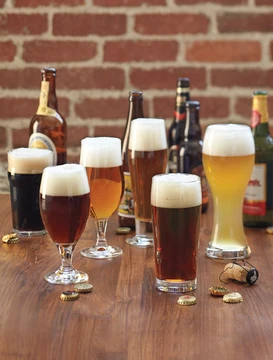
India pale ale
A hoppy pale ale originally brewed for export to India.

India pale ale (IPA) is a hoppy style of beer that falls under the broader pale ale category. It was first brewed in the United Kingdom for export to India, then under British East India Company control until 1858. The generous use of hops served as a natural preservative, keeping the beer from spoiling on the long sea voyage. The style lost popularity in the late 1800s and again in the mid-1900s, but since the 1970s it has made a strong comeback, closely tied to homebrewing and the craft beer movement.
The pale ales of the early 1700s were only lightly hopped and bore little resemblance to modern versions. By the mid-1700s, brewers began using coke-fired malt, which reduced smoking and roasting during malting, resulting in a lighter-colored beer. One early variety was Old ale, a pale, well-hopped brew favored by the landed gentry, who brewed it at home and aged it in cellars for two years.
One of the first brewers known to ship beer to India was George Hodgson’s Bow Brewery, located on the boundary between Middlesex and Essex. Hodgson’s beers became popular with East India Company traders in the late 1700s, partly because the brewery was just two miles up the Lea River from the East India Docks, and partly because Hodgson offered a generous 18-month credit line. His old ale, in particular, benefited from the voyage conditions and was highly regarded in India. Control of the brewery passed to Hodgson’s son early in the 1800s.
When the Napoleonic blockade cut off Burton breweries from their export markets in continental Europe, including Scandinavia and Russia, they began looking for new outlets. At the East India Company’s request, Allsopp’s brewery head maltser Job Goodhead developed a heavily hopped pale ale in Hodgson’s style for the Indian market. Other Burton brewers, such as Bass and Salt and Co., followed suit, taking advantage of the local water’s properties. In 1827, London East End brewer Charrington successfully shipped trial hogsheads of “India Ale” to Madras and Calcutta, leading to regular trade with key British agents and retailers in those cities.
Early IPAs were only slightly stronger in alcohol than other beers of the time, but more of the wort was fermented, leaving few residual sugars, and they were heavily hopped. While designed to survive long sea voyages, porter was also successfully shipped to India and California.
Quick Facts
- Origin
- United Kingdom
- Alcohol
- 4.5–20%
- Originalgravity
- 1.050–1.090
- Finalgravity
- 1.000–1.025
Facts from the source article.
Lore & Background
The pale ales of the early 18th century were lightly hopped and quite different from modern pale ales. By the mid-18th century, pale ale was often brewed with a coke-fired malt, which produced less smoking and roasting of barley, yielding a lighter hued beer. One variety was Old ale, a pale well-hopped brew intended to age in a cellar for two years. Among the first brewers known to export beer to India was George Hodgson's Bow Brewery, on the Middlesex-Essex boundary. Its beers became popular among East India Company traders' provisions in the late 18th century, helped by the brewery's location two miles up the Lea from the East India Docks and Hodgson's liberal credit line of 18 months. Ships exported his old ale to India, which benefited exceptionally from the voyage conditions and was highly regarded. The brewery came into the control of Hodgson's son early in the next century.
Burton breweries lost their export market in Continental Europe when the Napoleonic blockade was imposed and sought a new export market. At the behest of the East India Company, Allsopp's brewery's chief maltser, Job Goodhead, developed a strongly-hopped pale ale in the style of Hodgson's for export to India. Other Burton brewers, including Bass and Salt and Co, followed Allsopp's lead, taking advantage of Burton water. London East End brewer Charrington's trial shipments of hogsheads of 'India Ale' to Madras and Calcutta in 1827 proved successful, and a regular trade emerged with key British agents and retailers. Early IPAs were only slightly higher in alcohol than other beers brewed then, but more of the wort was fermented, meaning few residual sugars, and they were heavily hopped. By the 1860s, India pale ales were widely brewed in England and were much more attenuated and hopped than porters and ales.
Demand for the export style of pale ale, which had become known as 'India pale ale', developed in England around 1840 and became a popular product there. Some brewers dropped the term 'India' in the late 19th century, but records indicated that these 'pale ales' retained the features of earlier IPAs. American, Australian, and Canadian brewers manufactured beer with the label IPA before 1900, and records suggest these beers were similar to English IPA of the era. IPA style beers started being exported to other colonial countries, such as Australia and New Zealand, around this time, with many breweries dropping the 'I' and simply calling them Pale Ales or Export Pales.
Reader's Guide
India pale ale was well known as early as 1815, but gained popularity in the British domestic market sometime before then. By World War I, IPA in Britain had diverged into two styles: premium bottled IPAs of around 1.065 specific gravity and cask-conditioned draught IPAs which were among the weakest beers on the bar. Like all British beers, their strength declined during World War I. Worthington's White Shield, first brewed in 1829 principally for export to the British Empire, became a cult drink by the 1960s and found renewed popularity in the early 1970s when demand for real ale grew in the UK. The revival of IPA in modern times dates to a seminar on Burton pale ales in 1990, leading to a pale ale festival in 1992 and an IPA festival in 1993, for which Bass brewed a 7.2% beer inspired by Bass Continental. An IPA conference in 1994 was attended by brewers from both sides of the Atlantic, and its influence persists. In the 21st century, US-influenced IPA is one of the most popular beer styles in the UK.
In the late 20th century craft beer revolution in the United States, brewers sought out old beer styles; Ballantine IPA, made in the U.S. since 1890 until the 1990s, proved inspirational. The traditional IPA style was well-suited to model the intense flavour and aroma of American hops. Bert Grant of Yakima Brewing and Malting found that Cascade and Chinook hops, grown locally in Yakima, Washington, provided strong flavours when showcased in an IPA. The boom in popularity for IPA spread down the west coast of the United States, then across the United States and eventually the world. It is estimated that over 40% of craft beer brewed in the United States can be classified as an IPA. As the Oxford Companion to Beer notes, 'IPA is now the signature of craft brewers worldwide.' American varieties include West Coast IPA (or Classic IPA), which is hop-forward, typically very bitter between 40 and 70 IBUs, and often tastes of resin, citrus, and tropical fruit. Black IPA (also known as Cascadian Dark Ale or American Black Ale) is not pale in color but shares the bitter hoppy flavors of other IPAs, using dehusked roasted malts for a darker color and somewhat coffee or roasted flavor. Its origin lies with Vermont Pub & Brewery in Burlington, Vermont, where in 1989 or 1990 owner Greg Noonan created a strong, roasty 'winter IPA' called Tartan IPA, inspired by a local, hoppy, dark red ale.
Did You Know?
- George Hodgson's Bow Brewery was among the first known to export beer to India, helped by its location two miles up the Lea from the East India Docks.
- Ballantine IPA was made in the United States from 1890 until the 1990s and proved inspirational for the craft beer revolution.
Frequently Asked Questions
Who is India pale ale?
IPA is a hop-forward pale ale style that originated in 18th-century England, where brewers such as George Hodgson at his Bow Brewery crafted it specifically for shipment to British colonies in India. It sits within the broader pale ale family but is set apart by its aggressive hopping and higher alcohol tolerance.
What are India pale ale's powers/role?
The generous hopping that defines the style originally served a practical purpose: it acted as a natural preservative, keeping the beer from spoiling during months-long ocean crossings to India. Today that same hop intensity is what makes IPAs so aromatic and bitter, with American versions typically landing between 40 and 70 IBUs.
Why is India pale ale important?
IPA became the flagship style of the craft beer revolution, proving that bold, hop-driven flavors could challenge the dominance of mass-produced lagers. Its resurgence from the 1970s onward is closely linked to homebrewers who wanted to recreate and improve upon the old British export recipes.
Where does India pale ale come from?
The style was first brewed in the United Kingdom, with George Hodgson's Bow Brewery in London among the earliest known producers making it for export to British India. The beer was designed to survive long sea voyages under East India Company trade routes, a system that lasted until 1858.
More in Beer Styles 1-24
Spotted an error? Know more?
Reader corrections go straight into our review queue. Suggest an edit · How this site is sourced