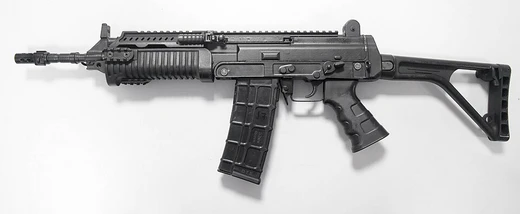
Winchester rifle
Lever action repeating rifles among the earliest repeaters.

The Winchester rifle refers to a series of lever-action repeating rifles made by the Winchester Repeating Arms Company. These firearms evolved from the 1860 Henry rifle and were among the earliest repeating rifles. The Model 1873, in particular, became widely known and was promoted by the company as "The Gun That Won the West."
The design lineage began in 1848, when Walter Hunt of New York patented a "Volition Repeating Rifle" that used a tubular magazine and operated through two levers and complex linkages. It fired a "Rocket Ball," an early caseless ammunition where the powder was inside the bullet's hollow base. Hunt's design was fragile and impractical, but in 1849, Lewis Jennings bought the patents and created a functioning, though still complicated, rifle. Robbins & Lawrence of Windsor, Vermont, produced a small number of these until 1852.
Horace Smith and Daniel Wesson of Norwich, Connecticut, then acquired the Jennings patent from Robbins & Lawrence, along with shop foreman Benjamin Tyler Henry. Smith improved the Jennings design, and in 1855, Smith and Wesson, with several investors, formed the Volcanic Repeating Arms Company to manufacture Smith's version—the Volcanic lever-action pistol and rifle. Oliver Winchester was the largest stockholder.
For the Volcanic rifle, Smith added a primer to Hunt's "Rocket Ball," creating one of the first fixed metallic cartridges that combined bullet, primer, and powder in a single unit. While still at the company, Smith further added a cylindrical copper case to hold the bullet and powder, with the primer in the case rim, inventing the metallic rimfire cartridge. This cartridge, the .22 Short, was introduced commercially in 1857 with the Smith & Wesson Model 1 revolver and remains in production today.
The Volcanic rifle saw limited success, partly due to its design and the poor performance of the Hunt-derived Volcanic cartridge—a hollow conical ball filled with black powder and sealed by a cork primer. Though the Volcanic's repeater design was far ahead of rivals, the weak and unreliable .25 and .32 caliber "Rocket Balls" could not compete with larger calibers. Wesson left Volcanic soon after its founding, and Smith followed eight months later to create the Smith & Wesson Revolver Company. Volcanic moved to New Haven in 1856 but became insolvent by year's end.
Quick Facts
- Origin
- United States
- Is Ranged
- yes
- Service
- 1866–present
- Design Date
- 1866
- Manufacturer
- Winchester Repeating Arms Company
- Number
- c. 720,000
- Variants
- Full-stocked "Musket", Carbine, Sporting model
- Weight
- 9.5 lb
- Length
- 49.3 in
- Part Length
- 30 in
- Caliber
- .44 Henry / .44-40 Winchester / .38-40 Winchester / .32-20 Winchester / .22 Long Rifle
- Action
- Lever action
Facts from the source article.
Lore & Background
The Winchester rifle lineage began with the Model 1866, the first Winchester rifle, originally chambered for the rimfire .44 Henry cartridge. Nicknamed the 'Yellow Boy' due to its bronze/brass alloy receiver, it featured a loading gate on the side of the frame and a round, sealed magazine partially covered by a forestock. A 27-inch musket version was produced primarily for military users. France purchased 6,000 Model 1866 rifles during the Franco-Prussian War, and the Ottoman Empire purchased 45,000 rifles and 5,000 carbines in 1870 and 1871, which were used in the 1877 Russo-Turkish War. The Swiss Army initially selected the Model 1866 but later adopted a domestic bolt-action design. The Model 1866 continued to be manufactured until 1899.
The Model 1873, introduced in 1873, was one of the most successful Winchester rifles. It was originally chambered for the .44-40 cartridge, the first centerfire cartridge manufactured by Winchester. Later chamberings included .38-40 and .32-20. The Model 1873 was produced in three variations: a 24-inch barrel rifle, a 20-inch barrel carbine, and a 30-inch musket. A coveted 'One of One Thousand' grade was established in 1875 for barrels producing unusually small groupings; approximately 136 were sold. A second grade, 'One of One Hundred', saw only eight rifles sold. From 1883, John Moses Browning designed a series of lever-action rifles for Winchester, including the Model 1886, Model 1892, Model 1894, and Model 1895.
Reader's Guide
The Winchester rifle's significance lies in its role as one of the earliest successful repeating rifles, evolving from the 1860 Henry rifle. The Model 1866 saw military use in the Franco-Prussian War and the Russo-Turkish War, where its repeating capability at the Siege of Plevna caused surprise and sparked renewed European interest in repeating rifles. The Model 1873, marketed as 'The Gun That Won the West', became an icon, with over 720,000 produced between 1873 and 1923. Its chambering in popular handgun cartridges like .44-40, .38-40, and .32-20 allowed users to carry one type of ammunition for both rifle and handgun. The 'One of One Thousand' grade rifles, selling for $100, became legendary, inspiring a 1950 Western film starring James Stewart. The partnership with John Moses Browning from 1883 produced further lever-action designs that extended the Winchester legacy. The Model 1866 remained in production until 1899 due to public demand, and the Model 1873 saw a return to popularity with modern Cowboy action shooting.
Did You Know?
- The Model 1866 was nicknamed 'Yellow Boy' because of its bronze/brass alloy receiver.
- The Ottoman Empire purchased 45,000 Model 1866 rifles and 5,000 carbines in 1870 and 1871.
- The Model 1873 was marketed as 'The Gun That Won the West'.
- Only eight 'One of One Hundred' Model 1873 rifles were sold.
From Smoothbore to Rifled: The Long Transition
The British Army's standard infantry weapon for generations was the Brown Bess musket, a .75-calibre smoothbore that sacrificed precision for practicality. Without rifling in its barrel and with generous internal tolerances designed to ease the muzzle-loading process, it was essentially useless beyond a hundred yards. Yet it was inexpensive to manufacture and could be reloaded rapidly, qualities that suited the prevailing tactical doctrine of massed volley fire where volume of lead mattered far more than individual accuracy.
The shift away from this philosophy began in the late 1830s, when the demonstrably superior range and precision of rifled barrels convinced military authorities to retire the Brown Bess in favour of smaller-calibre muzzle-loading rifles. The early transition was messy: many of these first rifles were non-standard, cobbled together by adapting Brown Bess locks and stocks to newly rifled barrels. It would not be until the closing decades of the nineteenth century that the rifle had completely displaced the musket as the default shoulder-weapon of the British infantryman.
First Steps: The 1776 Experiments
Rifled firearms had only a marginal presence in British military history before the eighteenth century. During the English Civil War of 1642 to 1651, civilian rifles were occasionally employed by individual marksmen, and in the 1750s a small number of German-made rifles found their way into the hands of British light infantry during the Seven Years' War. These remained curiosities rather than standard equipment.
The first genuine institutional commitment came in January 1776, when the Army ordered a thousand rifles built to a pattern designed by gunsmith William Grice, drawing on the German rifles already in limited service. Approved as the Pattern 1776 Infantry Rifle, these weapons were distributed to the light company of every regiment and likely saw action at most engagements of the American Revolution.
That same year, Major Patrick Ferguson patented a breech-loading rifle inspired by older French and Dutch designs dating to the 1720s and 1730s. Roughly two hundred were made, with one hundred issued to a dedicated rifle corps in 1777. However, the weapon's high cost, manufacturing difficulties, and mechanical fragility—combined with Ferguson's death at the Battle of Kings Mountain—doomed the project to a brief existence.
The Baker and Brunswick: Rifles for Specialists
The Baker rifle, a muzzle-loading flintlock, became the iconic weapon of British sharpshooters during the Napoleonic Wars, most famously carried by the 95th Rifles and the 5th Battalion of the 60th Regiment of Foot. For its era it was remarkably precise, with documented kills at ranges between 100 and 300 yards. At the 1809 battle of Cacabelos, Rifleman Tom Plunkett of the 95th reportedly brought down the French General Colbert-Chabanais at a distance of 400 yards. The Baker remained in British service into the 1840s, and even crossed the Atlantic, as Mexican forces under Santa Anna employed captured Baker Rifles during the 1836 Texas-Mexican War.
Its successor, the Brunswick rifle, was a .704-calibre percussion weapon manufactured at the Royal Small Arms Factory in Enfield. Weighing between nine and ten pounds without its bayonet, it featured a distinctive two-groove barrel designed to spin a belted round ball. Though notoriously difficult to load, the Brunswick stayed in production for roughly fifty years, from 1836 to 1885, serving in Britain and across its colonial outposts. Four basic patterns existed in .654 and .704 calibres, in both rifled and smoothbore oval-bore configurations.
The Enfield Revolution: Rifles for Every Soldier
The Royal Small Arms Factory in Enfield had been assembling muskets from externally manufactured components since 1804, and the Baker rifle was the first weapon produced there as a complete, standardised piece. Yet until 1851, rifles were still regarded as specialist tools for skirmishers and snipers, while the bulk of regular troops carried smoothbore muskets.
That changed with the Pattern 1851, a .702-inch rifled musket using the conical Minie bullet. It was built to the length of the old smoothbore muskets so that rank-firing drills and bayonet tactics could remain uniform. The Minie cartridge also solved the loading-speed problem that plagued earlier rifles. Relatively few were made before the Pattern 1853 replaced it within two years, stepping down to a .577-calibre Minie round with infantry, navy, artillery, and cavalry variants.
Both patterns saw service in the Crimean War, where the need for two different ammunition types caused logistical headaches. The Pattern 1853 also found a second life in the American Civil War, with both Union and Confederate agents contracting British private firms for production. A heavier five-groove naval barrel followed in the 1858 Admiralty pattern, while a short-lived Indian Service variant suffered barrel bulging after its rifling was reamed out.
Gallery
Frequently Asked Questions
What is the Winchester rifle?
The Winchester rifle is a family of lever-action repeating rifles manufactured by the Winchester Repeating Arms Company, representing some of the earliest practical repeating firearms in history. They grew directly out of the 1860 Henry rifle design and became deeply embedded in American frontier culture.
Which Winchester model is the most iconic?
The Model 1873 is the standout, famously marketed by the company as "The Gun That Won the West." It saw production from 1873 through 1923, with more than 720,000 units rolling off the line over those five decades.
What cartridge did the Winchester rifle popularize?
The .44-40 centerfire cartridge was introduced alongside the Winchester line and became one of its signature rounds. It helped set a standard for lever-action ammunition in the post-Civil War period.
What preceded the Winchester rifle in design?
The 1860 Henry rifle was the direct ancestor, establishing the tubular-magazine lever-action layout. That concept traces even further back to Walter Hunt's 1848 "Volition Repeating Rifle" patent, which relied on a tubular magazine and a pair of linked levers to cycle a caseless "Rocket Ball" cartridge.
What was the first model actually sold under the Winchester name?
The Model 1866 holds that distinction, marking the company's official launch into the repeating-arms market. It refined the Henry rifle's mechanism while debuting the new .44-40 centerfire round.
More in Battle Rifles and Carbines, Part 2 1-24
Spotted an error? Know more?
Reader corrections go straight into our review queue. Suggest an edit · How this site is sourced