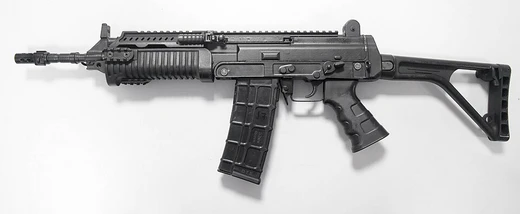
FN SCAR
Modular battle rifle family developed for U.S. Special Operations Command.

The FN SCAR, short for Special Operations Forces Combat Assault Rifle, is a family of automatic rifles that use a gas-operated short-stroke piston system. Belgian arms maker FN Herstal developed it in 2004, building the design around modularity to meet the needs of a U.S. Special Operations Command (SOCOM) competition. The family splits into two main types: the SCAR-L (light), which fires the 5.56×45mm NATO round, and the SCAR-H (heavy), chambered for the 7.62×51mm NATO cartridge. Each type comes in Close Quarters Combat (CQC), Standard (STD), and Long Barrel (LB) variants.
In early 2004, USSOCOM put out a call for a family of special operations assault rifles that could handle two different calibers while sharing many parts and identical ergonomics. The SCAR system finished low-rate initial production testing in June 2007. After some delays, the first rifles reached operational units in April 2009. That same year, a battalion of the U.S. 75th Ranger Regiment became the first large unit to take 600 of them into combat.
Later, SOCOM canceled its purchase of the SCAR-L and planned to remove it from inventory by 2013. However, it continued buying the SCAR-H version and also planned to acquire 5.56mm conversion kits for the SCAR-H, letting it fill the role of the SCAR-L. By 2015, the SCAR was in service in more than 20 countries.
On October 16, 2025, FN America announced it had finished the final production run of all civilian-market SCAR rifles, except for the SCAR 15P. The company said spare parts—including barrel assemblies, magazines, and other accessories—would remain available for a "period of time," and service support for existing owners would continue during that period. It added that more information about future FN products would come before the 2026 SHOT Show. On January 15, 2026, FN America announced an upgrade to SCAR rifles featuring M-LOK rails, a lengthened receiver, and a hydraulically buffed bolt carrier.
The SCAR-L (designated Mk 16 by USSOCOM) was meant to replace the M4A1, Mk 18 CQBR, and Mk 12 SPR, while the Mk 17 (SCAR-H) was intended to replace the M14 and Mk 11 sniper rifles. In practice, the weapon only supplements other firearms, and issuance remains at the operator's discretion.
Quick Facts
- Service
- 2009–present
- Wars
- War in Afghanistan (2001–2021) / Iraq War / Mexican drug war / Yemeni Civil War / Conflict in Najran, Jizan and Asir / Russo-Ukrainian War / M23 offensive / Internal Conflict in Peru
- Designer
- FN Herstal
- Length
- 889 mm stock extended, 635 mm stock folded (SCAR-L) / 965 mm stock extended, 711 mm stock folded (SCAR-H)
- Action
- Gas-operated short-stroke piston, rotating bolt
- Origin
- Belgium/United States
- Is Ranged
- Yes
- Design Date
- 2004
- Manufacturer
- FN Manufacturing, LLC
- Production Date
- 2004–present (Military) / 2004–2025 (Civilian)
- Weight
- 3.29 kg (SCAR-L) / 3.58 kg (SCAR-H)
- Part Length
- 355 mm (SCAR-L) / 400 mm (SCAR-H)
Facts from the source article.
Lore & Background
In early 2004, United States Special Operations Command issued a solicitation for a family of Special Operations Forces Combat Assault Rifles designed around two different calibers but featuring high commonality of parts and identical ergonomics. The SCAR system completed low rate initial production testing in June 2007. After delays, the first rifles began to be issued to operational units in April 2009, and a battalion of the U.S. 75th Ranger Regiment was the first large unit deployed into combat with 600 of the rifles in 2009. The U.S. Special Operations Command later cancelled their purchase of the SCAR-L and planned to remove the rifle from their inventory by 2013, but continued to purchase the SCAR-H version and planned to purchase 5.56mm conversion kits for the SCAR-H. As of 2015, the SCAR was in service in over 20 countries.
The SCAR has two receivers: the lower is constructed of polymer, and the upper receiver is one piece and constructed of aluminum. It features an integral, uninterrupted Picatinny rail on the top, two removable side rails, and a bottom rail for MIL-STD-1913 compliant accessories. The rifle uses a 'tappet' type of closed gas system much like the M1 carbine while the bolt carrier otherwise resembles the Stoner 63 or Heckler & Koch G36. The SCAR-L was intended to replace the M4A1, MK 18 CQBR, and MK 12 SPR, while the MK 17 was intended to replace the M14 and MK 11 sniper rifles, though the weapon only supplements other weapons at the operator's discretion. The semi-automatic only MK 20 Mod 0 Sniper Support Rifle is based on the SCAR-H and includes a longer receiver, strengthened barrel extension and barrel profile, and an enhanced modular trigger.
Reader's Guide
The FN SCAR represents a significant modular rifle system developed specifically for U.S. Special Operations Forces, emphasizing parts commonality across two calibers. Its adoption by the 75th Ranger Regiment in 2009 marked the first large-scale combat deployment of the system. The SCAR's design incorporates a short-stroke gas piston system and extensive use of Picatinny rails, reflecting modern small arms trends. Despite initial plans to replace several existing weapons, the SCAR ultimately supplemented rather than replaced them, and SOCOM cancelled the SCAR-L purchase while retaining the SCAR-H. The system saw service in over 20 countries by 2015. In 2025, FN America announced the end of civilian-market SCAR production (except the SCAR 15P), with spare parts and service support continuing for a period. A 2026 upgrade introduced M-LOK rails, a lengthened receiver, and a hydraulically buffed bolt carrier. The SCAR's performance in a 2007 U.S. Army dust test showed 226 stoppages, ranking second among four competitors, though magazine failures contributed to stoppages across all weapons. The Enhanced Grenade Launcher Module (FN40GL) added a third-generation 40mm grenade launcher capability with ambidextrous loading and standalone use.
Did You Know?
- The SCAR-L was designated MK 16 and the SCAR-H was designated MK 17 by USSOCOM.
- The SCAR uses a 'tappet' type closed gas system similar to the M1 carbine.
- The Enhanced Grenade Launcher Module (FN40GL) can be used mounted to the rifle or as a stand-alone system.
- In 2020, the FN SCAR 20S 6.5CM variant was announced chambered in 6.5mm Creedmoor.
Frequently Asked Questions
What is the FN SCAR?
The FN SCAR (Special Operations Forces Combat Assault Rifle) is a modular family of gas-operated, short-stroke piston rifles built by Belgian manufacturer FN Herstal. It was developed in 2004 specifically to compete in a U.S. Special Operations Command selection process.
What calibers does the FN SCAR use?
The SCAR-L fires the 5.56×45mm NATO round, while the SCAR-H is chambered for the 7.62×51mm NATO cartridge. Both types share the same gas-piston operating principle but differ in overall size and power.
What variants are available in the SCAR family?
Each of the two main types—L and H—comes in three barrel-length options: Close Quarters Combat, Standard, and Long Barrel. This gives operators a total of six configurations to match different mission profiles.
What are the USSOCOM designations for the SCAR?
The U.S. military designates the SCAR-L as the MK 16 and the SCAR-H as the MK 17. These designations reflect their adoption into special operations inventories following the 2004 competition.
Why is the FN SCAR considered important in modern firearms?
Its core design philosophy centers on modularity, letting operators swap handguards, barrels, and other components in the field without specialized tools. That adaptability made it a standout choice for special forces units that need one platform to cover multiple roles.
More in Battle Rifles and Carbines, Part 2 1-24
Spotted an error? Know more?
Reader corrections go straight into our review queue. Suggest an edit · How this site is sourced