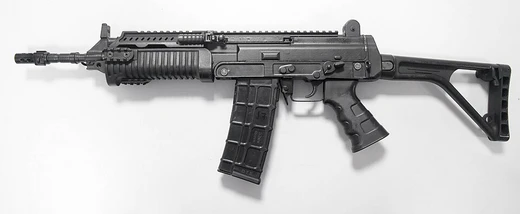
Special Operations Assault Rifle
Improved M4 carbine with reduced cyclic rate for better full-auto control.

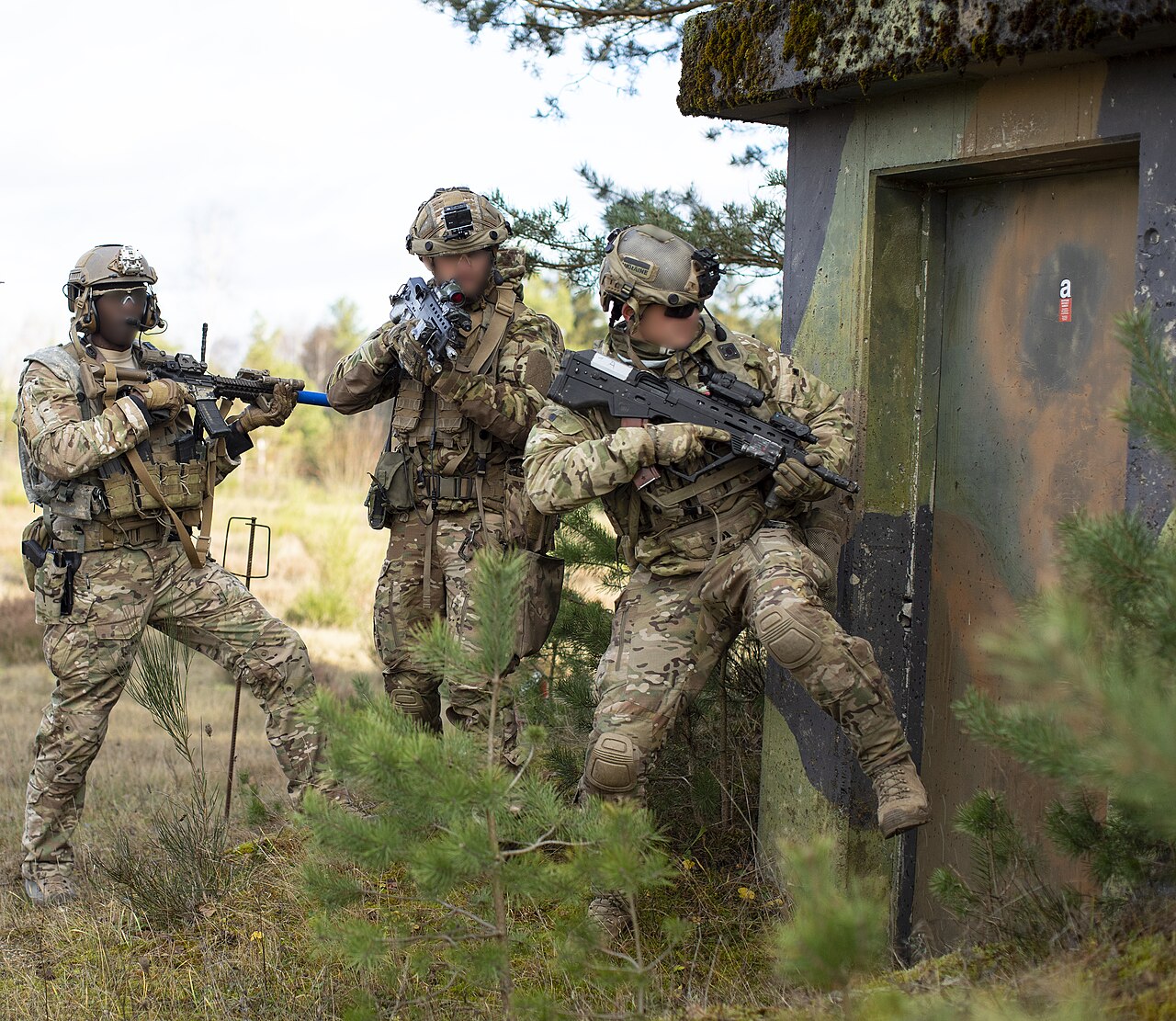
U.S. Navy photo by Mass Communication Specialist 3rd Class Matthew J. Kuhlman · Public domain
The Special Operations Assault Rifle (SOAR) is a selective-fire 5.56×45mm NATO assault rifle built by FERFRANS. It was created as an upgrade to the M4 carbine. The standard SOAR uses a closed rotating bolt with a direct impingement gas system, while the SOAR-P variant employs a short-stroke piston and rotating bolt.
FERFRANS focused on improving full-auto control. A patented Delayed Sear Activation System lowers the cyclic rate to between 550 and 680 rounds per minute, reducing muzzle climb. The rifle also uses a heavy machine gun barrel for better sustained-fire reliability, with rifling in either 1:7 or 1:9 right-hand twist.
The SOAR comes in two main lines: standard and piston-driven. Standard SOAR barrel lengths are 10.5, 11.5, 14.5, 16, 18, and 20 inches. Known upgrades include the 10.5 Mk2, 10.5 Mk2-2, and 11 Mk2. The SOAR-P, an earlier piston variant, features a fully adjustable short-stroke gas system and is available in 10.5, 11.5, 14.5, 16, and 18-inch barrels.
The SOAR IAR (Infantry Assault Rifle) is an improved piston variant with a 14.5-inch barrel, short-stroke piston, and a rate-reducing system for controllable full-auto fire. It includes an M-LOK attachment system as part of the Mission Adaptable Handguard System (MAHS). The SOAR CQB (Close Quarter Battle) is a 10-inch barrel carbine with a short-stroke piston and rate reducer, intended for close-quarters and counterterrorism. The SOAR SCW (Sub Compact Weapon) has a 7.5-inch barrel and a rate reduction system, designed to bridge the gap between low-penetration 9×19mm submachine guns and uncontrollable 5.56×45mm personal defense weapons, using standard 5.56mm rounds.
Users include the Philippine Army Special Operations Command, PNP Special Action Force, and Lapu-Lapu City SWAT. The Indonesian Marine Corps uses the SOAR IAR, and Kostrad Raider Infantry Battalion uses the SOAR SCW. Limited use is reported by the Royal Malaysia Police Special Actions Unit, Thailand’s Naval Special Warfare Command and Arintaraj 26, some SWAT teams, and the Military Marksman Demonstration Team.
Quick Facts
- Origin
- United States
- Is Ranged
- Yes
- Service
- 2004–present
- Wars
- Papua Conflict / Communist Insurgencies / Islamic Insurgencies
- Designer
- Ferdinand and Francis Sy
- Design Date
- 1998
- Manufacturer
- FERFRANS
- Production Date
- 2004-present
- Variants
- Variants
- Cartridge
- 5.56×45mm NATO
- Caliber
- 5.56 mm (.223 in)
- Action
- SOAR: Gas-operated, rotating bolt (direct impingement) / SOAR-P: Short-stroke piston, rotating bolt
Facts from the source article.
Lore & Background
The SOAR was developed by FERFRANS as a direct improvement of the M4 carbine, focusing on better control during full-automatic fire. It uses a heavy machine gun barrel for increased reliability in sustained firing, with rifling available in either 1:7 or 1:9 right-hand twist. The standard SOAR operates via direct impingement, while the SOAR-P variant uses a short-stroke piston system with a fully adjustable gas piston system.
Variants include the SOAR IAR (Infantry Assault Rifle), a 14.5-inch barrel piston-driven rifle with an M-LOK attachment system as part of its Mission Adaptable Handguard System (MAHS); the SOAR CQB, a 10-inch barrel carbine for close quarter battle and counterterrorism; and the SOAR SCW (Sub Compact Weapon), a 7.5-inch barrel compact rifle designed to bridge the gap between 9×19mm submachine guns and 5.56×45mm personal defense weapons. Known upgrades for the standard SOAR include the 10.5 Mk2, 10.5 Mk2-2, and 11 Mk2.
Reader's Guide
The SOAR's significance lies in its deliberate design to address the controllability issues of the M4 carbine in full-automatic fire, achieved through the Delayed Sear Activation System that lowers the cyclic rate to a manageable 550–680 rpm. This feature, combined with a heavy machine gun barrel, makes it suitable for sustained firing roles. The weapon's multiple variants—from the compact SCW to the IAR—allow it to cover a range of operational needs, from close quarters to infantry assault, without requiring new ammunition types. Its adoption by military and police units in the Philippines, Indonesia, Malaysia, Thailand, and limited use by SWAT teams and a marksman demonstration team underscores its niche as a specialized tool for operators who prioritize control and reliability in automatic fire. The piston-driven SOAR-P and its derivatives offer an alternative operating system for those preferring reduced fouling and gas blowback.
Did You Know?
- The SOAR uses a patented Delayed Sear Activation System that reduces its cyclic rate of fire in full-auto to 550–680 rpm.
- The SOAR-P variant incorporates a short-stroke piston operating system with a fully adjustable gas piston system.
Design Philosophy and the Rate-Control Revolution
FERFRANS set out to refine the M4 carbine platform with a singular focus: making full-automatic fire genuinely controllable in the hands of special operations personnel. The result, the Special Operations Assault Rifle, is a selective-fire 5.56×45mm NATO weapon whose defining innovation is a patented Delayed Sear Activation System. Rather than simply firing at the platform's inherent cyclic rate, this mechanism throttles the full-auto rate down to roughly 550 to 680 rounds per minute. The practical effect is a dramatic reduction in muzzle climb and a marked improvement in how the rifle behaves during sustained bursts, addressing what FERFRANS identified as the M4's primary weakness in full-auto mode. To complement this rate control, the SOAR incorporates a heavy machine-gun barrel, available in either a 1:7 or 1:9 right-hand twist, chosen to enhance reliability during extended firing sessions. The combination of a slower, more manageable cyclic rate with a sturdier barrel reflects a design philosophy that prioritizes sustained accuracy and shooter control over raw rate of fire.
Two Paths to the Same Goal: Operating Systems
The SOAR family offers operators two fundamentally different ways to cycle the action, each tailored to different operational preferences. The standard SOAR model employs a closed rotating bolt operated by direct impingement, the same basic principle found in the AR-15/M4 lineage it improves upon. In contrast, the SOAR-P variant switches to a short-stroke piston rotating bolt system, paired with a fully adjustable gas piston that allows the shooter to fine-tune the gas system for varying conditions. Both variants share the same 5.56×45mm NATO caliber and the same rate-reducing full-auto mechanism, but the piston-driven SOAR-P is generally regarded as the more robust option for sustained combat use. Barrel length options also differ slightly between the two lines: the standard SOAR spans from 10.5 inches up to 20 inches, while the SOAR-P covers 10.5 inches through 18 inches. This dual-path approach gives procurement officers and unit commanders a meaningful choice in operating principle without sacrificing the core controllability features that define the SOAR concept.
A Family Built for Every Mission Profile
Beyond the base SOAR and SOAR-P, FERFRANS has developed a range of specialized variants that stretch the platform from close-quarters rooms to infantry line-of-sight engagements. The SOAR IAR, or Infantry Assault Rifle, is a 14.5-inch-barrel piston-driven model equipped with a Mission Adaptable Handguard System featuring M-LOK attachment points, and it retains the full-auto rate-reducing mechanism for controllable bursts. For tighter spaces, the SOAR CQB carries a 10-inch barrel and is explicitly designated for close-quarter battle and counterterrorism work. The most compact entry, the SOAR SCW, shrinks the barrel to just 7.5 inches. Its stated purpose is to close the gap left by 9×19mm submachine guns, which lack penetration, and 5.56mm personal defense weapons, which become uncontrollable in full-auto during close combat—all while still using the standard 5.56×45mm round. On the standard direct-impingement line, barrel options extend up to 20 inches, and upgraded iterations such as the 10.5 Mk2, 10.5 Mk2-2, and 11 Mk2 represent incremental refinements to the shorter-barrel configurations.
From Southeast Asia to the Western World
The SOAR has found a niche across a surprisingly wide band of special operations and law-enforcement units on multiple continents. In the Philippines, the rifle is fielded by the Philippine Army Special Operations Command, the PNP Special Action Force, and the Lapu-Lapu City SWAT team. Indonesia represents one of the deepest adoptions: the Marine Corps operates the SOAR IAR, while the Kostrad Raider Infantry Battalion of the Indonesian Army wields the SOAR SCW. In Malaysia, the Special Actions Unit of the Royal Malaysia Police has taken limited numbers into service, and Thailand's Naval Special Warfare Command along with the Arintaraj 26 unit have also adopted the platform in limited quantities. Peru appears on the user list as well. In the United States, the SOAR sees limited use with certain SWAT teams, and Vietnam's Military Marksman Demonstration Team has incorporated it into its roster. The pattern that emerges is one of specialized, small-unit operators seeking a controllable full-auto rifle in the 5.56mm class rather than a mass-issued infantry weapon.
Gallery


Frequently Asked Questions
What is the Special Operations Assault Rifle?
The SOAR is a selective-fire assault rifle chambered in 5.56×45mm NATO, built by FERFRANS as a purpose-driven evolution of the M4 carbine platform. Its core design goal is making full-auto fire far more controllable for special-operations operators.
How does the SOAR differ from a standard M4 carbine?
The standout upgrade is a patented Delayed Sear Activation System that drops the full-auto cyclic rate to roughly 550–680 rounds per minute, which noticeably tames muzzle climb. The rifle also incorporates a heavier machine-gun-grade barrel to improve sustained-fire reliability.
What is the difference between the SOAR and the SOAR-P?
The standard SOAR pairs a closed rotating bolt with a direct-impingement gas system, whereas the SOAR-P swaps in a short-stroke piston driving a rotating bolt. The SOAR-P's barrel-length lineup also tops out at 18 inches rather than the standard model's 20 inches.
What barrel length options are available across the SOAR family?
The standard SOAR comes in six lengths from 10.5 to 20 inches, and the SOAR-P offers five from 10.5 to 18 inches. Specialized variants round out the range, including the 10-inch SOAR CQB, the 7.5-inch SOAR SCW, and the 14.5-inch SOAR IAR.
Why is the SOAR considered significant in the assault rifle category?
It directly addresses the long-standing complaint that 5.56mm carbines are difficult to control in full-auto, achieving a markedly lower cyclic rate while keeping the platform's compact footprint. The combination of the Delayed Sear Activation System and a heavy barrel makes it one of the more controllable selective-fire options in its class.
More in Battle Rifles and Carbines, Part 2 1-24
Spotted an error? Know more?
Reader corrections go straight into our review queue. Suggest an edit · How this site is sourced