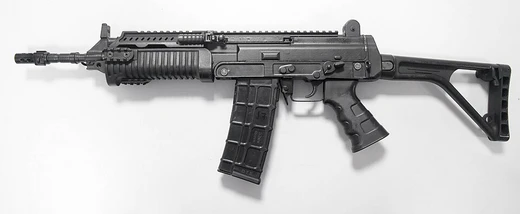
CETME rifle
Spanish battle rifle that became the basis for the Heckler & Koch G3.

Shotgun · CC BY-SA 3.0
The CETME Model 58 is a battle rifle made from stamped steel, capable of selective fire, and produced by the Spanish company Centro de Estudios Técnicos de Materiales Especiales (CETME). It fed from a 20-round box magazine and was eventually chambered for the 7.62×51mm NATO round, though it was initially designed for the 7.92×41mm CETME cartridge and later used a reduced-power Spanish 7.62×51mm cartridge. This rifle served as the basis for the widely adopted German Heckler & Koch G3 battle rifle. Civilian semi-automatic versions were also made.
The CETME rifle was chiefly designed by German engineer Ludwig Vorgrimler, who built on the experimental German StG 45(M) and the French AME 49. The StG45 used a roller-delayed blowback system, which differed from the roller-locking system patented by Edward Stecke in 1930s Poland and used in the MG 42. Unlike the MG 42’s fully locking system that required a short-stroke barrel moving backward to unlock, the StG45(M) never fully locked and did not need a moving barrel. The CETME kept the StG45(M)’s fixed barrel but introduced a fluted chamber—horizontal grooves that let cartridge cases float on a layer of gas for easier extraction. This left horizontal marks on spent cases, a signature of the design.
Original requirements called for a rifle weighing no more than 4.1 kg, with an effective range of 1,000 meters and a large magazine capacity. To meet these goals, CETME engineers developed an unconventional projectile. The 7.92×41mm CETME, CA-001 cartridge, unveiled in 1953, used a lightweight, elongated bullet for aerodynamics at normal rifle velocities. The rounds weighed 6.8 grams and had a muzzle velocity of 800 m/s. To stabilize the long projectile, the aluminum core was wrapped in a copper jacket open at both ends, leaving the core exposed at the tips; the core’s middle was compressed so the jacket fit flush. Though such a light bullet would normally be affected by crosswinds, CETME claimed its aerodynamic shape minimized this. Sources from the time said that at 1,000 meters, the bullet’s dispersion matched that of normal rifle projectiles, and it could perforate Spanish, Russian, Italian, Czech, and German helmets. It behaved like a standard full metal jacket bullet, and its lightness reduced recoil impulse, a key goal for controlling automatic fire.
Quick Facts
- Origin
- Spain
- Is Ranged
- Yes
- Service
- 1961–present
- Wars
- Ifni War / Basque conflict / Algerian War / Congo Crisis / Nigerian Civil War / Zemla Intifada / Sahrawi insurgency / Western Sahara War / Lebanese Civil War
- Designer
- Ludwig Vorgrimler
- Design Date
- 1948–1950
- Manufacturer
- Centro de Estudios Técnicos de Materiales Especiales (CETME)
- Production Date
- 1950–1983
- Weight
- 9.9 lb
- Length
- 40 in
- Part Length
- 17.7 in
- Cartridge
- 7.92×41mm CETME (Model A) / 7.62×51mm CETME (early Model B) / 7.62×51mm NATO (other models)
Facts from the source article.
Lore & Background
The CETME rifle was designed primarily by German engineer Ludwig Vorgrimler, who based his design on the experimental German StG 45(M) and the French-made AME 49. The StG45 used a roller-delayed blowback mechanism somewhat similar to the roller-locking system patented by Edward Stecke in the 1930s in Poland and used in the MG 42. The CETME design inherits the StG45(M)'s fixed barrel, but introduced a fluted chamber—horizontal grooves in the chamber—that allows cartridge cases to float on a layer of gas to aid extraction, leaving a horizontal marking on spent cases as a signature of the design.
The original design requirements specified a weight of no more than 4.1 kg, an effective range of 1,000 metres, and a large magazine capacity. The 7.92×41mm CETME cartridge was developed and unveiled in 1953, using a lightweight, elongated projectile with an aluminium core wrapped in a copper jacket open at both ends. Later, the Bundesgrenzschutz requested the cartridge diameter be reduced to 7.62mm while using the same 41mm case, resulting in the 7.62×41mm CETME round. The Bundesgrenzschutz later required rechambering for the 7.62×51mm NATO cartridge, leading to the Modelo B. The Spanish Army adopted the CETME B as the Fusil de Asalto CETME Modelo 1958 de 7,62mm in September 1957, with production beginning in 1961.
Reader's Guide
The CETME Model 58 is notable as the direct predecessor of the Heckler & Koch G3, one of the most widely deployed battle rifles of the Cold War. Its roller-delayed blowback mechanism, inherited from the StG 45(M), proved adaptable to different cartridges and was later used in numerous H&K designs. The rifle underwent extensive development from the original 7.92×41mm cartridge through the 7.62×41mm CETME to the final 7.62×51mm NATO chambering, driven by West German requirements. The fluted chamber, a novel solution to extraction problems, became a hallmark of the system. The CETME was produced in four main models—A, B, C, and E—with the Model C becoming the Spanish standard rifle by 1964. A downsized variant, the CETME Model L, was later chambered for 5.56×45mm NATO and served until replaced by the H&K G36 in 1999. Civilian semi-automatic versions were imported into the USA by the Mars Equipment Corporation in the 1960s.
Did You Know?
- The CETME rifle was designed primarily by German engineer Ludwig Vorgrimler, based on the experimental StG 45(M).
- The fluted chamber leaves horizontal markings on spent cartridge cases, a signature of the design.
- The original 7.92×41mm CETME cartridge used a lightweight bullet with an aluminium core wrapped in a copper jacket open at both ends.
- The CETME Model A fired from the closed bolt in semi-automatic and from the open bolt in full-auto mode.
Development & Service History
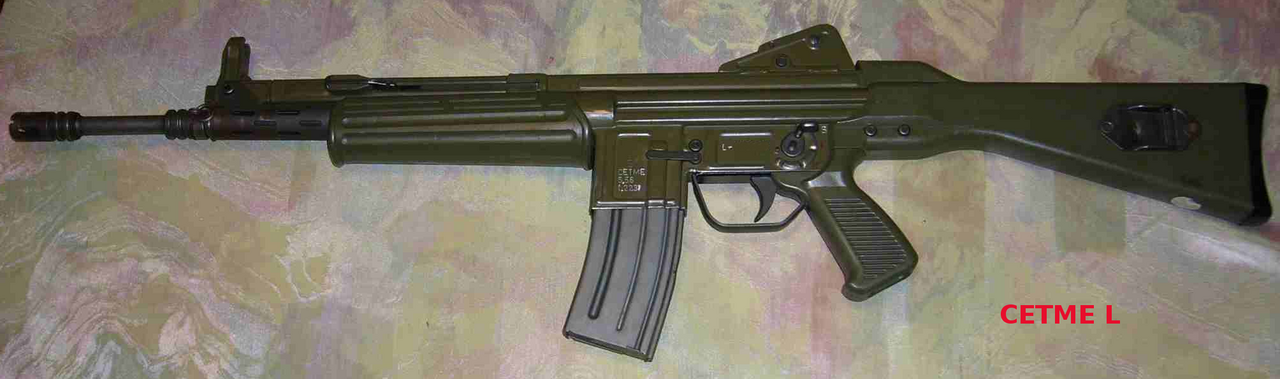
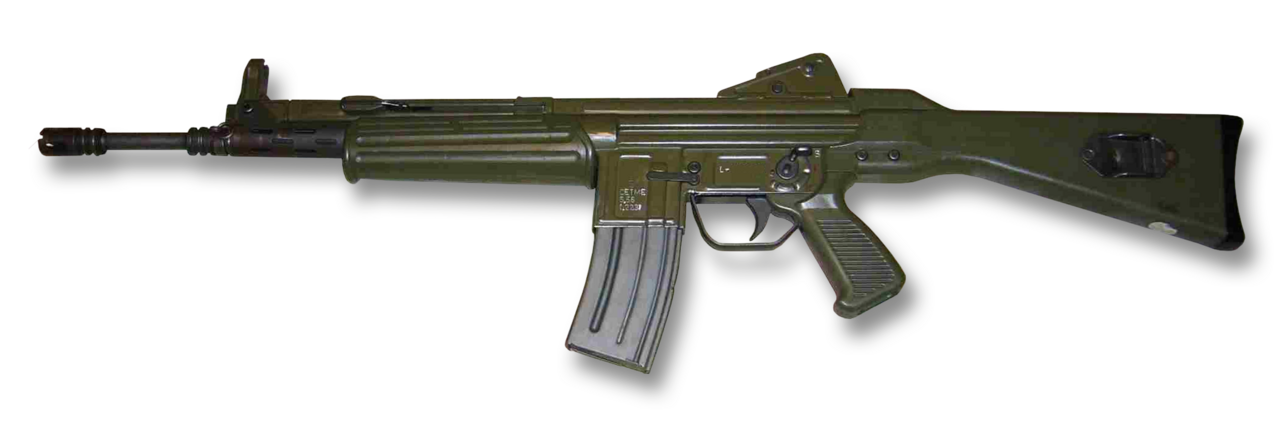
The CETME Model L emerged from the state-owned Centro de Estudios Técnicos de Materiales Especiales in Madrid during the late 1970s, representing Spain's transition from the 7.62mm Model C to the NATO-standard 5.56×45mm cartridge. The design deliberately carried forward proven engineering principles from the institute's earlier Model 58 battle rifles, ensuring continuity in a platform Spanish forces already trusted. After successful field trials spanning 1981 and 1982, the weapon received approval for serial production in 1984 at the Empresa Nacional Santa Bárbara facility, which today operates under the General Dynamics European Land Combat Systems umbrella. The first rifles reached Spanish Army units in 1987, at which point roughly 60,000 had already been ordered. The Model L served as Spain's standard-issue assault rifle for over a decade, but from 1999 onward it was progressively phased out in favor of a license-built Heckler & Koch G36E variant, marking the end of an era for domestically developed small arms.
Roller-Delayed Blowback Mechanism
At the heart of the Model L lies a roller-delayed blowback system that distinguishes it from the gas-operated rifles dominating NATO arsenals. The bolt assembly is a semi-rigid two-piece construction, pairing a bolt head with a supporting angular locking piece. Two cylindrical rollers housed within the bolt head are cammed inward against the inclined flanks of the barrel extension during the unlocking phase. This action drives the locking piece and bolt carrier rearward at a velocity exceeding that of the bolt itself, which stays sealed in the closed position until the fired projectile has fully exited the bore and internal pressures have dropped to a safe threshold. Only then does the bolt withdraw in concert with the carrier. The mechanism is hammer-fired, with a three-position fire control lever on the left side of the receiver offering Seguro (safe), Tiro a tiro (semi-automatic), and Ráfaga (full automatic). Early production rifles also included a burst selector option, though this was subsequently abandoned. The weapon fires from a closed bolt using the 62-grain SS109 projectile.
Reliability Struggles & the Magazine Problem
Perhaps no aspect of the Model L's service life generated more frustration than its feeding and ammunition ecosystem. The state-owned INI factory produced 5.56mm ammunition that ran dirtier and generated significantly higher chamber pressure than standard NATO loads, with hard primers contributing to the problem. At multinational exercises, allied units were routinely cautioned against chambering Spanish-made rounds in their gas-operated rifles. Compounding the issue, the issued steel magazines—despite being technically expendable at a cost of just 25 pesetas in 1995—suffered from thick-walled construction that caused misfeeds and instances where magazines could not even be inserted into the receiver. Soldiers were formally punished for losing a magazine, yet many quietly retained mags they trusted or scavenged surplus STANAG magazines from foreign sources. It became a well-known sight at NATO training grounds for Spanish troops combing the area where American units discarded their empty mags, a small but telling testament to how the rifle's reliability challenges were ultimately solved not by the manufacturer but by the soldiers themselves.
Variants, Sights & Configuration
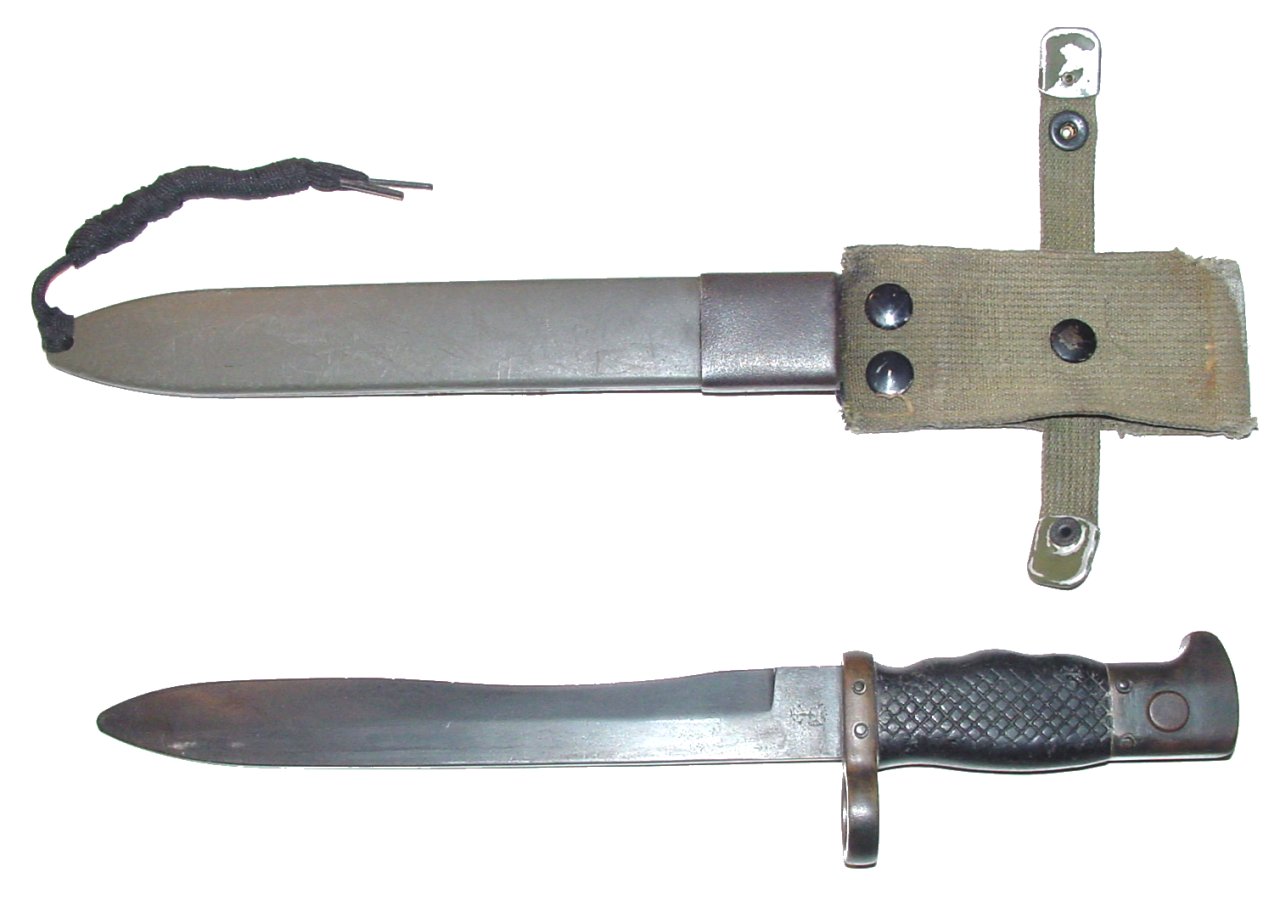
The Model L family expanded through several specialized variants and configuration changes. The Model LV (Visor) served as a marksman version, fitted with a fixed STANAG mount over the rear sight base and typically paired with a domestically produced four-power ENOSA scope; a starlight variant was also available. The Spanish Marines received an alternate LV equipped with a dovetail mount for the British SUSAT optic, alongside a removable flip rear sight. Iron sights on standard rifles consisted of a forward post in either a thick or thin profile—the thinner post favored for precision but vulnerable to bending—paired with a flip-up rear sight offering 200 and 400-meter settings, replacing an earlier rotating drum that provided 100 through 400-meter apertures. The barrel carries six right-hand grooves with a 1-in-178-mm twist and accepts a knife-type bayonet. Flash suppression evolved from an open three-prong design to a birdcage style, both compatible with rifle grenades. Handguards shifted from a heat-retaining square profile to a rounder half-length design in thicker plastic, though Guardia Civil rifles retained the original squared version.
Gallery
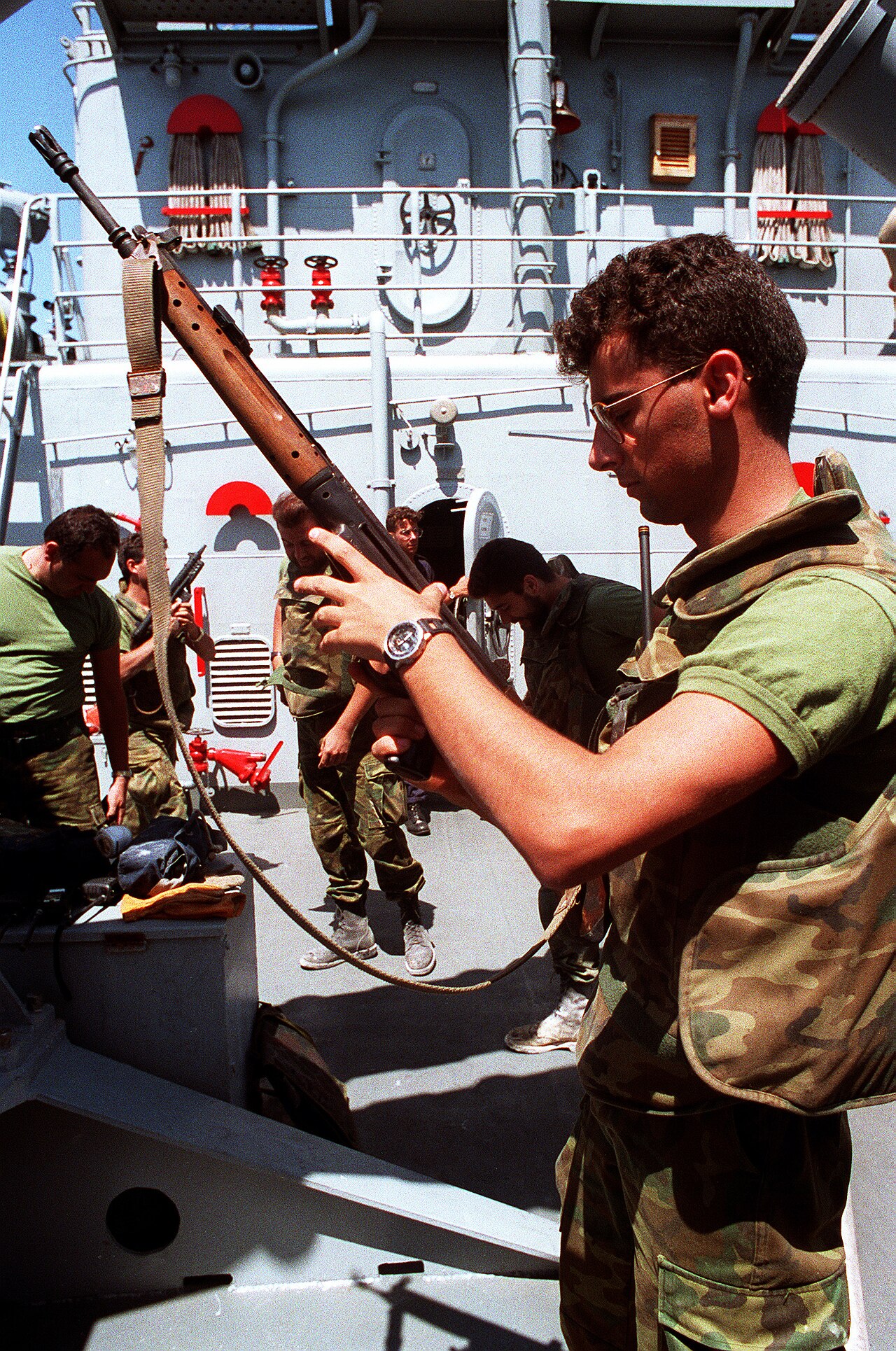
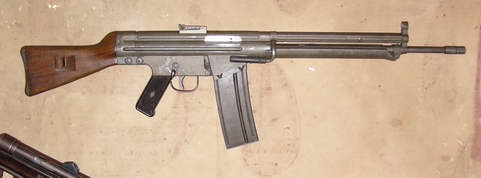
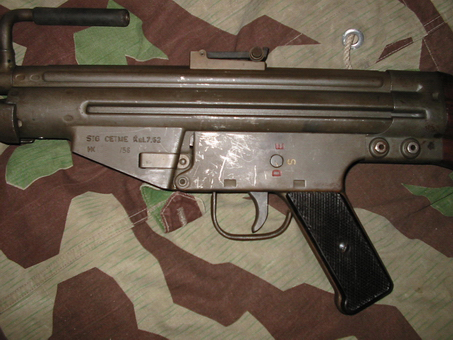
Frequently Asked Questions
Who is CETME rifle?
The CETME Model 58 is a Spanish battle rifle produced by the Centro de Estudios Técnicos de Materiales Especiales, with its core mechanism designed by German engineer Ludwig Vorgrimler. It is built from stamped steel and operates on a roller-delayed blowback principle.
What are CETME rifle's powers/role?
It delivers selective fire from a 20-round box magazine and was ultimately chambered for the 7.62×51mm NATO round after evolving from its original 7.92×41mm CETME cartridge. Its roller-delayed blowback action and sub-4.1-kg stamped-steel body made it a practical full-service rifle for infantry units.
Why is CETME rifle important?
It demonstrated that a roller-delayed blowback system could reliably cycle full-power 7.62×51mm NATO ammunition, a concept that spread to numerous nations through the G3. Its stamped-steel construction also proved that a selective-fire battle rifle could be produced at a lower cost than milled alternatives.
What cartridge does CETME rifle use?
The rifle was originally designed around the 7.92×41mm CETME round, then transitioned to a reduced-power 7.62×41mm CETME variant before settling on the 7.62×51mm NATO cartridge. This progression brought it into alignment with the broader NATO small-arms ammunition standard.
More in Battle Rifles and Carbines, Part 2 1-24
Spotted an error? Know more?
Reader corrections go straight into our review queue. Suggest an edit · How this site is sourced