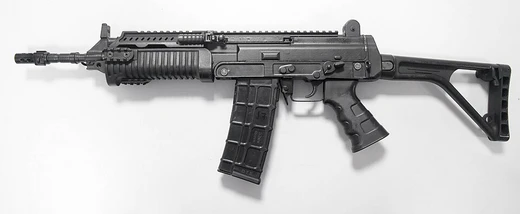
SIG SG 510
Export variant of the Swiss Stgw. 57 battle rifle.

The SIG SG 510 is a family of battle rifles that came from the Sturmgewehr 57 (Stgw. 57), a selective-fire assault rifle made by Schweizerische Industrie Gesellschaft (now SAN Swiss Arms) in Switzerland. The Stgw. 57 was the mechanical and design foundation for the export versions of the SG 510 line.
The Stgw. 57 uses a roller-delayed blowback system, similar to what is found in the Heckler & Koch G3 and CETME rifles. It was developed in the late 1950s under the in-house name AM 55 at SIG Combibloc Group, with Rudolf Amsler as the principal designer. The Swiss Army adopted it in 1957, designating it the F. ass. 57 7.5mm, Fucile d’Assalto 1957, and 7.5mm Stgw. 57. It replaced four weapons over its service life: the K31 rifle, the Suomi M-31/Mp. 43/Mp. 44 submachine gun, the Lmg 25 light machinegun, and, from 1974 to 1977, the Zf. Kar. 55 sniper’s rifle. After thirty-three years, from 1957 to 1990, the Swiss Army replaced the Stgw. 57 with the lighter SIG SG 550.
The rifle is built mostly from pressed sheet-metal for easier mass production and uses a straight-line recoil configuration. This layout keeps the center of gravity and shoulder stock nearly in line with the bore, reducing barrel climb and improving control during automatic fire. A distinctive T-shaped bolt handle, similar to the earlier K31, is present. The roller-delayed system has roller recesses and rollers that wear over time, reducing the bolt head-to-bolt carrier gap. Unlike many roller-delayed weapons that accept this as the end of service life, the Stgw. 57 has interchangeable locking recesses that can be replaced when worn.
The fixed buttstock is made of solid neoprene rubber, designed to be durable and to deform dynamically to handle recoil from heavy rifle grenades. A large carrying handle sits at the balance point for quick position changes or marching. The ribbed handguard is also molded from solid neoprene rubber.
The chamber is fluted and stepped, which is unusual. A stepped case expansion ring lets the brass obturate into the fluting, delaying extraction and creating a soft cycling action. This design differs from fluted chambers on other delayed-blowback firearms. The Stgw. 57 has four sets of two flutes that extend past the leade into the rifling, creating a slight bulge at the case shoulder.
Quick Facts
- Origin
- Switzerland
- Is Ranged
- yes
- Service
- 1957–present
- Wars
- The Troubles / For the SG 510-4: 1973 Chilean coup d'état / Armed conflict for control of the favelas
- Designer
- Rudolf Amsler
- Design Date
- 1950s
- Manufacturer
- Schweizerische Industrie Gesellschaft (SIG) / Waffenfabrik Bern / Swiss subcontractors
- Production Date
- 1957–1985
- Variants
- SG 510-1, SG 510-2, SG 510-3, SG 510-4, SG 510-5, SG 510-6, SG 510-7 T (SIG-AMT), PE-Stgw. 57
- Weight
- 5.70 kg (Stgw. 57) / 4.37 kg (SG 510-4)
- Length
- 1100 mm (Stgw. 57) / 1015 mm (SG 510-4)
- Part Length
- 609 mm (Stgw. 57) / 505 mm (SG 510-4)
Facts from the source article.
Lore & Background
The SG 510 family was developed from the Stgw. 57, which entered Swiss Army service in 1957 under three designations: F. ass. 57 7.5mm, Fucile d’Assalto 1957, and 7.5mm Stgw. 57. The Stgw. 57 was designed by Rudolf Amsler at SIG Combibloc Group during the late 1950s, with the in-house model name AM 55. It uses a roller-delayed blowback system similar to that of the Heckler & Koch G3 and CETME rifles. The weapon is constructed mainly from pressed sheet-metal components and features a straight-line recoil configuration to reduce barrel climb during automatic fire. The Stgw. 57 has a distinctive T-shaped bolt handle, a solid neoprene rubber butt-stock, a large carrying handle at the balance point, and a ribbed neoprene rubber handguard. Its stepped and fluted chamber is unusual, using a stepped case expansion ring that allows brass to obturate into the fluting, delaying extraction for a soft cycling operation. The barrel is surrounded by a perforated tubular aluminum jacket with an integrated underfolding bipod that can be positioned near the muzzle or nearer the receiver. The bipod legs are marked for use as an inclinometer for aiming rifle grenades. The trigger mechanism has a three-position fire selector (safe, semi-automatic, full-automatic) and a foldaway winter trigger on the right side for use with arctic mittens or for rifle grenade firing. The iron sights are elevated and foldable, with a rear peep sight adjustable from 100 to 640 m. For low-visibility use, a reversible clip-on diopter with tritium-powered inserts was issued, stored in the pistol grip cavity. The Stgw. 57 was issued as the personal weapon of every Swiss soldier, replacing the K31 rifle, the Suomi M-31/Mp. 43/Mp. 44 submachine gun, the Lmg 25 light machinegun, and the Zf. Kar. 55 sniper's rifle. After 33 years of service (1957–1990), it was replaced by the SIG SG 550.
Reader's Guide
The SG 510 family represents the export-oriented evolution of the Swiss Stgw. 57, a battle rifle that served as the standard infantry weapon of the Swiss Army for over three decades. Its roller-delayed blowback system, derived from earlier German and Spanish designs, proved reliable and accurate, with the Swiss Army reporting a 50% windage and elevation dispersion of 6 cm at 300 m from a machine rest. The rifle's stepped and fluted chamber was a distinctive innovation that softened cycling and reduced bolt bounce during automatic fire. The Stgw. 57's design emphasized durability and versatility: the neoprene rubber stock could deform to handle recoil from heavy rifle grenades, and the interchangeable locking recesses allowed the rifle's service life to be extended beyond that of typical roller-delayed weapons. The integrated bipod served dual purposes as a shooting support and an inclinometer for indirect rifle-grenade fire, a unique feature for a service rifle. The SG 510's legacy is tied to its Swiss origin and its role as the basis for export variants, though the Stgw. 57 itself was eventually replaced by the lighter SIG SG 550. The rifle's accuracy, robust construction, and innovative chamber design remain notable in the history of battle rifles.
Did You Know?
- The Stgw. 57 has interchangeable locking recesses, allowing the rifle's service life to be extended when the roller recesses wear down.
- The bipod legs are marked for use as an inclinometer to aim rifle grenades at various ranges, with a weighted string used as a plumb line.
More in Battle Rifles and Carbines, Part 2 1-24
Spotted an error? Know more?
Reader corrections go straight into our review queue. Suggest an edit · How this site is sourced