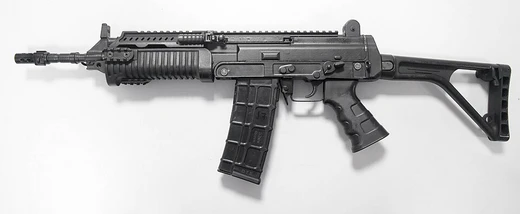
Mk 14 Enhanced Battle Rifle
Modernized M14 variant for special operations designated marksman use.

The Mk 14 Enhanced Battle Rifle (EBR) is an American military designated marksman rifle and a modernized tactical chassis-based variant of the select-fire M14 battle rifle chambered for the 7.62×51mm NATO cartridge. It was originally built for use with units of United States Special Operations Command, such as the United States Navy SEALs, Delta Force, and task specific Green Berets ODA teams.
Quick Facts
- Origin
- United States
- Is Ranged
- Yes
- Service
- 2002–present
- Wars
- War in Afghanistan (2001–2021) / Iraq War / Syrian Civil War / War in Iraq (2013–2017) · Russo-Ukrainian War
- Designer
- Mike Rock and Jim Ribordy (Original) / Smith Enterprise, Inc. (Current)
- Design Date
- 2001
- Manufacturer
- Naval Surface Warfare Center Crane Division / Smith Enterprise Inc. / Sage International
- Weight
- 11.24 lb (5.1 kg)
- Length
- 35 in (889 mm)
- Part Length
- 18 in (457 mm) (Mod 0, Mod 1) · 22 in (558.8 mm) (Mod 2, EBR-RI)
- Cartridge
- 7.62×51mm NATO
- Action
- Gas-operated, rotating bolt
Facts from the source article.
Lore & Background
Development began in 2000 with a request by the United States Navy SEALs for a more compact M14 battle rifle. A few prototype stocks were made that same year. In 2001, Mike Rock Rifle Barrels was the only barrel maker asked by United States Special Operations Command to participate in a SOPMOD conference to create what would become the Mk 14 MOD 0 EBR, which included a collapsible stock and an aluminum body with telescopic rails. Mike Rock collaborated with engineer Jim Ribordy to make the prototype. Tests showed that their rifle was effective, but had excessive noise. In 2003, Ron Smith and Smith Enterprise, Inc. created their own version (MK14 SEI) using a medium heavy weight 457 mm barrel, which was more widely favored and used as the basis for the Mk 14 MOD 0, with Springfield Armory, Inc. tasked to supply machinery in cooperation with the Naval Surface Warfare Center Crane Division.
The United States Navy SEALs were the first to be armed with the EBR in 2004, followed by the U.S. Coast Guard. The U.S. Army also uses the M14 EBR-RI, created and updated by the Weapons Product Support Integration Directorate of the TACOM Life Cycle Management Command at the Keith L. Ware Test Facility in Rock Island Arsenal, Illinois; approximately 5,000 units had been fielded by mid-2010. The rifle upgrades the standard M14 action and replaces the standard 22.0 in barrel with an 18.0 in barrel bolted onto a telescoping chassis stock system with a pistol grip, a different front sight, Harris bipod, four Picatinny accessory rails, and a more effective flash hider. A paddle-type bolt stop similar to that of the M4 carbine is used. The EBR chassis system stock is made entirely of lightweight aircraft alloy. The Mk 14 has been criticised for being too heavy, at 14 lb when loaded, with most of this weight at the front, making it difficult to aim.
Reader's Guide
The Mk 14 Enhanced Battle Rifle represents a significant evolution of the M14 platform for modern designated marksman roles within U.S. special operations forces. Its development, initiated by Navy SEAL requirements in 2000, led to a collaborative effort involving multiple contractors and the Naval Surface Warfare Center Crane Division. The rifle's adoption by the Navy SEALs in 2004, followed by the Coast Guard and Army, demonstrates its perceived value in providing accurate 7.62×51mm firepower in a more compact, rail-equipped package. However, its weight—14 lb loaded—and front-heavy balance drew criticism, and by 2017 the Army began seeking a lighter SDM rifle, eventually selecting a version of the HK G28 in 2018. Despite this, the Mk 14 EBR saw extensive use in Iraq and Afghanistan, and its chassis system influenced civilian clones and variants such as the M39 Enhanced Marksman Rifle used by the Marine Corps. The rifle's legacy includes its role in equipping elite units and its adaptation by other nations and non-state actors.
Did You Know?
- The Mk 14 EBR was originally requested by the U.S. Navy SEALs in 2000 for a more compact M14.
- Smith Enterprise, Inc. created the MK14 SEI variant in 2003, which became the basis for the Mk 14 MOD 0.
- The rifle weighs 14 lb when loaded with a 20-round magazine, with most weight at the front.
- The U.S. Army fielded approximately 5,000 M14 EBR-RI units by mid-2010.
More in Battle Rifles and Carbines, Part 2 1-24
Spotted an error? Know more?
Reader corrections go straight into our review queue. Suggest an edit · How this site is sourced