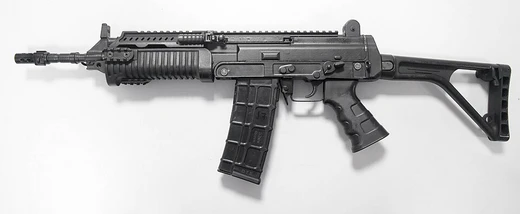
M14 rifle
American battle rifle adopted in 1957, still in limited service.

The M14 is an American battle rifle that fires the 7.62×51mm NATO round. It became the standard service rifle for the U.S. armed forces in 1957, with manufacturing beginning two years later, and it took over from the M1 Garand. Though the M16 assault rifle—lighter and chambered for the smaller 5.56×45mm cartridge—officially replaced it as the primary service weapon in 1967, the M14 was still used for basic and advanced training by the Army, Navy, and Marine Corps from the mid-1960s into the early 1970s. Today, the M14 sees limited duty across all military branches, with specialized versions serving as sniper rifles, designated marksman weapons, accurized competition arms, and ceremonial pieces for honor guards, color guards, drill teams, and ceremonial guards. Civilian semi-automatic models are used for hunting, target shooting, and competitions. The M14 also formed the basis for the M21 and M25 sniper rifles, which were later succeeded by the M24 Sniper Weapon System. A newer variant, the Mk 14 Enhanced Battle Rifle, has been in very limited service since 2002.
The rifle’s development grew out of a long line of experimental weapons based on the M1 Garand. While the M1 was one of the most advanced infantry rifles of the late 1930s, it had flaws, and modifications were considered during the final months of World War II. These changes included adding fully automatic fire and swapping the eight-round en bloc clip for a 20-round detachable box magazine. Winchester, Remington, and John Garand at Springfield Armory each offered their own conversions. Garand’s design, the T20, proved the most popular, and its prototypes served as the foundation for several Springfield test rifles from 1945 into the early 1950s.
In 1945, Earle Harvey at Springfield Armory designed a completely different rifle, the T25, for the new T65 .30 light rifle cartridge (7.62×49mm). This was done at the direction of Col. Rene Studler, then stationed at the Pentagon. Harvey and Studler were transferred to Springfield Armory later that year to continue developing the T25. The T25 was built around the T65 service cartridge, a Frankford Arsenal design based on the .30-06 round used in the M1 but shortened to the length of the .300 Savage.
Quick Facts
- Service
- 1957–present · 1957–1964 (as the standard U.S. service rifle)
- Number
- 1.3 million
- Length
- 44.3 in (1,126 mm)
- Action
- Gas-operated, rotating bolt
- Origin
- United States
- Is Ranged
- Yes
- Design Date
- 1954
- Manufacturer
- Springfield Armory · Winchester · Harrington & Richardson · Thompson-Ramo-Wooldridge, Inc.
- Production Date
- 1957–1980
- Weight
- 9.2 lb empty · 10.7 lb with loaded magazine
- Part Length
- 22 in (559 mm)
Facts from the source article.
Lore & Background
The M14's development stemmed from experimental weapons based on the M1 Garand, including John Garand's T20 design. Earle Harvey of Springfield Armory designed the T25 for the T65 .30 light rifle cartridge, which evolved into the T47. The T44 prototype, a conventional design with refinements by Lloyd Corbett, was tested against the T47 and the T48 (a variant of the FN FAL) in service rifle trials at Fort Benning. The T44 was selected due to lower weight, simplicity, its self-compensating gas system, and the belief it could be manufactured on existing M1 machinery. Production contracts were awarded to Springfield Armory, Winchester, Harrington & Richardson, and later Thompson-Ramo-Wooldridge Inc. (TRW). The M14 was intended to replace four weapons—the M1 Garand, M3 submachine gun, M1 carbine, and M1918 Browning automatic rifle—but this proved impossible. A September 1962 report by the U.S. Department of Defense comptroller deemed the M14 'completely inferior' to the M1 Garand. The rifle was unwieldy in Vietnam's thick brush due to its length and weight, and traditional wood stocks tended to swell and expand in the humidity.
Reader's Guide
The M14's significance lies in its role as the last American battle rifle before the shift to smaller-caliber assault rifles. Though it served only briefly as the primary infantry weapon, it was used for Basic and Advanced Individual Training from the mid-1960s to the early 1970s. Its legacy endures through specialized variants: the M21 and M25 sniper rifles (later replaced by the M24 Sniper Weapon System), the Mk 14 Enhanced Battle Rifle (in very limited service since 2002), and National Match rifles produced for competition. Civilian semi-automatic versions are used for hunting, target shooting, and competitions. The M14 also remains in ceremonial roles with honor guards, color guards, drill teams, and ceremonial guards. Despite its shortcomings, the M14's longevity in limited roles demonstrates its adaptability and the enduring utility of the 7.62×51mm cartridge in precision and support applications.
Did You Know?
- National Match M14 rifles were produced by Springfield Armory, Rock Island Arsenal, and TRW from 1962 to 1967, totaling 11,130 rifles.
- The T44 prototype was selected over the T48/FAL due to lower weight, simplicity, and its self-compensating gas system.
More in Battle Rifles and Carbines, Part 2 1-24
Spotted an error? Know more?
Reader corrections go straight into our review queue. Suggest an edit · How this site is sourced