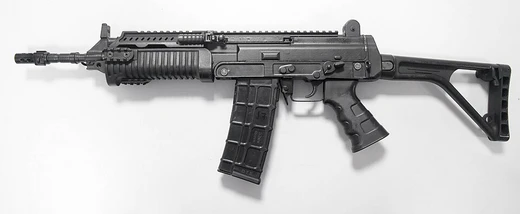
IWI Tavor 7
Bullpup battle rifle in 7.62×51mm NATO with ambidextrous controls.

The IWI Tavor 7 is a bullpup battle rifle from Israel Weapon Industries (IWI), part of the Tavor family and chambered in 7.62×51mm NATO. It is fully ambidextrous. Unlike earlier Tavor rifles, which used a long-stroke gas piston system derived from Kalashnikov designs (including the Galil), the Tavor 7 employs a short-stroke gas piston. This reduces recoil by cycling less mass per shot. A four-position gas regulator offers settings for regular (R), adverse/extreme (A), suppressed (S), and off/closed for special operations. The barrel is hammer-forged, chrome-lined, and free-floating, with four right-hand grooves and a 1:12" twist. It feeds from SR-25 pattern magazines.
The rifle’s external appearance closely resembles the original Tavor TAR-21, while its controls mirror the Tavor X95. The magazine release and charging handle are positioned nearly identically to the X95; the bolt release matches the previous two rifles. The selector switch is similar, but the semi-auto position is at a 45-degree angle rather than 90 degrees. The removable handguard includes integrated Picatinny rails at the 6 and 12 o’clock positions and M-LOK slots at 3 and 9 o’clock for attaching accessories or Picatinny rail sections. A removable rail cover protects the 6 o’clock rail when unused. The main receiver has a Picatinny rail across the top.
Ejection can be reversed by pulling the brass deflector open to the opposite side of the port, rotating it 180 degrees, then closing it on the other side. The bolt must also be rotated 180 degrees, and the cam pin flipped to the opposite side (marked R or L). The non-reciprocating charging handle is reversible as well. It can be held in the rear position—similar to an HK MP5—and “slapped” down to release.
Variants allow swapping the pistol grip for the standard Tavor Talon trigger guard, a traditional trigger guard, or any compatible third-party accessory. The base Tavor 7 has a 432 mm (17 in) barrel and 730 mm (28.7 in) overall length. A variant with a 508 mm (20 in) barrel and 806 mm (31.7 in) overall length likely serves as a designated marksman rifle, though it has no separate designation. For the U.S. civilian market, IWI US sells only semi-automatic versions. The T7B16 has a 16.5 in (419 mm) barrel and 26.75 in (679.5 mm) overall length.
Quick Facts
- Designer
- Israel Weapon Industries
- Length
- 730 mm / 806 mm
- Action
- Short-stroke gas-operated, rotating bolt
- Origin
- Israel
- Is Ranged
- Yes
- Design Date
- 2013–2017
- Weight
- 4.1 kg (unloaded)
- Cartridge
- 7.62×51mm NATO
- Feed
- SR-25 pattern magazines / (7.62×51mm NATO)
- Sights
- Meprolight MOR with integrated laser and IR pointer, Trijicon ACOG, Meprolight M5 and other optical sights
- Rate
- 600-900 rounds/min
Facts from the source article.
Lore & Background
The Tavor 7 uses a short-stroke gas piston system, differing from the long-stroke system used in earlier Tavor rifles and the Galil. This design reduces recoil by cycling less mass with each shot. It features a gas regulator with four positions: regular (R), adverse/extreme (A), suppressed/suppressor (S), and off/closed, intended for special operations. The barrel is hammer-forged, chrome-lined, and free-floating, with four right-hand grooves and a 1:12" right-hand rifling twist. The rifle feeds from SR-25 pattern magazines.
The handguard is removable and comes with integrated Picatinny rails at the 6 and 12 o'clock positions, plus M-LOK slots at the 3 and 9 o'clock positions for attaching compatible devices, including Picatinny rail sections. A removable rail cover covers the 6 o'clock rail when not in use. The main receiver has a Picatinny rail across the top. Ejection can be reversed by pulling the brass deflector open, turning it 180 degrees, and closing it on the opposite side; the bolt must then be rotated 180 degrees and the cam pin flipped to the opposite side (indicated by an R or L). The non-reciprocating charging handle is reversible and can be held in the rear position like an HK MP5, or slapped down to release.
The Tavor 7 comes with the option of changing the pistol grip to either the standard Tavor Talon trigger guard, a traditional trigger guard, or any compatible third-party accessory. Variants include the base model with a 432 mm barrel, a 20-inch barrel variant (likely a designated marksman rifle, though not separately designated), and the T7B16 with a 16.5-inch barrel sold on the U.S. civilian market in semi-automatic only. IWI US offers Tavor 7s in Black (B), Flat Dark Earth (FD), and OD Green (G), with the color letter replacing 'B' in the designation.
Reader's Guide
The Tavor 7 represents a significant evolution within the Tavor rifle family, adapting the bullpup configuration to the full-power 7.62×51mm NATO cartridge while maintaining the ambidextrous design that characterizes the series. Its shift to a short-stroke gas piston system marks a departure from the long-stroke system used in earlier Tavor rifles and the Galil, intended to reduce felt recoil. The inclusion of a four-position gas regulator provides adaptability for suppressed use and adverse conditions, a feature aimed at special operations. The rifle's compatibility with SR-25 pattern magazines and its reversible ejection and charging handle underscore its design for left- and right-handed shooters alike. On the U.S. civilian market, the Tavor 7 is offered only in semi-automatic, with barrel length options including a 16.5-inch variant. The availability of multiple color options and interchangeable pistol grips allows for some user customization. The 20-inch barrel variant, while not separately designated, suggests a role as a designated marksman rifle. Overall, the Tavor 7 extends the Tavor platform into the battle rifle category, retaining the compact bullpup layout while chambering a larger cartridge.
Did You Know?
- The Tavor 7 uses a short-stroke gas piston system, unlike the long-stroke system of earlier Tavor rifles.
- Its gas regulator has four positions: regular, adverse/extreme, suppressed, and off/closed.
- The ejection can be reversed by rotating the brass deflector and bolt 180 degrees and flipping the cam pin.
- The Tavor 7 feeds from SR-25 pattern magazines.
More in Battle Rifles and Carbines, Part 2 1-24
Spotted an error? Know more?
Reader corrections go straight into our review queue. Suggest an edit · How this site is sourced