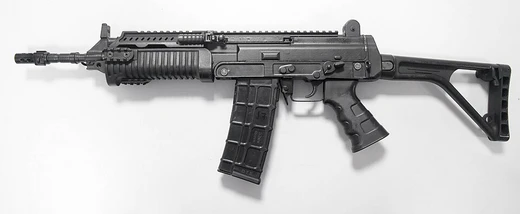
Howa Type 64
Japanese battle rifle used by JSDF and Coast Guard.

The Howa Type 64 is a battle rifle used only by Japan’s Self-Defense Forces and Coast Guard. It is gas-operated, can fire semi- or fully automatically, and uses a detachable 20-round box magazine for 7.62×51mm NATO ammunition. Japan’s strict anti-export laws have kept it from ever being sold abroad. Although the more advanced Howa Type 89 began replacing it in 1989–1990, the Type 64 remains in service across all branches of the Self-Defense Forces and the Coast Guard. A small number of marksman versions have also been issued to the Special Armed Police unit.
About a decade after the Self-Defense Forces were created, the Defense Agency decided to develop a homegrown main battle rifle to replace the American-supplied M1 Garands. Howa Heavy Industries handled development, and large-scale production started in 1964 under General Kenzo Iwashita, who also helped design the rifle. Official trademark rights were granted to Howa in 1964, with the rights finalized in 1966. Production ended in 1988, and the patent trademark expired in 2020.
In tests against the M14, the Type 64 proved more accurate in practical use, likely because its special reduced-powder 7.62mm ammunition lowered both rate of fire and recoil. Still, the rifle has faced consistent problems due to its overcomplicated construction, and it suffers from an undeserved reputation for shedding parts and being unreliable in the field.
The JSDF adopted the Type 64 in 1964. Some were given to the Special Armed Police for use as designated marksman rifles when those units were first formed.
In January 2007, the JGSDF’s Ōita Prefecture garrison lost track of 30 Type 64 rifles. A massive search involving 95,000 soldiers on January 24 failed to account for them.
During development, the Defense Agency researched which rifle should replace the M1 Garand. Howa built several prototypes: the R1 and R2, based on the Armalite AR-10, and the R3, based on the M14 with a curved magazine. Feedback led to the R63E prototype, which became the basis for the Type 64.
The Type 64 uses a linear hammer. Its selector switch is famously labeled in Japanese: ア (safe), タ (semi), and レ (auto), which together spell アタレ—meaning “hit the target.” The stock has a hinged buttplate to improve accuracy during full-auto fire.
Quick Facts
- Origin
- Japan
- Is Ranged
- yes
- Service
- 1964–present
- Used By
- Japan Self-Defense Forces / Japan Coast Guard / Special Assault Team
- Designer
- Iwashita Kenzō · 岩下 賢蔵 / Dōgane Giichi · 銅金 義一
- Unit Cost
- ¥188,000 (In 1985)
- Manufacturer
- Howa
- Production Date
- 1964–1988
- Number
- 230,000
- Weight
- 4.4 kg
- Length
- 990 mm
- Part Length
- 450 mm
Facts from the source article.
Lore & Background
Roughly a decade after the creation of the Japan Self-Defense Forces, the Defense Agency decided to produce a domestically designed and manufactured main battle rifle to replace the M1 Garand rifles supplied by the United States. Howa Heavy Industries developed prototypes including the R1, R2 (based on the AR-10), and R3 (based on the M14), with the R63E serving as the basis for the Type 64. Production began in 1964 and was completed in 1988. The rifle was never exported due to Japan's strict anti-hardware export laws.
The Type 64 fires from a linear hammer and features a distinctive selector switch labeled ア (safe), タ (semi), and レ (auto), which together spell アタレ (Atare), meaning 'Hit the target' in Japanese. The stock has a hinged buttplate to improve full-auto accuracy, and an external gas regulator controls cyclic rate. The rifle was designed around a specialized reduced-powder 7.62×51mm cartridge (approximately 10% less powder) to reduce recoil and muzzle climb for the Japanese physique, though the gas regulator can accommodate standard NATO ammunition. Using full-power ammunition causes substantially accelerated wear and tear. The bolt hold-open feature causes the bolt to slam forward when an empty magazine is removed, similar to the Zastava M70.
Reader's Guide
The Howa Type 64 served as the primary battle rifle of the Japan Self-Defense Forces and Coast Guard for decades, being superseded by the Howa Type 89 from 1989 to 1990 but remaining in service with all branches. It was found superior in practical accuracy to the M14 during testing, attributed to its lower rate of fire and reduced recoil from the special ammunition. However, the rifle has had consistent problems due to its reportedly overcomplicated construction and suffers from a false reputation for shedding parts and overall unreliability. A designated marksman variant exists, fitted with a 2.2× magnification scope (either a surplus M84 or a Nikon replica), but accuracy complaints stem from a poorly conceived single-screw attachment system that causes the scope to go askew; a cloth shim is often used to correct this, though it obscures iron sights. The marksman version was phased out in front-line JGSDF units with the adoption of the M24 Sniper Weapon System in 2002. A small number of Type 64 marksman rifles were used by the Special Armed Police unit. In 2007, the JGSDF's Ōita Prefecture garrison conducted a massive search involving 95,000 soldiers for 30 lost Type 64 rifles.
Did You Know?
- The selector switch labels spell 'Atare', meaning 'Hit the target' in Japanese.
- The Type 64 uses a reduced-powder 7.62×51mm cartridge to suit the Japanese physique.
- The bolt slams forward when an empty magazine is removed, lacking a proper bolt hold-open device.
- A 2007 search involving 95,000 soldiers failed to account for 30 lost Type 64 rifles.
Frequently Asked Questions
What is the Howa Type 64?
It is a gas-operated, selective-fire battle rifle adopted by Japan in 1964 and built by Howa Heavy Industries. It has served as the standard-issue rifle for the Self-Defense Forces and the Coast Guard ever since.
What caliber and magazine does the Howa Type 64 use?
The rifle fires the 7.62×51mm NATO round and is fed by a detachable 20-round box magazine.
Why has the Howa Type 64 never been exported?
Japan's strict anti-export laws have barred any foreign sale of the weapon. As a result, despite being a NATO-caliber battle rifle, it has remained a domestic-only service arm.
Is the Howa Type 64 still in service after the Type 89 arrived?
Yes. Although the Howa Type 89 began replacing it around 1989–1990, the Type 64 continues to be issued across all branches of the Self-Defense Forces as well as the Coast Guard.
Does the Howa Type 64 have any special-purpose variants?
A small number of marksman-configured rifles have been issued to Japan's Special Armed Police unit. Beyond that niche role, the standard issue remains the semi- and full-auto battle rifle with its 20-round magazine.
More in Battle Rifles and Carbines, Part 2 1-24
Spotted an error? Know more?
Reader corrections go straight into our review queue. Suggest an edit · How this site is sourced