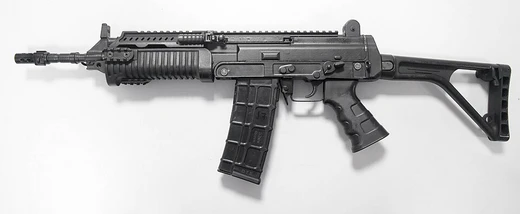
Dragunov SVU
A Russian bullpup designated marksman rifle derived from the SVD.

The Dragunov SVU (OTs-03 SVU) is a bullpup designated marksman rifle developed for the security forces of the Russian Ministry of Internal Affairs, such as OMON. It was first seen in use during the First Chechen War, and was created by completely altering the configuration of the aging SVD rather than simply modernizing it.
Quick Facts
- Origin
- Russia
- Is Ranged
- Yes
- Service
- 1994–present
- Designer
- KBP Instrument Design Bureau
- Design Date
- 1990
- Variants
- OTs-03A (SVU-A)
- Weight
- 3.6 kg (unloaded without scope)
- Length
- 87 cm
- Part Length
- 52 cm (4 grooves, 1 in 245 mm right-hand twist)
- Cartridge
- 7.62×54mmR
- Action
- Gas-operated, three-lug rotating bolt
- Rate
- 650 rpm (SVU-AS)
Facts from the source article.
Lore & Background
The SVU was developed to meet the needs of the security forces of the Russian Ministry of Internal Affairs, such as OMON. Originally, the plan was to slightly modernize the aging SVD, but the designers eventually realized that the configuration of the weapon would have to be completely altered, leading to the creation of the SVU. The rifle was first seen in use in the First Chechen War. A special muzzle brake was added that could absorb up to 40% of the recoil energy, and an elastic butt stock with lamellar spring was non-rigidly attached to the receiver. The acoustics were improved by adding a sound suppressor. Other main improvements over the SVD include replacement of the butt stock, pistol grip, trigger, and the mounting for the sight; shortening the barrel by 100 mm afforded the weapon perfect balance. Around 1991, the Russians developed the OTs-03A (SVU-A), a fully automatic variant. In the SVU-A, the center of gravity was moved forward by the addition of a forward extended bipod mounted on the receiver. Developing 20- and 30-round box magazines increased capacity for effective use in full automatic mode, and better optics were incorporated. Though it has folding iron sights, the SVU is almost always used with the PSO-1 scope with illuminated reticle, which features rangefinders in the lower left, chevrons for bullet drop compensation in the middle, and stadia marks for windage to the left and right of the center reticule; the reticle is illuminated by radioactive tritium. The SVU also comes with an adjustable bipod, an integral flash hider and muzzle brake, and a bayonet may be fitted under the forestock.
Reader's Guide
The Dragunov SVU represents a significant adaptation of the SVD platform into a compact bullpup configuration for specialized internal security roles. Its development for the Russian Ministry of Internal Affairs, particularly OMON, highlights its intended use in close-quarters and urban environments where a shorter overall length is advantageous. The addition of a muzzle brake absorbing up to 40% of recoil energy, a sound suppressor, and an elastic butt stock with lamellar spring non-rigidly attached to the receiver improved controllability and reduced noise. The SVU-A variant introduced selective-fire capability, with a forward-extended bipod and larger magazines to manage full-automatic fire. The rifle's use of the PSO-1 scope with tritium-illuminated reticle and its ability to mount other Russian scopes maintained its marksman role. The SVU was first seen in the First Chechen War, and its users include the Russian Ministry of Internal Affairs, with some imported prior to the ousting of the Saleh government. Its legacy is as a specialized bullpup derivative of the SVD, tailored for Russian security forces rather than general military service.
Did You Know?
- The SVU's barrel was shortened by 100 mm compared to the SVD, giving the weapon perfect balance.
- The SVU-A variant is capable of fully automatic fire, unlike the semi-automatic SVU.
- The PSO-1 scope's reticle is illuminated by radioactive tritium rather than a battery-powered lamp.
- A special muzzle brake on the SVU can absorb up to 40% of the recoil energy.
More in Battle Rifles and Carbines, Part 2 1-24
Spotted an error? Know more?
Reader corrections go straight into our review queue. Suggest an edit · How this site is sourced