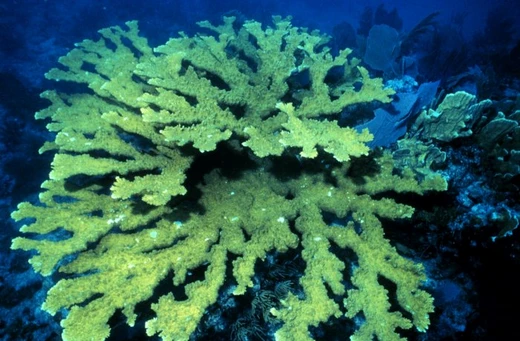
Elkhorn coral
A fast-growing Caribbean reef-builder with antler-like branches.

Elkhorn coral (Acropora palmata) is a key builder of Caribbean reefs. Its branching form, which looks like elk antlers, gives the coral its name. This structure provides homes and hiding spots for many other reef creatures. The coral grows fast, adding about 5 to 10 centimeters (2 to 4 inches) each year. It can reproduce in two ways—sexually and asexually—but asexual reproduction is far more common, happening when pieces break off and form new colonies.
The coral’s hard, antler-like branches are made of calcium carbonate and can reach over 2 meters (6 feet) tall and 13 meters (43 feet) wide, with a dull brownish-yellow color. Most of its food comes from tiny algae called zooxanthellae that live inside its cells. These algae use sunlight to make sugars and oxygen, which the coral uses to grow quickly. Because of this, Elkhorn coral depends on clear, sunlit water. When water is murky or during bleaching events, it can switch to filter feeding at night, using its tentacles to catch zooplankton that rise from the depths after dark. This method takes more energy, so it’s only used when sunlight is blocked.
Elkhorn coral lives in shallow water, usually 1 to 5 meters deep, where light is plentiful. It thrives in clear, turbulent areas with frequent wave action, which helps break off fragments and spread new colonies. These corals are found from the Bahamas and Florida through the Caribbean to northern Venezuela, with the northernmost population off Broward County, Florida.
Over the past 5,000 years, Elkhorn coral, along with staghorn and star corals, formed the backbone of southeastern Caribbean reefs. It evolved during the Mid-Pliocene epoch, about 5.2 to 2.58 million years ago, and adapted to the unstable climate of glacial and interglacial periods. Rising seas during glacial times increased wave energy, which helped the coral reproduce.
Elkhorn coral provides important ecosystem services. Its lattice-like branches create varied habitats that support fish nurseries and protect fish from predators, boosting reef diversity and attracting tourists. The thick branches also absorb storm wave energy, reducing damage to beaches and coastal properties.
Colonies can live for centuries, growing 5 to 10 centimeters each year and reaching full size in 10 to 12 years.
Quick Facts
- Taxon
- Acropora palmata
Facts from the source article.
Lore & Background
Elkhorn coral produce hard antler-like structures composed of calcium carbonate. These structures can be over 2 meters high and 13 meters wide and are a dull, brownish-yellow. The species evolved during the Mid-Pliocene epoch, 5.2–2.58 million years ago, and the unstable climate during this period allowed it to thrive during glacial and interglacial events. During glacial events, sea levels rise and cause an increase in wave energy, which aids in the reproductive process through fragmentation.
Elkhorn coral's primary source of nutrients comes from photosynthetic algae, zooxanthellae, that live inside the coral's cells. Therefore, Elkhorn coral are highly dependent on sunlight for sustenance, leaving them vulnerable to increased turbidity. At night, they can also use filter feeding to snatch free-swimming zooplankton from the water, but this method is more energy intensive and is only resorted to when water conditions are poor. Elkhorn coral live in shallow habitats between 1 and 5 meters deep to ensure abundant light reaches the zooxanthellae, maximizing photosynthesis.
Although Elkhorn coral dominated the Caribbean in the early 1980s, the species has since dramatically declined in numbers. Scientists have estimated that between 1980 and 2006, when it was listed in the Endangered Species Act (ESA), the population declined by around 97%. This decline was due to a variety of factors, including disease, algae growth, climate change, ocean acidification, and human activity. In May 2006, Elkhorn coral was officially listed as threatened in the ESA along with staghorn coral.
Reader's Guide
Elkhorn coral is notable as a primary foundation in the development of Caribbean coral reefs over the last 5,000 years, alongside Staghorn coral and Star coral. Its interwoven lattice-like branches create a variety of habitats that support diverse fish populations, including fish nurseries and protection from predators, which increases reef diversity and economic value for tourism. Additionally, Elkhorn coral provides storm protection by absorbing the energy of storm waves, dissipating force that would otherwise damage beach shorelines and reduce financial demands for restoration.
The species reproduces both sexually and asexually. Sexual reproduction occurs once per year after a full moon in late summer (July, August, or September), with gametes released by broadcast spawning for only a few nights. However, successful reproduction rates are low because only about 50% of Elkhorn corals are genetically unique individuals. Asexual reproduction through fragmentation is much more common and can occur at any time of the year, especially during storms or strong waves. Conservation efforts are now in place to protect the species and promote increased genetic variability. Four critical habitats have been designated under the Endangered Species Act, including regions in Florida (1,329 square miles), Puerto Rico (3,582 square miles), St. John and St. Thomas (121 square miles), and the St. Croix area (126 square miles).
Did You Know?
- Elkhorn coral can grow up to 13 cm (5 inches) in branch length per year, making it one of the fastest growing coral species.
- Elkhorn coral colonies can live for centuries and reach maximum size in 10 to 12 years.
More in Acropora Corals, Part 2 1-24
Spotted an error? Know more?
Reader corrections go straight into our review queue. Suggest an edit · How this site is sourced