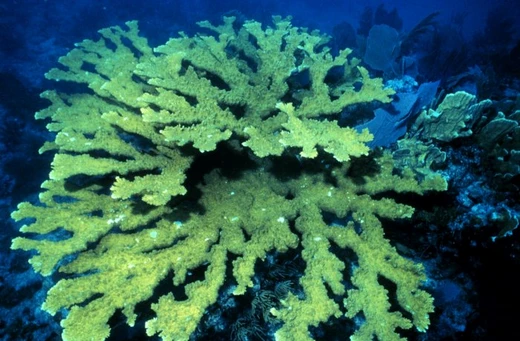
Acropora multiacuta
Endangered acroporid coral found in tropical shallow reefs.

Acropora multiacuta is an acroporid coral first described by F. Nemenzo in 1967. It forms dense colonies with many straight branches, each ending in a long axial corallite that tapers toward the tip. The coral is typically white or cream, with smaller incipient axial corallites below the main ones that can grow into branchlets. It resembles the species Acropora fastigata and Acropora suharsonoi. This coral lives in marine, tropical shallow reef environments, including lagoons, rocks, reef tops, and reef walls, often where wave action occurs. It is found at depths of 3 to 15 meters and is made of aragonite.
The species has a wide but scattered distribution across the Indian Ocean, Indo-Pacific, western Pacific, Solomon Islands, Southeast Asia, Eastern Australia, Raja Ampat, Papua New Guinea, and two regions of Indonesia. It is common on the Great Barrier Reef. Acropora multiacuta usually grows in groups of colonies. Its population is decreasing due to threats such as climate change, rising sea temperatures that cause bleaching, coral disease, reef destruction, predation by the crown-of-thorns starfish (Acanthaster planci), and human activity. It is classified as endangered on the IUCN Red List and is listed under CITES Appendix II. It may occur within Marine Protected Areas. The species was first described by F. Nemenzo in 1967 in the Philippines.
Quick Facts
- Genus
- Acropora
- Species
- multiacuta
Facts from the source article.
Lore & Background
Acropora multiacuta occurs in dense colonies consisting of many branches, which contain long coral bodies growing in a straight line (axial corallites), decreasing in width towards the end of the branches. Often white or cream in colour, incipient axial corallites occur below the axial corallites and form branchlets. The species is similar to Acropora fastigata and Acropora suharsonoi. It occurs in a marine environment in tropical, shallow reefs, on rocks, reef walls, lagoon areas exposed to wave action, and may be a dominant species. It is composed of aragonite (calcium carbonate).
The species is found over a large area but is generally rare, with occurrences in the Indian Ocean, the Indo-Pacific, the western Pacific, the Solomon Islands, Southeast Asia, Eastern Australia, Raja Ampat, and Papua New Guinea. In the Great Barrier Reef, this species is common, and it also occurs in two regions of Indonesia. It is usually found in groups of colonies. The population of the species is decreasing, threatened by climate change, rising sea temperatures leading to bleaching, coral disease, reef destruction, being prey to Acanthaster planci, and human activity.
Reader's Guide
Acropora multiacuta is significant as an endangered species with a decreasing population, highlighting the vulnerability of acroporid corals to environmental stressors. Its listing under CITES Appendix II indicates international concern over its trade and conservation. The species is threatened by climate change, rising sea temperatures causing bleaching, coral disease, reef destruction, predation by Acanthaster planci, and human activity. It could occur within Marine Protected Areas, suggesting potential conservation refuges. Its presence across a large geographic range, including the Great Barrier Reef and two regions of Indonesia, underscores its ecological role in tropical shallow reef ecosystems, though its rarity in most areas emphasizes the need for continued monitoring and protection.
Did You Know?
- It is classed as an endangered species on the IUCN Red List with a decreasing population.
- The species is composed of aragonite (calcium carbonate).
- It occurs at depths between 3 and 15 m (10 and 49 ft).
Frequently Asked Questions
What is Acropora multiacuta?
Acropora multiacuta is an acroporid coral species formally described by F. Nemenzo in 1967. It builds dense colonies composed of numerous straight branches, each capped by a long axial corallite that narrows to a point at the tip.
Where does Acropora multiacuta live and at what depth?
This coral is found in tropical shallow reef settings such as lagoons, rocky outcrops, reef crests, and reef walls, often in areas exposed to wave action. Its typical depth range spans roughly 3 to 15 meters (about 10 to 49 feet).
What does Acropora multiacuta look like?
The colony is generally white or cream in color, with tightly packed straight branches. Below each main axial corallite sit smaller, developing corallites that can eventually elongate into new branchlets, giving the coral a layered, densely branched appearance.
What is Acropora multiacuta's conservation status?
The species is currently classified as Endangered on the IUCN Red List, and its populations are on a declining trend. It is also listed under CITES Appendix II, which regulates international trade in the species.
How is Acropora multiacuta distinguished from look-alike species?
It is frequently confused with Acropora fastigata and Acropora suharsonoi due to similar overall branching form. The key distinguishing features are the particular density of its straight branches and the notably long, tapering axial corallites that cap each branch tip.
More in Acropora Corals, Part 2 1-24
Spotted an error? Know more?
Reader corrections go straight into our review queue. Suggest an edit · How this site is sourced