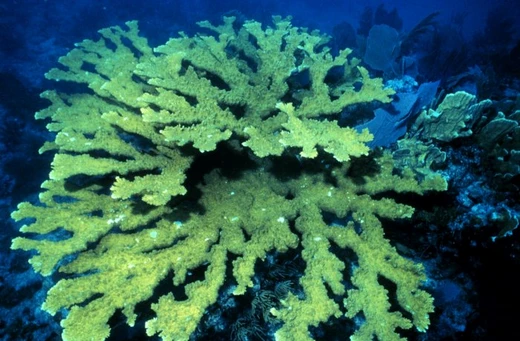
Acropora lokani
A vulnerable acroporid coral from shallow Indo-Pacific reefs.

Acropora lokani is a coral species first identified by C. C. Wallace in 1994. It forms colonies up to 30 centimeters wide, with sturdy, upright branches that are brown, cream, or blue. These branches, 5 to 7 millimeters in diameter and up to 20 millimeters long, split into smaller branchlets. At the tips are large, tube-shaped axial corallites, while smaller radial corallites, covered in fine spinules, dot the sides. The coral resembles *Acropora caroliniana* and *Acropora granulosa*. Its skeleton is made of aragonite.
This coral lives in sheltered lagoons, shallow reef flats, and patch reefs, typically at depths of 8 to 25 meters. It is not abundant but has a wide range across the Indo-Pacific, including Fiji, Southeast Asia, American Samoa, Raja Ampat, the Solomon Islands, Pohnpei, and the Great Barrier Reef. It is native to American Samoa, Australia, three regions of Indonesia, Fiji, Micronesia, Malaysia, New Caledonia, Papua New Guinea, Samoa, Singapore, Thailand, the Philippines, and the Solomon Islands. Population data is lacking, but numbers are thought to be dropping. Threats include climate change, rising sea temperatures causing bleaching, reef destruction, coral disease, predation by the crown-of-thorns starfish (*Acanthaster planci*), and human activity. It is listed as vulnerable on the IUCN Red List and under CITES Appendix II, and may occur in Marine Protected Areas.
Quick Facts
- Taxon
- Acropora lokani
Facts from the source article.
Lore & Background
Acropora lokani forms colonies up to 30 cm wide with upright strong branches that are brown, cream, or blue in color. Its branches have diameters of 5 to 7 mm and may grow to 20 mm long, dividing into branchlets that bear axial, incipient axial, and radial corallites. The axial corallites are large and tube-shaped, with inner diameters of 0.6 to 0.9 mm and outer diameters of 2.2 to 2.6 mm. The radial corallites are small and surrounded by and contain elaborate spinules. The species resembles Acropora caroliniana and Acropora granulosa.
It occurs in sheltered lagoons, flats of shallow reefs, patch reefs, and other shallow marine environments at depths of 8 to 25 m. The coral is composed of aragonite (calcium carbonate). It is not common but found over a large area, including in three regions of Indonesia, and is listed under CITES Appendix II.
Reader's Guide
Acropora lokani is notable for its vulnerable conservation status and wide but sparse distribution across the Indo-Pacific. The species is threatened by climate change, rising sea temperatures causing bleaching, reef destruction, coral disease, predation by the starfish Acanthaster planci, and human activity. It is listed as vulnerable on the IUCN Red List with a believed decreasing population, though there is a lack of detailed population data. Its inclusion in CITES Appendix II indicates international trade regulation. The coral may occur within Marine Protected Areas, offering some potential refuge. Its description by C. C. Wallace in 1994 added to the known diversity of acroporid corals, and its morphological similarity to Acropora caroliniana and Acropora granulosa highlights taxonomic relationships within the genus. The species' presence in regions such as the Great Barrier Reef, Fiji, American Samoa, and the Solomon Islands underscores its broad geographic range despite its uncommon occurrence.
Did You Know?
- Acropora lokani was first described by C. C. Wallace in 1994.
- It is found at depths between 8 and 25 m (26 and 82 ft).
- Its colonies are composed of aragonite (calcium carbonate).
- It is prey to the starfish Acanthaster planci.
Frequently Asked Questions
Who first identified Acropora lokani and when?
C. C. Wallace originally described this species in 1994. It has been recognized as a distinct acroporid coral ever since.
What does an Acropora lokani colony look like?
The coral grows into a cluster of thick, vertical branches reaching roughly 30 centimeters across, colored in shades of brown, cream, or blue. Each branch is about 5 to 7 millimeters thick and forks into finer offshoots, with prominent tube-like corallites crowning the tips and tiny spiny radial corallites scattered along the sides.
Where can you find Acropora lokani in the wild?
This species inhabits protected lagoon environments, shallow reef flats, and scattered patch reefs across the Indo-Pacific region, typically at depths between 8 and 25 meters.
How do you tell Acropora lokani apart from similar corals?
It is often confused with Acropora caroliniana and Acropora granulosa, but its combination of sturdy upright branching, large axial corallites at the branch tips, and fine spinules on the radial corallites helps distinguish it. Its aragonite-based skeleton is shared with other acroporids, so morphology is the key to identification.
What is the conservation status of Acropora lokani?
The species is classified as vulnerable, making it one of the at-risk acroporid corals in shallow Indo-Pacific reef systems. Its restricted habitat in sheltered, shallow waters leaves it particularly exposed to environmental stressors.
More in Acropora Corals, Part 2 1-24
Spotted an error? Know more?
Reader corrections go straight into our review queue. Suggest an edit · How this site is sourced