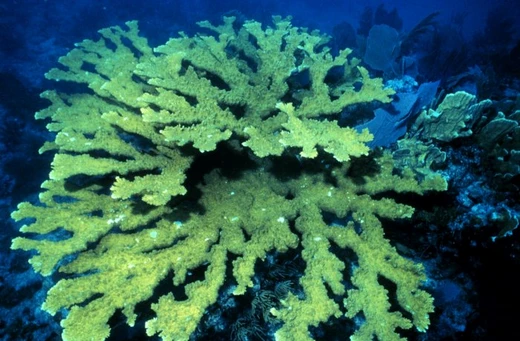
Acropora microclados
Endangered acroporid coral found in tropical shallow reefs.

Acropora microclados is a species of acroporid coral first identified by Christian Gottfried Ehrenberg in 1834. It forms corymbose colonies that can reach about one meter across. The colonies are made up of short, orderly branchlets that taper at the ends, with bases up to ten millimeters wide. The coral is usually pale pink or brown, and its grey tentacles extend during the day. The branchlets have tube-shaped axial corallites at their tips, along with frequent incipient axial corallites and tube-shaped radial corallites that line the sides, each with nose-shaped openings. The skeleton is composed of aragonite. This species resembles *Acropora lamarcki*, *Acropora macrostoma*, and *Acropora massawensis*.
It lives in marine tropical shallow reefs on upper slopes, at depths between five and twenty meters. The species is uncommon but has a wide distribution across the Indo-Pacific Ocean, Red Sea, Indian Ocean, Gulf of Aden, East China Sea, West Pacific, Cook Islands, Australia, Japan, Southeast Asia, Samoa, and Chagos. It occurs in five regions of Indonesia and is found at water temperatures of 25.48 to 27.23 °C. Population data are lacking, but numbers are thought to be declining. Threats include climate change, rising sea temperatures causing bleaching, reef destruction, coral disease, predation by the starfish *Acanthaster planci*, and human activity. It is listed as endangered on the IUCN Red List and under CITES Appendix II, and may occur within Marine Protected Areas.
Quick Facts
- Taxon
- Acropora microclados
Facts from the source article.
Lore & Background
Acropora microclados forms colonies of corymbose structures up to 1 m wide, composed of short, orderly branchlets that taper at the ends. The branchlet bases can reach 10 mm in width. The coral is usually pale pink or brown in color, with grey tentacles that extend during the day. Branchlets contain axial corallites at the tips, incipient axial corallites, and radial corallites along the sides. The radial corallites are tube-shaped, closely spaced, and have nose-shaped openings. The species is composed of aragonite (calcium carbonate).
It was originally described as Heteropora microclados by Ehrenberg in 1834. The coral is found in marine, tropical shallow reefs on upper slopes at depths of 5 to 20 m. It occurs over a large area including the Indo-Pacific Ocean, Red Sea, Indian Ocean, Gulf of Aden, East China Sea, West Pacific, Cook Islands, Australia, Japan, Southeast Asia, Samoa, and Chagos, and in five regions of Indonesia. It is uncommon but widespread.
Reader's Guide
Acropora microclados is significant as an endangered species with a decreasing population, threatened by climate change, rising sea temperatures causing bleaching, reef destruction, coral disease, predation by the starfish Acanthaster planci, and human activity. Its listing on the IUCN Red List and under CITES Appendix II highlights its conservation concern. The species may occur within Marine Protected Areas, though population data are lacking. Its wide distribution across the Indo-Pacific, Red Sea, and other regions, despite being uncommon, underscores its ecological role in shallow reef ecosystems. The coral's corymbose growth form and distinctive corallite structure, including nose-shaped radial corallite openings, aid in identification, though it resembles Acropora lamarcki, Acropora macrostoma, and Acropora massawensis. The species' reliance on aragonite skeletons and its occurrence at specific temperature ranges (25.48–27.23 °C) make it vulnerable to ocean warming.
Did You Know?
- Acropora microclados was first described by Christian Gottfried Ehrenberg in 1834 as Heteropora microclados.
- Its radial corallites contain nose-shaped openings.
- It is preyed upon by the starfish Acanthaster planci.
- The species is found at depths of 5 to 20 m (16 to 66 ft).
Frequently Asked Questions
Who is Acropora microclados?
Acropora microclados is a stony coral in the acroporid family, first named and described by the German zoologist Christian Gottfried Ehrenberg in 1834. It builds spreading, corymbose colonies made up of short, neatly arranged branchlets that taper toward their tips, with bases reaching up to ten millimeters wide.
What are Acropora microclados's powers or role?
Unlike many reef corals that rely mostly on symbiotic algae, this species extends its grey tentacles during daylight hours to actively capture plankton. Its colonies can spread to roughly one meter across, and each branchlet carries tube-shaped axial corallites at the tips alongside radial corallites with nose-shaped openings lining the sides.
Where does Acropora microclados live?
You'll encounter it on tropical shallow reefs at depths of about 5 to 20 meters, in water temperatures between roughly 25.5 and 27.2 °C. The coral typically shows a pale pink or brown coloration across its colony surface.
Why is Acropora microclados important?
As a reef-building acroporid, it adds structural complexity to tropical coral communities and provides shelter for a wide array of small marine organisms. Its orderly, corymbose growth form helps stabilize reef frameworks in the 5-to-20-meter zone where it thrives, making it a meaningful contributor to overall reef biodiversity.
More in Acropora Corals, Part 2 1-24
Spotted an error? Know more?
Reader corrections go straight into our review queue. Suggest an edit · How this site is sourced