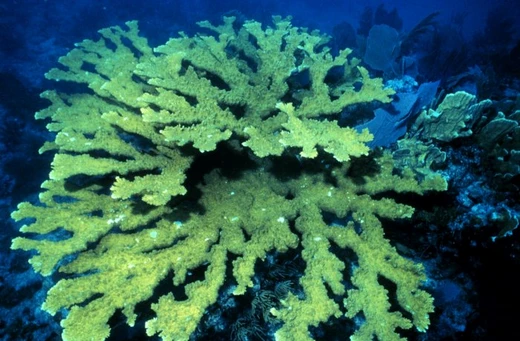
Acropora microphthalma
A common arborescent coral found across the Indo-Pacific.

Acropora microphthalma is a type of acroporid coral with a wide distribution across the Red Sea, Gulf of Aden, southwest and northern Indian Ocean, central Indo-Pacific, Australia, Southeast Asia, Japan, the East China Sea, the oceanic west and central Pacific, and the Line Islands. It lives in shallow tropical reefs, typically on upper reef slopes, as well as in turbid water and sandy lagoons, at depths between 5 and 25 meters.
Colonies of this species are small and tree-like, often forming dense thickets. The branches are slender and straight. The coral is usually pale grey, though it can sometimes appear pale brown or cream.
Like many corals, *Acropora microphthalma* is zooxanthellate, meaning it relies on symbiotic dinoflagellates living in its tissues for most of its nutrition. These photosynthetic partners supply the coral with organic carbon and nitrogen, meeting up to 90% of its energy needs for growth and metabolism. The coral supplements this diet by capturing plankton with its polyp tentacles.
This species is common, and no specific threats have been identified for it alone. However, corals in general face dangers from climate change, mechanical destruction of reef habitats, extreme weather, rising sea temperatures, and ocean acidification. The IUCN lists *Acropora microphthalma* as "near threatened." All corals are protected under CITES Appendix II.
Quick Facts
- Taxon
- Acropora microphthalma
Facts from the source article.
Lore & Background
Colonies of Acropora microphthalma are small and arborescent, usually forming thickets. The branches are slender and straight. Its colour is usually pale grey, but it is sometimes pale brown or cream. This coral is a zooxanthellate species, obtaining most of its nutritional needs from symbiotic dinoflagellates that live inside its soft tissues. These photosynthetic organisms provide organic carbon and nitrogen, sometimes supplying up to 90% of the host's energy needs for metabolism and growth. Remaining needs are met by planktonic organisms caught by the tentacles of the polyps.
Reader's Guide
Acropora microphthalma is a common species with no species-specific threats identified. The main threats faced by corals in general are related to climate change and the mechanical destruction of their coral reef habitats, including increasing damage from extreme weather events, rising sea water temperatures, and ocean acidification. The International Union for Conservation of Nature has assessed its conservation status as 'near threatened'. All corals receive protection by being listed on CITES Appendix II. Its wide distribution across the Indo-Pacific and its occurrence in turbid water and sandy lagoons indicate a degree of habitat tolerance, though its shallow depth range (5–25 m) makes it vulnerable to local disturbances. As a zooxanthellate coral, its reliance on symbiotic algae ties its health to water clarity and temperature stability.
Did You Know?
- Acropora microphthalma is found in the Line Islands.
- It occurs in turbid water and sandy lagoons.
- Its colour is usually pale grey, but sometimes pale brown or cream.
- It is a zooxanthellate species, obtaining up to 90% of its energy needs from symbiotic dinoflagellates.
Genomic Sequencing Milestone
Acropora microphthalma secured its entry in the catalog of fully sequenced animal genomes when its complete nuclear genome was assembled, annotated, and made publicly available in 2020. This designation carries specific weight: the reference lists from which it is drawn deliberately exclude partial assemblies and organelle-only sequences, meaning the 2020 publication represents a genuinely comprehensive genomic resource rather than a fragmentary sketch. For a cnidarian coral, having a complete reference genome transforms what is possible in downstream research—comparative genomics, gene family analysis, and evolutionary inference all become tractable in ways they were not before. The year 2020 thus marks the point at which the full genetic blueprint of this species entered the public scientific record, available for any laboratory to query, align, and interpret alongside the growing body of animal genomic data.
Taxonomic Context Within Cnidaria
Within the phylum Cnidaria, Acropora microphthalma occupies a position among a remarkably diverse assemblage of sequenced species that stretches from hydrozoans to cubozoans and from octocorals to scleractinian corals. Its genomic neighbors include long-standing model organisms such as the starlet sea anemone Nematostella vectensis (2007) and the hydrozoan Hydra vulgaris (2010), as well as jellyfish like the moon jellyfish Aurelia aurita and the Nomura jellyfish Nemopilema nomurai, both published in 2019. Other corals on the list—Stylophora pistillata (2017), Acropora digitifera (2011), and the broader Acropora cohort—illustrate how cnidarian genomics has broadened well beyond a handful of foundational species. Acropora microphthalma, entering the record in 2020, adds another data point to this expanding taxonomic sampling of the phylum's genetic architecture.
The Acropora Genus in Comparative Genomics
The year 2020 witnessed an extraordinary concentration of genomic work on the coral genus Acropora, with Acropora microphthalma joining at least fourteen congeneric species whose complete genomes were published that same year. The cohort includes A. acuminata, A. awi, A. cytherea (table coral), A. echinata, A. florida (branching staghorn coral), A. hyacinthus (brush coral), A. intermedia (noble staghorn coral), A. muricata (staghorn coral), A. nasta (branching staghorn coral), A. selago (green selago acropora), A. tenuis (purple tipped acropora), and A. yongei (Yonge's staghorn coral). A. gemmifera followed in 2021 and A. pulchra in 2025. This density of effort within a single genus points toward a coordinated strategy to build a comparative genomic framework for Acropora, enabling fine-grained studies of gene family evolution, adaptive variation, and phylogenetic relationships across the group at a resolution previously unattainable.
Place in the Broader Animal Genomics Landscape
The 2020 publication of the Acropora microphthalma genome situates the species within a sweeping international endeavor to catalogue the genetic blueprints of animals across every major lineage. The comprehensive reference list it appears on spans sponges (from Amphimedon queenslandica in 2009 to Ephydatia muelleri in 2020), ctenophores, echinoderms, tunicates, and vertebrates ranging from chimeras to teleost fish. The list explicitly separates nuclear genome assemblies from the far more numerous mitochondrial genome projects and sets a quality threshold by excluding partial or organelle-only sequences. In this wider context, Acropora microphthalma represents one strand in a tapestry of animal genomics that has grown from a few pioneering sequences in the early 2000s—the larvacean Oikopleura dioica in 2001, the sea urchin Strongylocentrotus purpuratus in 2006—into a vast, taxonomically diverse collection of reference genomes.
Frequently Asked Questions
What is Acropora microphthalma?
It is a small, tree-like stony coral in the acroporid family whose slender, straight branches tend to cluster into dense thicket formations. It is one of the more commonly encountered arborescent corals across tropical reef habitats.
Where can Acropora microphthalma be found?
Its range spans the Red Sea, Gulf of Aden, the Indian Ocean, Southeast Asia, Australia, Japan, the East China Sea, the central Pacific, and the Line Islands. Within that broad distribution it favors shallow tropical reefs, upper reef slopes, sandy lagoons, and even somewhat turbid water.
What does Acropora microphthalma look like?
Colonies are typically small with thin, straight branches arranged in a tree-like shape that often grows into dense thickets. Coloration is usually a pale grey, though some individuals appear pale brown or cream.
At what depths does Acropora microphthalma live?
It occupies the shallow zone of tropical reefs, generally between 5 and 25 meters below the surface. It tolerates a variety of settings within that band, from open upper slopes to sheltered sandy lagoon areas.
What is the conservation status of Acropora microphthalma?
The IUCN currently classifies the species as Near Threatened, and it is listed under CITES Appendix II. Despite its wide geographic spread, ongoing reef degradation keeps it on the conservation watch list.
More in Acropora Corals, Part 2 1-24
Spotted an error? Know more?
Reader corrections go straight into our review queue. Suggest an edit · How this site is sourced