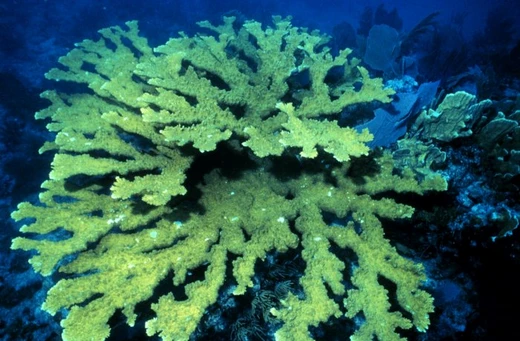
Acropora loripes
A branching colonial coral of Indo-Pacific reefs and flats.

Acropora loripes is a species of branching colonial stony coral found in the tropical Indo-Pacific. It is common on reefs, upper reef slopes and reef flats, with its type locality being the Great Barrier Reef.
Quick Facts
- Taxon
- Acropora loripes
Facts from the source article.
Lore & Background
Acropora loripes exhibits a variety of growth forms, including heads, plate-like layers, and sometimes stalks resembling bottlebrushes. Its branchlets are 5 to 12 mm wide and up to 45 mm long, with axial corallites about 3 mm in diameter and large, tubular radial corallites that are crowded and often touch each other. The skeleton is secreted by the polyps and covered by a thin layer of tissue; when feeding, each polyp protrudes from its corallite and has twelve tentacles, one longer than the others. The interior of the polyps opens into a body cavity that interconnects through a system of channels called the coenenchyme.
This is a zooxanthellate species, hosting symbiotic dinoflagellates that provide much of its energy through photosynthesis. Together with pigments in the tissue, these symbionts give the colony a yellowish-brown colour. Acropora loripes is a hermaphrodite; colonies in an area synchronise breeding. On the Great Barrier Reef, mature individuals release eggs and sperm into the sea five or six days after the full moon in November and December. Fertilisation is external, and the larvae form part of the plankton before settling on the seabed to undergo metamorphosis and found new colonies.
Reader's Guide
Acropora loripes is notable as a common component of Indo-Pacific reef ecosystems, occurring subtidally at depths between 5 and 25 metres on upper reef slopes and reef flats. Its range extends from the Red Sea to Thailand, Malaysia, Indonesia, Papua New Guinea and Australia. The species is threatened more by damage to the reefs where it lives than by specific threats to the coral itself. Like other members of its genus, it is susceptible to bleaching and several coral diseases, and is particularly favoured as part of its diet by the crown-of-thorns starfish, which feeds on the external tissue and polyps. The IUCN Red List of Threatened Species lists Acropora loripes as an endangered species. Its biology—including its symbiotic relationship with dinoflagellates, its synchronised hermaphroditic spawning, and its varied growth forms—illustrates key characteristics of the genus Acropora and the ecological dynamics of coral reef systems.
Did You Know?
- Acropora loripes has branchlets up to 45 mm in length and 5 to 12 mm wide.
- Each polyp has twelve tentacles, one of which is longer than the others.
- The IUCN Red List lists Acropora loripes as an endangered species.
Morphology & Growth Forms
Acropora loripes is a branching colonial stony coral that displays remarkable versatility in how it builds its structure. Rather than a single rigid form, it can develop into rounded heads, broad plate-like layers, or even stalked structures that evoke the appearance of bottlebrushes. The individual branchlets are relatively slender, measuring between 5 and 12 millimetres in width, and can stretch up to 45 millimetres in length. At their tips, the branches may appear bare, but just beneath these naked points, the axial corallites sit at roughly 3 millimetres in diameter. Surrounding them, the radial corallites take on a tubular shape and are packed so densely that they frequently press against one another, giving the colony a distinctive crowded texture. As a member of the stony coral group, its calcium carbonate framework is laid down by the living polyps themselves, all wrapped in a thin outer layer of tissue. The type locality for this species is the Great Barrier Reef, anchoring its formal scientific description to that iconic Australian waterscape.
Distribution & Habitat
Acropora loripes holds a broad but geographically coherent footprint across the tropical Indo-Pacific. Its native range stretches from the Red Sea eastward through Thailand, Malaysia, and Indonesia, continuing on to Papua New Guinea and Australia. Within this span, it is a common sight on healthy reef systems, favouring upper reef slopes and the shallower reef flats where light penetration supports its photosynthetic partners. It lives subtidally, occupying a depth window between 5 and 25 metres. This places it squarely in the zone where wave energy is moderate and water temperatures remain warm enough to sustain the symbiotic dinoflagellates that fuel its metabolism. The species is not restricted to a single microhabitat; instead, it appears across a variety of structural settings within those depth and slope parameters, making it a versatile component of Indo-Pacific reef communities. Its presence on both the Great Barrier Reef and the more western reaches of the Red Sea underscores how widely this single branching coral has colonised the tropical belt.
Symbiosis, Feeding & Colouration
Beneath the hard skeleton, Acropora loripes is a living network of interconnected polyps. When conditions allow, each polyp extends from its corallite to feed, deploying twelve tentacles in which one is noticeably longer than the rest. The interior of every polyp opens into a shared body cavity, and these cavities are linked to one another through a web of channels known as the coenenchyme, creating a colonial circulatory system. The colony's survival depends heavily on a symbiotic partnership with photosynthetic dinoflagellates that reside within the tissue. These zooxanthellae convert sunlight into energy that the coral harnesses for growth and repair, making the species a zooxanthellate coral. Together with the pigments embedded in the tissue, these symbionts produce the characteristic yellowish-brown hue of a healthy Acropora loripes colony. The thin tissue layer covering the skeleton is thus not merely protective but metabolically essential, housing the microscopic algae that power the entire organism.
Reproduction & Conservation Pressures
Acropora loripes is a hermaphroditic species, meaning each mature colony produces both eggs and sperm. Across a given reef area, colonies coordinate their reproductive timing so that spawning occurs in synchrony. In the Great Barrier Reef, this event is tied to the lunar cycle: five or six days after the full moon in November or December, mature corals release gametes into the surrounding water. Fertilisation takes place externally in the open sea, and the resulting larvae drift as part of the plankton until they locate a suitable substrate on the seabed. There they undergo metamorphosis and begin to build new colonies. Despite this reproductive strategy, the species faces mounting pressure. It is vulnerable to bleaching events and several coral diseases, and the crown-of-thorns starfish actively targets it, consuming the external tissue and polyps. The IUCN Red List classifies Acropora loripes as endangered, reflecting the cumulative impact of reef degradation rather than any single isolated threat.
Frequently Asked Questions
Who is Acropora loripes?
Acropora loripes is a branching colonial stony coral native to tropical Indo-Pacific waters. It was first described from the Great Barrier Reef, which serves as its type locality.
What role does Acropora loripes play on the reef?
It builds delicate branching colonies across upper reef slopes and shallow reef flats, contributing structural complexity to the habitat. Each individual polyp extends 12 tentacles to capture plankton and organic particles from the water column.
How big does Acropora loripes grow?
Its branchlets are typically 5 to 12 mm wide and can reach a maximum length of about 45 mm. The axial corallites sit at roughly 3 mm in diameter, giving the colony a fine, twiggy appearance.
When does Acropora loripes reproduce?
On the Great Barrier Reef, spawning occurs roughly 5 to 6 days after the full moon during the November–December window. This lunar-timed release synchronises gamete dispersal across the population.
At what depth can you find Acropora loripes?
It is generally encountered between 5 and 25 metres (about 16 to 82 feet) on tropical Indo-Pacific reefs, upper slopes, and flats. Its preference for well-lit, shallow zones reflects its dependence on photosynthetic symbionts.
More in Acropora Corals, Part 2 1-24
Spotted an error? Know more?
Reader corrections go straight into our review queue. Suggest an edit · How this site is sourced