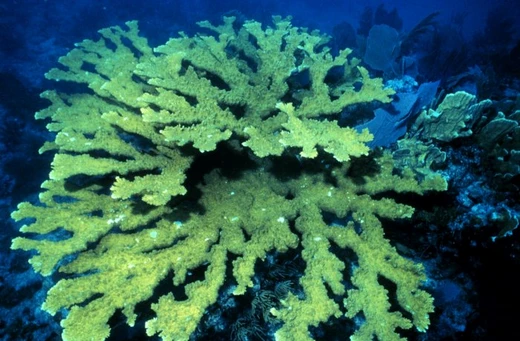
Acropora monticulosa
Endangered dome-shaped coral from Indo-Pacific shallow reefs.

Acropora monticulosa is a species of acroporid coral found in tropical shallow reefs on upper slopes, at depths of 1 to 12 metres. It was described by Brüggemann in 1879 and is notable for its large, dome-shaped colonies and its classification as an endangered species on the IUCN Red List.
Quick Facts
- Genus
- Acropora
- Species
- monticulosa
Facts from the source article.
Lore & Background
Acropora monticulosa forms colonies with diameters over 3 metres in dome-shaped structures. Its digitate colonies have thick branches that taper to a single axial corallite at the end, and its radial corallites are uniformly arranged and sized. The species is cream or blue in colour and resembles Acropora globiceps and Acropora retusa.
The species occurs in the northern and southwestern Indian Ocean, the central Indo-Pacific, Australia, Southeast Asia, Japan, the East China Sea, the oceanic west Pacific Ocean, and the Tuamotus. It is found on tropical shallow reefs on upper slopes at depths of 1 to 12 metres.
Originally described as Madrepora monticulosa by Brüggemann in 1879, the species is classed as endangered on the IUCN Red List with a decreasing population. Threats include global reduction of coral reefs, temperature increase causing coral bleaching, climate change, human activity, the crown-of-thorns starfish (Acanthaster planci), and disease.
Reader's Guide
Acropora monticulosa is significant as an endangered species whose population is believed to be decreasing. Its listing under Appendix II of CITES reflects international concern over its trade and conservation. The species is threatened by multiple factors including global coral reef decline, rising temperatures leading to coral bleaching, climate change, human activity, predation by the crown-of-thorns starfish (Acanthaster planci), and disease. Although exact population figures are unknown, these pressures collectively endanger its persistence across its wide range from the Indian Ocean to the Pacific, including the Tuamotus. Its occurrence in shallow upper-slope reefs makes it particularly vulnerable to environmental changes. The species' large dome-shaped colonies, reaching over 3 metres in diameter, contribute to reef structure and habitat complexity. Its resemblance to Acropora globiceps and Acropora retusa may complicate field identification. The original description by Brüggemann in 1879 as Madrepora monticulosa provides taxonomic foundation, but the species now faces ongoing conservation challenges that underscore the broader plight of acroporid corals worldwide.
Did You Know?
- Its colonies can exceed 3 metres in diameter and form dome-shaped structures.
- It is listed as endangered on the IUCN Red List and under Appendix II of CITES.
Frequently Asked Questions
What is Acropora monticulosa?
Acropora monticulosa is a stony coral in the acroporid family, native to tropical Indo-Pacific reefs. It is best recognized by its massive, rounded dome-shaped growth form that can exceed three metres across.
Where does Acropora monticulosa grow?
This species inhabits the upper slopes of shallow coral reefs, typically between one and twelve metres below the surface. Its range spans tropical waters of the Indo-Pacific region.
What makes Acropora monticulosa visually distinctive?
Its most striking feature is the enormous hemispherical colony shape, with domes that can stretch well past three metres in diameter. This gives reef sections a bold, mound-like silhouette that sets it apart from more branching acroporids.
Who first described Acropora monticulosa and when?
The species was formally described by Brüggemann in 1879. At the time it was placed under the genus Madrepora, carrying the original binomial Madrepora monticulosa.
What is the conservation status of Acropora monticulosa?
The IUCN Red List currently classifies this species as endangered, reflecting significant population pressure across its Indo-Pacific range. Its large, slow-growing dome colonies make it especially vulnerable to habitat loss and thermal stress events.
More in Acropora Corals, Part 2 1-24
Spotted an error? Know more?
Reader corrections go straight into our review queue. Suggest an edit · How this site is sourced