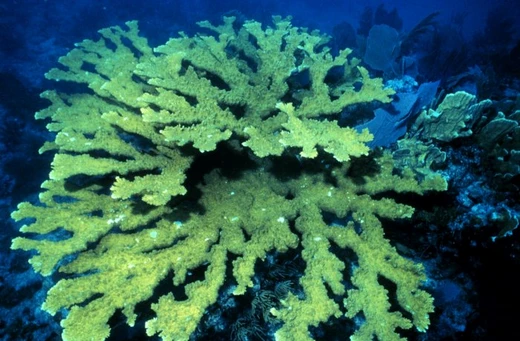
Acropora kosurini
Vulnerable acroporid coral found in shallow Indo-Pacific reefs.

Acropora kosurini is a coral species first identified by C. C. Wallace in 1994. It grows in corymbose colonies with long branches that taper toward the tips, ranging from 4 to 12 mm in diameter and up to 100 mm in length. The branch ends have rounded axial corallites, while radial corallites—closely spaced with small openings and outer diameters up to 2.7 mm—line the sides. Corallites vary in size, with the larger ones being uniform and neatly arranged. The coral is brown in color and resembles *Acropora divaricata*, *A. variabilis*, and *A. hoeksemai*. It is composed of aragonite (calcium carbonate).
This species inhabits shallow marine reefs, specifically on slopes and reef walls, at depths of 8 to 20 m (26 to 66 ft). It reaches maturity between three and eight years. Though rare, *A. kosurini* has a broad distribution across the Indian Ocean, Australia, the Indo-Pacific, Thailand, the Philippines, the Andamans, and one region of Indonesia. It is native to Thailand, Australia, Indonesia, India, Myanmar, and the Philippines. No precise population data exist, but numbers are known to be declining. Threats include bleaching from rising sea temperatures, pollution, coral disease, climate change, human development, fishing, infrastructure, and potential export for aquariums. It is listed as vulnerable on the IUCN Red List and on CITES Appendix II, and may occur within Marine Protected Areas.
The species was first described by C. C. Wallace in 1994 from the North-East Indian Ocean.
Quick Facts
- Taxon
- Acropora kosurini
Facts from the source article.
Lore & Background
Acropora kosurini forms corymbose colonies with long branches that taper toward the ends. Branches have diameters of 4 to 12 mm and lengths up to 100 mm. Branchlets bear rounded axial corallites at the ends, while radial corallites on the sides have outer diameters up to 2.7 mm, are closely spaced, and have small openings. Corallites vary in size, with larger ones being uniform and orderly. The species is brown in color. It is similar to Acropora divaricata, Acropora variabilis, and Acropora hoeksemai. It occurs on shallow reef slopes and reef walls at depths of 8 to 20 m, and reaches maturity between three and eight years. It is composed of aragonite.
Reader's Guide
Acropora kosurini is significant as a vulnerable species with a decreasing population, threatened by bleaching from rising sea temperatures, pollution, coral disease, climate change, human development, fishing, infrastructure, and potential export for aquariums. It is rare but found over a large range including the Indian Ocean, Australia, the Indo-Pacific, Thailand, the Philippines, the Andamans, and one region of Indonesia. It is native to Thailand, Australia, Indonesia, India, Myanmar, and the Philippines. No specific population data exists, but numbers are known to be decreasing. Its listing on CITES Appendix II and the IUCN Red List as vulnerable highlights conservation concern, though it may occur within Marine Protected Areas. The species was first described by C. C. Wallace in 1994 in the North-East Indian Ocean.
Frequently Asked Questions
What is Acropora kosurini?
It is a branching coral species formally named by C. C. Wallace in 1994, native to shallow reefs across the Indo-Pacific. It forms corymbose colonies of long, tapering branches that can grow up to about 10 cm in length and 4–12 mm in diameter.
What does Acropora kosurini look like?
The coral is brown in color, with rounded axial corallites capping the branch tips and tightly packed radial corallites (up to 2.7 mm across) lining the sides. Its skeleton is built from aragonite, and the larger corallites tend to be uniform in size and neatly arranged.
Where does Acropora kosurini live?
It is found on shallow Indo-Pacific reefs, typically at depths between 8 and 20 meters (roughly 26 to 66 feet). It thrives in the same general reef zone as several other branching Acropora relatives.
What is the conservation status of Acropora kosurini?
The IUCN classifies it as Vulnerable, and its population trend is currently decreasing. It is also listed under CITES Appendix II, which places restrictions on international trade in the species.
How is Acropora kosurini similar to other Acropora species?
It closely resembles A. divaricata, A. variabilis, and A. hoeksemai in overall branching habit and brown coloration. Separating it from those look-alikes generally requires a closer look at corallite size, spacing, and the precise arrangement of the larger, uniform corallites.
More in Acropora Corals, Part 2 1-24
Spotted an error? Know more?
Reader corrections go straight into our review queue. Suggest an edit · How this site is sourced