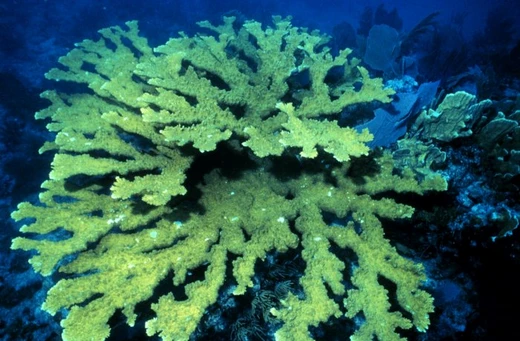
Acropora loisetteae
Vulnerable acroporid coral found in sheltered tropical lagoons.

Acropora loisetteae is a species of acroporid coral that forms tree-like colonies and is typically blue or pink. Its branches are straight, circular, thin, and can reach up to 110 mm in length and 5 to 12 mm in width. The branchlets have obvious, tube-shaped axial corallites at their tips, while the sides bear small, uniform radial corallites up to 2.8 mm wide. The coral is composed of aragonite and resembles *Acropora abrolhosensis*, *Acropora parilis*, and *Acropora pulchra*.
This species inhabits marine, tropical, shallow reefs in sheltered lagoons, at depths between 1 and 30 m. It is widely distributed across the Indo-Pacific, including Australia, Malaysia, Micronesia, the Philippines, the Adamans, and Banggai, with specific occurrences in two regions of Indonesia and four locations in the Marshall Islands. Although often uncommon, it may dominate other species in some areas. Its population is thought to be declining due to threats such as climate change, rising sea temperatures causing bleaching, coral disease, reef destruction, predation by the starfish *Acanthaster planci*, and human activity. It is listed as vulnerable on the IUCN Red List and under CITES Appendix II, and may be found within Marine Protected Areas.
The species was first described by C. C. Wallace in 1994 from the Indian Ocean.
Quick Facts
- Taxon
- Acropora loisetteae
Facts from the source article.
Lore & Background
Acropora loisetteae forms colonies of tree-like structures with circular, straight, thin branches up to 110 mm long and 5–12 mm wide. The branchlets have obvious, tube-shaped axial corallites at the ends and small, uniform radial corallites up to 2.8 mm wide on the sides. The coral is blue or pink in color and is composed of aragonite. It is similar to Acropora abrolhosensis, Acropora parilis, and Acropora pulchra. The species occurs in marine, tropical, shallow reefs in sheltered lagoons at depths between 1 and 30 m. It is often uncommon but found over a large area, including the Indo-Pacific, Australia, Malaysia, Micronesia, the Philippines, the Adamans, and Banggai. It occurs in two regions of Indonesia and in four locations in the Marshall Islands, and may dominate other species in some locations. The population is known to be declining, though no exact numbers are available.
Reader's Guide
Acropora loisetteae was described by C. C. Wallace in 1994 in the Indian Ocean. Its listing as vulnerable on the IUCN Red List reflects threats including climate change, rising sea temperatures causing bleaching, increasing coral disease within its range, reef destruction, predation by the starfish Acanthaster planci, and human activity. The species is listed under CITES Appendix II and may occur within Marine Protected Areas. Despite being uncommon over much of its range, it is believed to dominate other corals in some locations. Its presence across a wide geographic area from the Indo-Pacific to the Marshall Islands suggests a broad but fragmented distribution. The species' reliance on sheltered lagoon habitats and its sensitivity to environmental stressors underscore its conservation concern.
Did You Know?
- It is found at depths between 1 and 30 m (3.3 and 98.4 ft).
- The coral is blue or pink in colour and forms tree-like colonies.
Frequently Asked Questions
What is Acropora loisetteae?
It is a stony coral in the acroporid family that builds upright, tree-like colonies, usually in shades of blue or pink. The species was formally named by C. C. Wallace in 1994.
What does Acropora loisetteae look like?
Its branches are straight, thin, and circular in cross-section, reaching up to about 110 mm in length and 5–12 mm in width. The tips carry prominent tube-shaped axial corallites, while the sides are lined with small, uniform radial corallites no wider than 2.8 mm.
Where does Acropora loisetteae live?
This coral favors sheltered tropical lagoons on shallow marine reefs, typically between 1 and 30 meters depth. It is not found on exposed, high-energy reef slopes but rather in calmer, protected waters.
How is Acropora loisetteae different from similar species?
It is morphologically close to A. abrolhosensis, A. parilis, and A. pulchra, which can make field identification challenging. Its combination of very thin, straight branches and the specific size range of its radial corallites helps distinguish it from those look-alikes.
Why is Acropora loisetteae a conservation concern?
The species is currently classified as vulnerable, meaning its populations face a high risk of decline in the wild. For reef enthusiasts and marine biologists alike, that status underscores the importance of protecting the sheltered lagoon habitats where it grows.
More in Acropora Corals, Part 2 1-24
Spotted an error? Know more?
Reader corrections go straight into our review queue. Suggest an edit · How this site is sourced