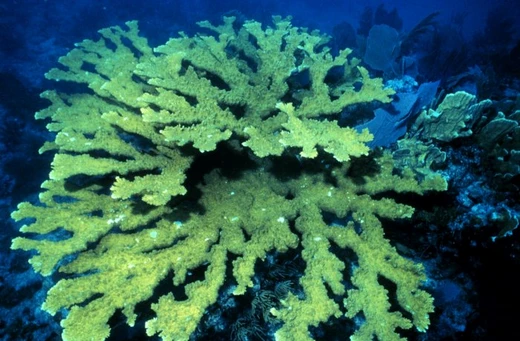
Acropora millepora
A shallow-water branching coral with variable color and scale-like corallites.

Acropora millepora is a branching stony coral that forms small, clumped colonies with short, cylindrical branches. Its radial corallites are uniform in size and feature projecting lower rims that create a scale-like texture. The coral’s coloration varies, appearing as green with orange branch tips, pale pink, orange, plain green, or blue. First described in 1834 by Christian Gottfried Ehrenberg under the name *Heteropora millepora*, this species is native to the western Indo-Pacific, ranging from the east coast of Africa to Japan and Australia. It thrives in shallow waters between two and twelve meters deep, commonly on reef flats, upper reef slopes, and in lagoons.
This coral is zooxanthellate, hosting symbiotic dinoflagellates within its tissues. Its larvae tend to settle on vertical surfaces and on encrusting coralline algae. At lower temperatures (around 22.5 °C), the larvae become less selective about settlement sites and show reduced survival rates. Interestingly, the choice of substrate is influenced by the local strain of symbiont, even before the larvae have been infected.
The primary threat to *Acropora millepora* is the destruction of its coral reef habitat. As a shallow-water species, it is vulnerable to bleaching and coral diseases, and it is also collected for the aquarium trade. Rising sea temperatures and ocean acidification pose additional risks to corals generally. Consequently, the IUCN lists *Acropora millepora* as "Near Threatened."
Quick Facts
- Taxon
- Acropora millepora
Facts from the source article.
Lore & Background
Acropora millepora is a small colonial coral that grows in clumps, with short cylindrical branches. The radial corallites are all the same size and have projecting lower rims, giving them a scale-like appearance. Its colour is variable and may be green with orange tipped branches, or pale pink, orange, plain green or blue.
This coral is common in the western and central Indo-Pacific, ranging from the Red Sea, Kenya and South Africa to India, Malaysia, Japan, Indonesia and Australia. It grows in shallow water between two and twelve metres deep, mostly on reef flats, but also on upper reef slopes and in lagoons.
Acropora millepora is a zooxanthellate species, harbouring symbiotic dinoflagellates in its tissues. Its larvae preferentially settle on vertical surfaces and on encrusting coralline algae. At lower temperatures (22.5 °C) the larvae were less specific as to their choice of settlement sites and their survival rates were lower. The choice of substrate for settlement was modified by the strain of symbiont present in the locality even though it had not yet infected the tissues.
Reader's Guide
Acropora millepora is a relatively common shallow-water coral, but it is susceptible to bleaching and coral diseases, and is collected for the reef aquarium trade. The main threat affecting it is the destruction of the coral reefs where it lives. Corals in general are expected to be impacted by rising sea temperatures and ocean acidification. For these reasons, the IUCN has listed Acropora millepora as 'Near Threatened'. Its ecological significance lies in its role as a zooxanthellate species that contributes to reef structure in shallow Indo-Pacific waters. The species is notable for the surprising finding that larval settlement preferences are modified by the strain of symbiont present in the locality, even before infection occurs. This suggests complex interactions between the coral and its potential symbionts that may influence its distribution and resilience.
Did You Know?
- Acropora millepora was first described in 1834 by Christian Gottfried Ehrenberg as Heteropora millepora.
- At lower temperatures (22.5 °C), larvae were less specific in settlement site choice and had lower survival rates.
Frequently Asked Questions
What is Acropora millepora?
It is a branching stony coral that grows in small, clumped colonies made up of short, cylindrical branches. Its radial corallites are uniform in size and carry projecting lower rims that give the colony a distinctive scale-like surface texture.
What colors can Acropora millepora display?
Individual colonies show a surprisingly wide palette, ranging from green bodies with orange-tipped branches to pale pink, solid orange, plain green, or even blue. This color variability is one of the features that makes the species popular among reef observers.
Where does Acropora millepora naturally occur?
The species is native to the western Indo-Pacific, with a range that stretches from the eastern coast of Africa through to Japan and Australia. It is a shallow-water specialist, typically found between two and twelve metres (about six to forty feet) below the surface.
Who first described Acropora millepora and under what name?
Christian Gottfried Ehrenberg formally described the species in 1834, originally placing it under the name Heteropora millepora. It was later transferred to the genus Acropora, where it remains today.
What is Acropora millepora's current conservation status?
The IUCN classifies this species as Near Threatened, a designation that reflects ongoing pressures on the shallow reef habitats it depends on. Its small, clumped growth form and preference for exposed, shallow waters make it particularly vulnerable to storm damage and coastal development.
More in Acropora Corals, Part 2 1-24
Spotted an error? Know more?
Reader corrections go straight into our review queue. Suggest an edit · How this site is sourced