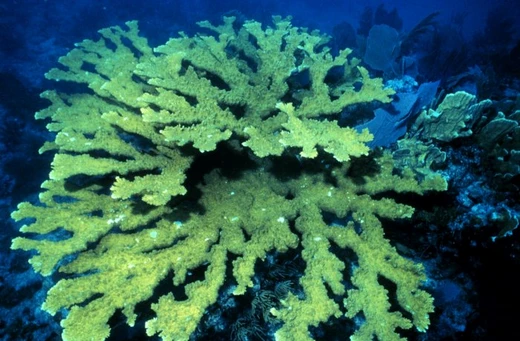
Acropora verweyi
An endangered acroporid coral found across the Indo-Pacific.

Acropora verweyi is a species of acroporid coral found in tropical shallow reefs on upper slopes. It is notable for its occurrence across a wide geographic range, from the Indian Ocean to the western Pacific, and for being classed as an endangered species on the IUCN Red List.
Quick Facts
- Taxon
- Acropora verweyi
Facts from the source article.
Lore & Background
Acropora verweyi was described in 1984 by Veron and Carden Wallace. It forms encrusted colonies arranged in cushion-, plate-shaped, or corymbose structures. Its branches are short, with diameters of seven to nine millimetres, and contain very short branchlets growing near their bases. The axial corallites are obvious, while the radial corallites are appressed, tube-shaped, orderly arranged, and round. The species is mostly a cream-brown colour, with yellow axial corallites.
Its distribution includes the southwest and northern Indian Ocean, the central Indo-Pacific, Australia, southeast Asia, Japan, the East China Sea, and the oceanic western Pacific Ocean. It is also found in the Philippines, American Samoa, Fiji and Rodrigues. It occurs in tropical shallow reefs on upper slopes, from depths of 2 to 15 metres.
The species is classed as endangered on the IUCN Red List, with its population believed to be decreasing in line with the global decline in coral reefs. It is also listed under Appendix II of CITES. Threats include global reduction of coral reefs, temperature increase causing coral bleaching, climate change, human activity, the crown-of-thorns starfish, and disease.
Reader's Guide
Acropora verweyi is significant as an endangered species whose population is decreasing in line with the global decline of coral reefs. Its listing under Appendix II of CITES reflects international concern over its conservation status. The species is threatened by multiple factors, including coral bleaching from rising temperatures, climate change, human activity, predation by the crown-of-thorns starfish, and disease. Although exact population figures are unknown, the species' wide distribution across the Indian and Pacific Oceans—from the southwest Indian Ocean to Japan and the western Pacific—highlights its ecological role in tropical shallow reef ecosystems. Its description in 1984 by Veron and Carden Wallace contributed to the taxonomic understanding of acroporid corals. The species' occurrence on upper slopes at depths of 2 to 15 metres places it in habitats vulnerable to environmental changes. Its legacy is tied to the broader challenges facing coral reefs globally, serving as an indicator of reef health and the impacts of anthropogenic and natural stressors.
Did You Know?
- Its branches have diameters of seven to nine millimetres.
- It is found at depths of 2 to 15 metres on tropical shallow reefs.
More in Acropora Corals, Part 2 1-24
Spotted an error? Know more?
Reader corrections go straight into our review queue. Suggest an edit · How this site is sourced