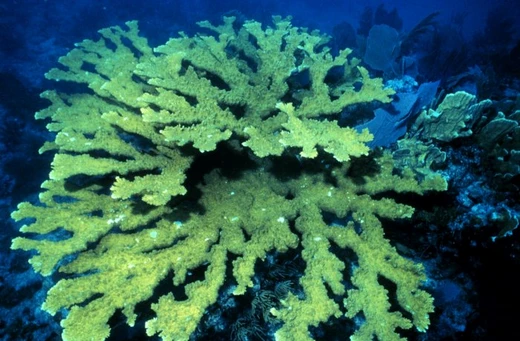
Acropora teres
A data-deficient acroporid with uncertain taxonomy and twisted branches.

Acropora teres is a species of acroporid coral found in the central Indo-Pacific, Southeast Asia, Japan, the East China Sea and the oceanic western Pacific Ocean. It inhabits tropical shallow reefs on slopes and in lagoons at depths of 2 to 20 metres. Its taxonomic status is uncertain.
Quick Facts
- Taxon
- Acropora teres
Facts from the source article.
Lore & Background
Acropora teres was originally described as Madrepora teres by Verrill in 1866. Its taxonomic status remains uncertain. The species forms arborescent colonies with a number of twisted branches that sometimes divide. It has small axial corallites and radial corallites that are immersed in the branches, with small circular openings. The coral is white in colour and resembles Acropora abrolhosensis and Acropora formosa.
Reader's Guide
Acropora teres is notable primarily for its uncertain taxonomic status, which complicates conservation assessment. It is listed as data deficient on the IUCN Red List, meaning insufficient information exists to evaluate its risk of extinction directly. However, its population is believed to be decreasing in line with the global decline of coral reefs. Threats include rising temperatures causing coral bleaching, climate change, human activity, predation by the crown-of-thorns starfish (Acanthaster planci), and disease. The species is listed under Appendix II of CITES, which regulates international trade. Its distribution spans the central Indo-Pacific, Southeast Asia, Japan, the East China Sea, and the oceanic western Pacific Ocean, occurring in shallow reef slopes and lagoons at depths of 2 to 20 metres. The lack of population figures and taxonomic clarity means that targeted conservation measures remain limited, and the species' legacy is tied to broader reef decline rather than specific documented impacts.
More in Acropora Corals, Part 2 1-24
Spotted an error? Know more?
Reader corrections go straight into our review queue. Suggest an edit · How this site is sourced