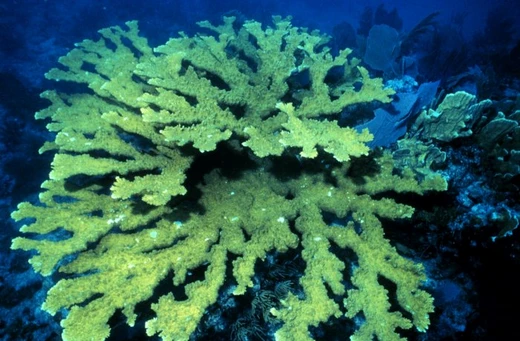
Acropora tenuis
A near-threatened acroporid coral found across the Indo-Pacific.

Acropora tenuis is a species of acroporid coral found in tropical shallow reefs on upper slopes and in subtidal habitats, at depths of 8 to 20 metres. It occurs in the Red Sea, the Gulf of Aden, the southwest, northwest and northern Indian Ocean, the Persian Gulf, the central Indo-Pacific, Australia, Southeast Asia, Japan, the East China Sea and the oceanic west and central Pacific Ocean. It is notable for being classed as near threatened on the IUCN Red List, with its population believed to be decreasing due to threats such as global reduction of coral reefs, temperature increase causing coral bleaching, climate change, human activity, the crown-of-thorns starfish, and disease.
Quick Facts
- Taxon
- Acropora tenuis
Facts from the source article.
Lore & Background
Acropora tenuis forms corymbose colonies with orderly-spaced branchlets. Its axial corallites are tube-shaped, and its radial corallites have flaring lips. The coral is blue, cream, yellow or green in colour, and is similar to Acropora vermiculata. It occurs in the Red Sea, the Gulf of Aden, the southwest, northwest and northern Indian Ocean, the Persian Gulf, the central Indo-Pacific, Australia, Southeast Asia, Japan, the East China Sea, and the oceanic western and central Pacific Ocean, at depths of 8 to 20 metres in tropical shallow reefs on upper slopes and in subtidal areas.
Biologically, Acropora tenuis is a simultaneous hermaphrodite. Spawning takes place once a year and is synchronised among colonies in any one locality. Packets of eggs and sperm are released into the water column and, being buoyant, rise to the surface, where the packets break up and cross-fertilisation takes place with gametes from different colonies intermixing.
The species is classed as near threatened on the IUCN Red List, and its population is believed to be decreasing. Figures of its population are unknown, but it is likely threatened by the global reduction of coral reefs, the increase of temperature causing coral bleaching, climate change, human activity, the crown-of-thorns starfish (Acanthaster planci), and disease. It is listed under Appendix II of CITES.
Reader's Guide
Acropora tenuis is significant as a near-threatened indicator species for the health of tropical shallow reef ecosystems across a vast geographic range, from the Red Sea and Indian Ocean to the central and western Pacific. Its listing under Appendix II of CITES reflects international concern over its trade and conservation status. The species' population is believed to be decreasing, though exact figures are unknown, and it faces multiple threats including global coral reef reduction, temperature-induced bleaching, climate change, human activity, predation by the crown-of-thorns starfish (Acanthaster planci), and disease. Its biology as a simultaneous hermaphrodite with annual synchronized spawning contributes to its reproductive strategy, but also makes it vulnerable to disruptions in spawning synchrony caused by environmental changes. The coral's occurrence in shallow, subtidal habitats on upper slopes places it in direct contact with many of these stressors. Its legacy lies in its role as a representative of the broader decline of acroporid corals worldwide, highlighting the urgent need for conservation measures in the face of ongoing environmental pressures.
Did You Know?
- Acropora tenuis is a simultaneous hermaphrodite that spawns once a year with synchronized release of egg and sperm packets.
- Its colour can be blue, cream, yellow or green, and it is similar to Acropora vermiculata.
More in Acropora Corals, Part 2 1-24
Spotted an error? Know more?
Reader corrections go straight into our review queue. Suggest an edit · How this site is sourced