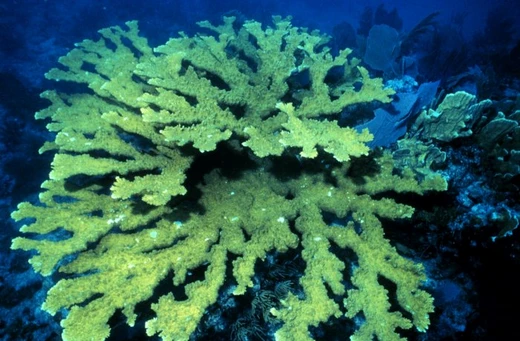
Acropora striata
Endangered acroporid coral found in Indo-Pacific and Indian Ocean reefs.

Acropora striata is a species of acroporid coral found in tropical shallow reefs across the southwest Indian Ocean, central Indo-Pacific, Japan, the East China Sea, and numerous Pacific islands. It is notable for being classed as an endangered species on the IUCN Red List, with a decreasing population threatened by global reef degradation, climate change, and disease.
Quick Facts
- Taxon
- Acropora striata
Facts from the source article.
Lore & Background
Acropora striata was originally described as Madrepora striata by Addison Emery Verrill in 1866. It forms colonies composed of short branches, with small axial corallites and radial corallites that have no defined shape or size. The coral is grey-brown in colour with white branch tips, and it resembles Acropora parahemprichii and Acropora sekiseiensis.
Its distribution spans the southwest Indian Ocean, central Indo-Pacific, Japan, the East China Sea, the Marshall Islands, the Society Islands, the Cook Islands, Kiribati, the Solomon Islands, western and eastern Australia, the Great Barrier Reef, Palau, the south Mariana Islands, and Pohnpei. It occurs at depths of 10 to 25 metres on tropical shallow reefs, specifically on reef flats or rocky foreshores. The species probably spawns in October.
The population figures are unknown, but the species is believed to be decreasing due to threats including the global reduction of coral reefs, temperature-induced coral bleaching, climate change, human activity, the crown-of-thorns starfish, and disease.
Reader's Guide
Acropora striata holds significance as an endangered species on the IUCN Red List, reflecting the broader decline of coral reef ecosystems. Its listing under Appendix II of CITES indicates international concern over its trade and conservation. The species is threatened by multiple factors: global reduction of coral reefs, rising temperatures causing coral bleaching, climate change, human activity, predation by crown-of-thorns starfish, and disease. Although its population figures are unknown, the decreasing trend underscores the vulnerability of this coral. Its occurrence across a wide geographic range—from the southwest Indian Ocean to the central Indo-Pacific and numerous Pacific islands—highlights its ecological role in tropical shallow reefs, particularly on reef flats and rocky foreshores at depths of 10 to 25 metres. The species' spawning likely in October and its morphological similarity to Acropora parahemprichii and Acropora sekiseiensis provide context for taxonomic and ecological studies. The legacy of Acropora striata is tied to the ongoing challenges facing coral reefs globally, serving as an indicator of environmental stress and the need for conservation efforts.
Did You Know?
- The species is classed as endangered on the IUCN Red List and listed under Appendix II of CITES.
- It probably spawns in October.
More in Acropora Corals, Part 2 1-24
Spotted an error? Know more?
Reader corrections go straight into our review queue. Suggest an edit · How this site is sourced