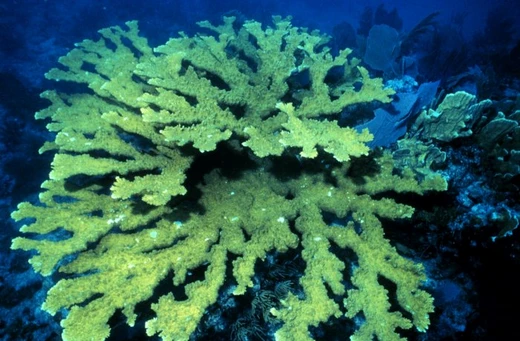
Acropora speciosa
A table-forming acroporid coral from Indo-Pacific reefs.

Acropora speciosa is a table-forming acroporid coral that builds colonies over a meter wide. Its horizontal branches grow in an irregular pattern. The coral has long, tube-shaped axial corallites, while the radial corallites are triangular with nariform openings and sit flush on the main branches. It is pale brown and resembles *Acropora batunai*, *Acropora echinata*, and *Acropora granulosa*.
First described by J.J. Quelch in 1886, this species inhabits shallow reefs across a wide range: the Red Sea, Gulf of Aden, southwest and northern Indian Ocean, central Indo-Pacific, Southeast Asia, Japan, the East China Sea, eastern Australia, and the oceanic west and central Pacific. It lives at depths of 2 to 25 metres.
The IUCN lists *Acropora speciosa* as Data Deficient, but its population is thought to be declining due to the global loss of coral reefs. Threats include rising sea temperatures causing bleaching, climate change, human activity, predation by the crown-of-thorns starfish (*Acanthaster planci*), and disease. No population figures are known. The species is also listed under Appendix II of CITES.
Quick Facts
- Taxon
- Acropora speciosa
Facts from the source article.
Lore & Background
Acropora speciosa was originally described by JJ Quelch in 1886. The species forms table-shaped colonies with diameters sometimes exceeding 1 metre, and its horizontal branches are irregularly arranged. Its axial corallites are tube-shaped and long, while radial corallites are triangular with nariform openings and are immersed on the main branches. The coral is pale brown in colour and resembles Acropora batunai, Acropora echinata, and Acropora granulosa.
Reader's Guide
Acropora speciosa is classed as data deficient on the IUCN Red List, but its population is believed to be decreasing in line with the global decline in coral reefs. It is listed under Appendix II of CITES. Figures of its population are unknown, but the species is likely threatened by the global reduction of coral reefs, increased temperature causing coral bleaching, climate change, human activity, the crown-of-thorns starfish (Acanthaster planci), and disease. Its distribution spans the Red Sea, Gulf of Aden, southwest and northern Indian Ocean, central Indo-Pacific, Southeast Asia, Japan, the East China Sea, eastern Australia, and the oceanic west and central Pacific Ocean, at depths of 2 to 25 metres in shallow reefs. The species' significance lies in its wide geographic range and its vulnerability to multiple stressors affecting coral reefs worldwide.
More in Acropora Corals, Part 2 1-24
Spotted an error? Know more?
Reader corrections go straight into our review queue. Suggest an edit · How this site is sourced