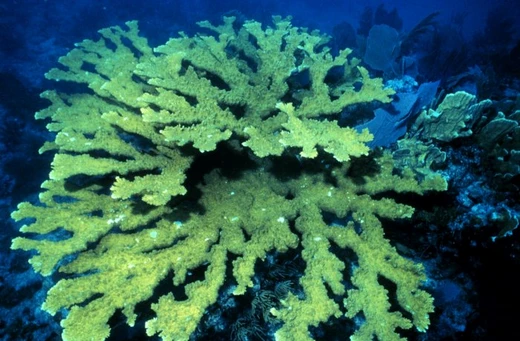
Acropora secale
A staghorn coral forming low hummocks with level tops.

Acropora secale is a species of branching staghorn stony coral found in shallow parts of the Indo-Pacific Ocean, with its type locality in Sri Lanka. It is notable as a reef-building coral that forms low hummocks with a level-topped appearance, and its oldest known fossils date back to the Pleistocene.
Quick Facts
- Genus
- Acropora
- Species
- secale
Facts from the source article.
Lore & Background
Acropora secale is a colonial coral that forms low hummocks, with cylindrical branches that taper toward the tips and grow in a corymbose fashion—lower branches longer than upper ones, giving a level-topped appearance. The corallites vary in size and are arranged in vertical rows, often with alternate rows of larger and smaller corallites; axial corallites reach up to 3 mm in diameter, while radial corallites have long tubular or nariform openings. The skeleton is covered by a thin ectodermal layer of tissue, and when feeding, polyps protrude from the corallites, each with a single ring of twelve tentacles, one longer than the others. The polyps have a mouth opening into the coelenteron, which interconnects with other polyps through a complex channel system (coenenchyme) inside the porous skeleton. Several colour schemes occur: purple with yellow tips, pale brown with blue tips, plain green, or plain brown.
This species is found in tropical waters of the west Indo-Pacific, including East Africa, Mozambique, Rodrigues, Aldabra, Chagos, and further east around Singapore, Thailand, Indonesia, Japan, the Philippines, Taiwan, and north and west Australia. It occurs at depths down to 5 metres on outer reef flats, reef slopes, reef edges, and walls. Acropora secale is a zooxanthellate coral, hosting symbiotic dinoflagellates within its tissues, which—combined with tissue pigments—are responsible for its colour. It is a hermaphrodite, with both female gonads and testes maturing once a year; colonies release eggs and sperm simultaneously, usually six days after the full moon, in November in the Southern Hemisphere and June in the Northern Hemisphere. Fertilisation is external, and the developing larvae drift as plankton before settling on the seabed.
Reader's Guide
Acropora secale is significant as a reef-building coral in the Indo-Pacific, contributing to the structural complexity of shallow reef flats, slopes, edges, and walls. Its corymbose growth form, with level-topped hummocks, distinguishes it from other staghorn corals and influences local habitat architecture. The species' reproductive strategy—simultaneous spawning six days after the full moon, timed to November or June depending on hemisphere—aligns with broader coral spawning synchrony patterns, though the article does not compare it to other species. Its zooxanthellate nature underscores its reliance on symbiotic dinoflagellates for colour and nutrition, a common trait among reef-building corals. The presence of Pleistocene fossils indicates a long evolutionary history in the region. The variety of colour morphs (purple with yellow tips, pale brown with blue tips, plain green, plain brown) may reflect genetic or environmental factors, but the article does not elaborate. As a stony coral, its porous skeleton and interconnected polyp system via coenenchyme are typical of the genus Acropora. The species' distribution across a wide Indo-Pacific range, from East Africa to Japan and Australia, highlights its adaptability to diverse shallow-water environments. Its legacy lies in its role as a foundational species in reef ecosystems, though the article does not discuss threats or conservation status.
Did You Know?
- The type locality of Acropora secale is Sri Lanka.
- The coral forms low hummocks with a level-topped appearance due to corymbose branching.
More in Acropora Corals, Part 2 1-24
Spotted an error? Know more?
Reader corrections go straight into our review queue. Suggest an edit · How this site is sourced