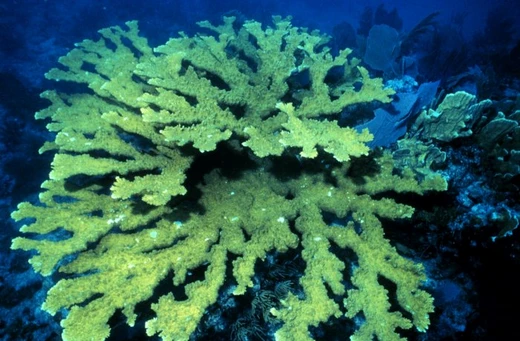
Acropora samoensis
A digitate acroporid coral from tropical shallow reefs.

Acropora samoensis is a species of acroporid coral found in tropical shallow reefs on upper slopes, at depths of 5 to 15 metres. It was described by Brook in 1891 and is notable for its digitate colonies that are either prostrate or corymbose, with diameters up to 1 metre.
Quick Facts
- Taxon
- Acropora samoensis
Facts from the source article.
Lore & Background
Acropora samoensis forms digitate colonies that are either prostrate or corymbose, with branches that taper slightly towards the ends and are curved. Its axial corallites are dome-shaped and at least double the diameter of its tube-shaped radial corallites. The coral is blue, cream, or purple in colour and resembles Acropora torresiana.
It occurs in the Red Sea, the Gulf of Aden, the southwest and northern Indian Ocean, the central Indo-Pacific, Australia, Southeast Asia, Japan, the East China Sea, and the oceanic west and central Pacific Ocean. It is found on upper slopes of reefs at depths between 5 and 15 metres.
Originally described as Madrepora samoensis by Brook in 1891, the species is classed as least concern on the IUCN Red List, though its population is believed to be decreasing. It is listed under Appendix II of CITES.
Reader's Guide
Acropora samoensis is significant as a widespread Indo-Pacific acroporid coral that occupies upper reef slopes in tropical shallow waters. Its digitate growth form, with prostrate or corymbose colonies reaching up to 1 metre in diameter, contributes to the structural complexity of reef habitats. The species is listed as least concern on the IUCN Red List, but its population is believed to be decreasing due to threats including global reduction of coral reefs, temperature-induced coral bleaching, climate change, human activity, predation by the crown-of-thorns starfish (Acanthaster planci), and disease. Its inclusion under Appendix II of CITES reflects international concern over trade impacts. The coral's colour variation—blue, cream, or purple—and its resemblance to Acropora torresiana aid field identification. The original description as Madrepora samoensis by Brook in 1891 anchors its taxonomic history. While population figures remain unknown, the species' broad distribution across the Red Sea, Indian Ocean, Indo-Pacific, and Pacific Ocean underscores its ecological role in diverse reef systems.
Did You Know?
- Its axial corallites have diameters at least double the size of its radial corallites.
- It is found at depths of 5 to 15 metres on upper slopes of tropical shallow reefs.
More in Acropora Corals, Part 2 1-24
Spotted an error? Know more?
Reader corrections go straight into our review queue. Suggest an edit · How this site is sourced