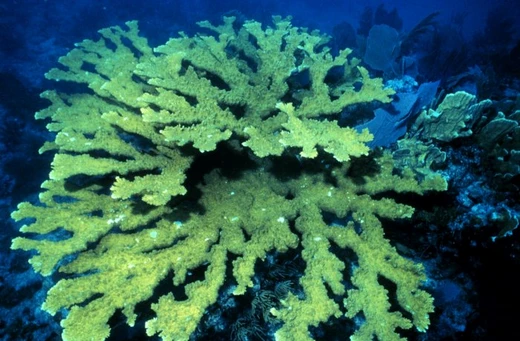
Acropora rudis
An uncommon Indo-Pacific coral endangered by bleaching and habitat loss.

Acropora rudis is an uncommon acroporid coral native to the Indo-Pacific. The International Union for Conservation of Nature lists it as endangered due to its high vulnerability to coral bleaching, diseases, predation by crown-of-thorns starfish, and the loss of its reef habitat.
This coral grows in robust, irregular clumps up to about a meter across. Its branches are thick—up to 40 mm in diameter—and can reach 160 mm in length. Some branches grow upward, others horizontally, and some curve downward near the tips. The axial corallites at the branch ends are very large, while the radial corallites along the sides are smaller, closely spaced, and rounded or tubular-conical in shape. The coral’s color varies, appearing dark green or brown.
Acropora rudis has a patchy distribution in the northern Indian Ocean, including Sri Lanka, the Seychelles, Bangladesh, Thailand, and western Sumatra. It inhabits rocky fringing reefs, shallow reef edges, and the upper parts of submerged reefs, typically at depths between 3 and 15 meters.
Corals in the genus Acropora are especially prone to bleaching and disease and recover slowly after damage. They are also harmed by storms, trawling, ocean warming, and acidification. Because Acropora rudis is uncommon, has a limited range, and faces ongoing habitat destruction, the IUCN considers its conservation status endangered.
Quick Facts
- Taxon
- Acropora rudis
Facts from the source article.
Lore & Background
Acropora rudis is a colonial stagshorn coral forming clumps up to a metre across. The branches are tapering, irregular and robust, up to 40 mm in diameter; some extend upwards, others are horizontal, and some turn downwards near the tips. The branches are up to 160 mm in length. At the ends of the branches, the axial corallites are very large. The radial corallites at the sides of the branches are smaller, close together, rounded and tubular, or tubular-conical. The colour of this coral varies, sometimes being dark green and other times being brown.
This species is native to the northern Indian Ocean where it has a patchy distribution in Sri Lanka, the Seychelles, Bangladesh, Thailand and western Sumatra. It occurs on rocky fringing reefs, the edges of shallow reefs and the upper parts of submerged reefs, at depths between about 3 and 15 m.
Corals in the genus Acropora are particularly prone to bleaching and coral disease and when they have been damaged, are slow to recover; they are also affected when the reefs where they grow are destroyed by storms or trawling, and by ocean warming and acidification. Acropora rudis is an uncommon species with a somewhat limited range and habitat destruction is predicted to reduce populations considerably.
Reader's Guide
Acropora rudis is notable primarily for its endangered status as assessed by the International Union for Conservation of Nature. The species is particularly susceptible to coral bleaching, coral diseases, damage by the crown-of-thorns starfish, and destruction of its coral reef habitat. Its limited and patchy distribution across the northern Indian Ocean—including Sri Lanka, the Seychelles, Bangladesh, Thailand, and western Sumatra—makes it vulnerable to localised threats. The coral grows on rocky fringing reefs, shallow reef edges, and upper submerged reef slopes at depths of 3 to 15 meters. As a member of the genus Acropora, it shares the group's general susceptibility to bleaching and disease, and its slow recovery after damage. Habitat destruction from storms, trawling, ocean warming, and acidification is predicted to reduce its populations considerably. The species' conservation significance lies in its rarity and the multiple, compounding threats it faces, which together justify its endangered classification.
Did You Know?
- Acropora rudis forms clumps up to a metre across with branches up to 160 mm long.
- It is found in the northern Indian Ocean in Sri Lanka, the Seychelles, Bangladesh, Thailand, and western Sumatra.
More in Acropora Corals, Part 2 1-24
Spotted an error? Know more?
Reader corrections go straight into our review queue. Suggest an edit · How this site is sourced