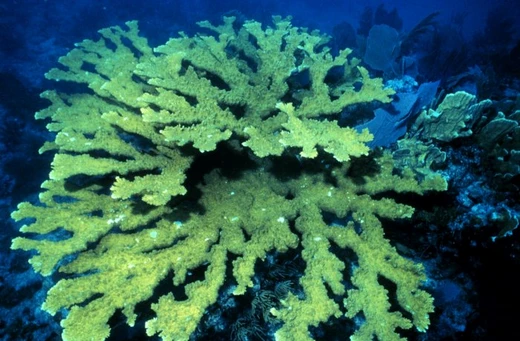
Acropora pulchra
A branching staghorn coral found on back reef fringes in the western Indo-Pacific.

Acropora pulchra belongs to the staghorn coral group within the family Acroporidae. This colonial species lives in shallow waters along the back edges of reefs across the western Indo-Pacific. Its earliest known fossils come from the Pleistocene epoch.
The coral’s hard skeleton can take several shapes. It grows in branching forms, sometimes resembling a tree and forming dense thickets, while elsewhere it creates tangled colonies with flat tops. Individual branches measure up to 12 mm across and 18 cm long. Many colonies spread horizontally and reach no more than 5 cm in thickness. The growth pattern depends largely on how the coral sits relative to tidal levels. The polyps emerge from small cup-like depressions called corallites, which are spaced widely along the branches and have elongated lower lips. Colors range from blue to various browns, often with pale blue branch tips.
This species occurs from the Gulf of Aden through Southeast Asia, Japan, the East China Sea, and Australia. It typically grows between 1 and 20 meters deep on back-reef fringes, flats, and lagoon areas, often alongside the similar species Acropora aspera.
The polyps extend their tentacles to capture plankton, but most of the coral’s nutrition comes from symbiotic zooxanthellae living in its tissues. These photosynthetic algae produce energy in sunlight, which the coral uses. Like other Acropora species, this coral grows slowly and thrives in clear water. It is sensitive to sediment, pollution, and algal blooms that cloud the water and reduce sunlight. It also dislikes water temperatures outside 19–30 °C. If the sea becomes too warm, the coral may expel its zooxanthellae, leading to bleaching.
Reproduction is synchronized with the moon’s phase, so all corals in one area spawn within the same two days, though the exact date varies between hemispheres and across the species’ range. Asexual reproduction also occurs when broken fragments settle and establish themselves. Transplant experiments have succeeded, but transplants grew more slowly and suffered from excess sedimentation compared to control corals.
The IUCN lists Acropora pulchra as endangered, mainly due to increased coral bleaching from rising water temperatures. Major threats include general reef destruction, ocean acidification, higher sea temperatures, and coral diseases.
Quick Facts
- Taxon
- Acropora pulchra
Facts from the source article.
Lore & Background
The stony skeleton of Acropora pulchra takes on various forms. It is a branching species, sometimes being tree-like and forming thickets and in other locations forming tangled colonies with level upper surfaces. The branches are up to 12 mm in diameter and up to 18 cm long. Often the whole colony spreads horizontally and is no more than 5 cm thick. The growth habit largely depends on where the coral is growing in relation to the tide levels. The polyps protrude from little cup-shaped depressions called corallites which are widely spaced on the branches and which have elongated lower lips. The colour of this coral varies from blue to various shades of brown, often with pale blue tips to the branches.
Acropora pulchra is found in the western Indo-Pacific region, its range extending from the Gulf of Aden to Southeast Asia, Japan, the East China Sea and Australia. It chiefly grows at depths which range from 1 to 20 metres on back reef fringes and flats and in reef lagoons, often growing among the closely related coral species Acropora aspera.
The polyps extend their tentacles to catch plankton, but much of the nutrition comes from symbiotic zooxanthellae. These photosynthetic dinoflagellates produce energy when exposed to sunlight. Acropora spp. corals are slow-growing and flourish in clear water. They are particularly sensitive to sediment, pollution and algal blooms, which cloud the water and reduce sunlight. If the sea gets too hot they may expel the zooxanthellae, causing bleaching.
Reader's Guide
Acropora pulchra is notable for its variable growth forms, which depend on tidal levels, and its wide distribution across the western Indo-Pacific. The species synchronizes its reproductive activities with the phase of the moon, spawning on the same couple of days in a locality, though the date varies between hemispheres and parts of its range. It can also reproduce asexually when broken fragments establish themselves. Experiments on transplanting this coral to other suitable habitats were successful, but transplants were adversely affected by excess sedimentation and grew more slowly than control corals.
The IUCN Red List lists Acropora pulchra as endangered due to increased occurrences of coral bleaching from rising water temperatures. Chief threats include general destruction of coral reefs, ocean acidification, raised sea temperatures, and coral diseases. The crown-of-thorns starfish feeds preferentially on Acropora species and sometimes has sudden population increases that may threaten this coral. Its sensitivity to sediment, pollution, and temperature extremes underscores its vulnerability in changing marine environments.
Did You Know?
- The oldest fossils of Acropora pulchra date back to the Pleistocene.
- It synchronizes spawning with the phase of the moon, with all corals in one locality spawning on the same couple of days.
- Transplanted fragments grew more slowly than control corals when affected by excess sedimentation.
More in Acropora Corals, Part 2 1-24
Spotted an error? Know more?
Reader corrections go straight into our review queue. Suggest an edit · How this site is sourced