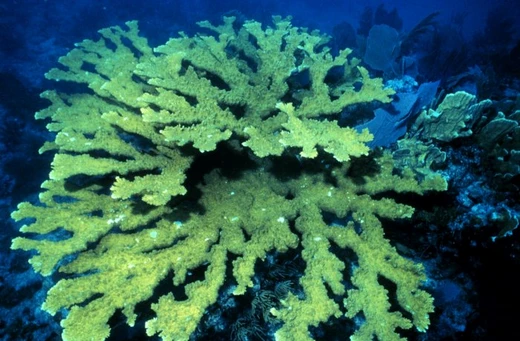
Acropora prolifera
A hybrid stony coral of the Caribbean, Bahamas, and Florida.

Acropora prolifera, called the fused staghorn coral, is a branching, colonial, stony coral that lives in shallow waters of the Caribbean Sea, the Bahamas, and southern Florida. It is a hybrid of two other Caribbean corals: Acropora cervicornis and Acropora palmata.
In appearance, it closely resembles staghorn coral but tends to form smaller, denser clumps. Its branches are mostly horizontal, often splitting near the tip, and sometimes fuse with neighboring branches. It also looks like elkhorn coral, and genetic studies confirm it is a cross between that species and staghorn coral. The corallites—the small, cup-like skeletal structures housing the polyps—are tubular and stick out from the branch surface. They are tightly packed in linear rows, with a larger corallite at each branch tip. Branches reach up to 2 cm (0.8 in) in diameter, and the whole colony can grow to 1.2 meters (3 ft 11 in) across. The coral is generally pale yellowish-brown, with lighter tips on the branches.
This species occurs in the Caribbean Sea, the Gulf of Mexico, the Bahamas, and southern Florida, extending south to Colombia and Venezuela. It typically inhabits outer reef slopes, calm-water bays, and areas sheltered by land, most often at depths around 7 meters (23 ft), though it can be found down to about 30 meters (98 ft). It is generally uncommon.
Many reef corals, including elkhorn and staghorn corals, undergo mass spawning events where large numbers of gametes are released simultaneously. When these two species spawn at the same time, F1 hybrids can form. These hybrids cannot reproduce sexually but can increase their numbers through asexual reproduction. In Acropora prolifera, two forms arise: if the female gamete comes from elkhorn coral, the offspring is bushy and compact; if from staghorn coral, the offspring takes on a more palmately dividing shape. The coral is zooxanthellate, meaning its tissues contain symbiotic dinoflagellates that photosynthesize, using the coral’s carbon dioxide and waste while supplying oxygen and organic compounds in return.
Quick Facts
- Taxon
- Acropora prolifera
Facts from the source article.
Lore & Background
Acropora prolifera is very similar to staghorn coral (Acropora cervicornis) in appearance but usually forms smaller, denser clumps. Its branches are mostly horizontal and often divide near the tip, sometimes fusing with other branches. It also resembles elkhorn coral (Acropora palmata), and genetic studies show that it is a hybrid between that and staghorn coral. The corallites are tubular, tightly packed, arranged in linear rows, with a larger corallite at the tip of each branch.
This coral is found in the Caribbean Sea, the Gulf of Mexico, the Bahamas, and southern Florida southwards to Colombia and Venezuela. It generally occurs on outer reef slopes, in calm-water bays, and in the lee of land masses, most commonly at a depth of around 7 meters but occasionally down to about 30 meters. It is generally an uncommon species.
Many reef corals have mass spawning events, and when elkhorn and staghorn corals spawn at the same time, F1 hybrids can be formed. These hybrids cannot propagate sexually but can reproduce asexually. In Acropora prolifera, if the female gamete comes from elkhorn coral, the offspring is bushy and compact; if from staghorn coral, the offspring adopts a more palmately dividing form. The coral is zooxanthellate, containing symbiotic dinoflagellates that are photosynthetic.
Reader's Guide
Acropora prolifera is significant as a naturally occurring hybrid between two well-known Caribbean corals, Acropora cervicornis and Acropora palmata. Its existence demonstrates that hybridization can occur in reef-building corals when sympatric species spawn simultaneously. The hybrid cannot reproduce sexually but persists through asexual reproduction, increasing the number of individuals. Its morphology varies depending on which species contributed the female gamete: offspring are bushy and compact when the female gamete is from elkhorn coral, and more palmately dividing when from staghorn coral. This coral is found across a wide geographic range from southern Florida to Colombia and Venezuela, typically in shallow, calm-water environments. It is generally uncommon, but its presence in outer reef slopes and bays adds to the diversity of Caribbean reef ecosystems. As a zooxanthellate coral, it relies on symbiotic dinoflagellates for photosynthesis, which supply oxygen and organic compounds while using the coral's waste products. The fused staghorn coral's hybrid nature and limited reproductive strategy make it a notable example of coral evolution and adaptation.
Did You Know?
- Acropora prolifera is a hybrid of Acropora cervicornis and Acropora palmata.
- The branches are up to 2 cm in diameter and the whole colony may grow to 1.2 meters across.
- Its general color is pale yellowish-brown with paler branch tips.
More in Acropora Corals, Part 2 1-24
Spotted an error? Know more?
Reader corrections go straight into our review queue. Suggest an edit · How this site is sourced