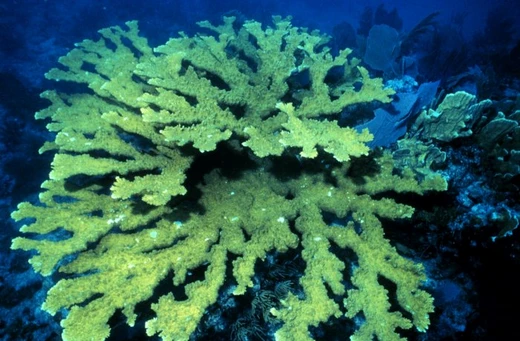
Acropora polystoma
An endangered acroporid coral of strong-wave reef slopes.

Acropora polystoma, a type of acroporid coral, was first documented by G. Brook in 1891. This species lives in tropical marine settings, typically on upper reef slopes exposed to strong wave action, at depths ranging from 3 to 10 meters. It is listed as endangered on the IUCN Red List, with its population trending downward, and is included in CITES Appendix II. Though uncommon, it is spread across a wide geographic range.
The coral forms colonies as clumps or corymbose plates, reaching up to 80 centimeters across. Its branchlets grow to lengths of 100 millimeters, with diameters between 5 and 15 millimeters, and they taper toward the tips. Colors include blue, cream, yellow, lavender, or brown. Branches bear both axial and radial corallites: axial corallites sit at branch tips, with outer diameters of 2.4 to 4 millimeters and inner diameters of 0.8 to 1.5 millimeters; radial corallites are tube-shaped, arranged in regular rows. A small number of randomly placed spinules are present. The skeleton is made of aragonite (calcium carbonate). This species resembles Acropora massawensis and others in the robusta group.
Acropora polystoma is found over a large area, including the Gulf of Aden, the Indian Ocean, the Indo-Pacific, Southeast Asia, Australia, and the western Pacific. It also occurs in Japan, American Samoa, the Cook Islands, and five regions of Indonesia. In French Polynesia, it spawns in October. Threats include reef destruction, climate change, rising sea temperatures causing bleaching, coral disease, predation by the starfish Acanthaster planci, and human activities and infrastructure. It may be present in Marine Protected Areas.
Originally, G. Brook described it in 1891 under the name Madrepora polystoma.
Quick Facts
- Genus
- Acropora
- Species
- polystoma
Facts from the source article.
Lore & Background
Acropora polystoma forms colonies of clumps or corymbose plates up to 80 cm in diameter. Its branchlets reach 100 mm in length and 5–15 mm in diameter, tapering toward the ends. The coral appears in blue, cream, yellow, lavender, or brown. Axial corallites are small, with outer diameters of 2.4–4 mm and inner diameters of 0.8–1.5 mm; radial corallites are tube-shaped and arranged in regular rows. A small number of randomly positioned spinules are present. The species is composed of aragonite (calcium carbonate).
It occurs on upper slopes of reefs damaged by strong waves and on reef edges, at depths of 3–10 m. Its distribution spans the Gulf of Aden, Indian Ocean, Indo-Pacific, Southeast Asia, Australia, western Pacific, Japan, American Samoa, Cook Islands, and five regions of Indonesia. It spawns in October in French Polynesia. Threats include reef destruction, climate change, rising sea temperatures causing bleaching, coral disease, predation by the starfish Acanthaster planci, and human activity and infrastructure.
Reader's Guide
Acropora polystoma is notable as an endangered species with a decreasing population, first described in 1891 by G. Brook. Its listing on the IUCN Red List and under CITES Appendix II reflects its vulnerability. The species is uncommon yet widespread across the Indo-Pacific, from the Gulf of Aden to the western Pacific, including Japan, American Samoa, and the Cook Islands. Its occurrence on upper reef slopes subject to strong wave action indicates a specialized habitat. The coral's reproduction is documented by spawning in October in French Polynesia. Threats from climate change, bleaching, disease, and predation by Acanthaster planci are explicitly noted. The species may be found in Marine Protected Areas, offering some conservation potential. Its similarity to Acropora massawensis and other robusta-group species places it within a taxonomic context, though no further resolution of that relationship is provided in the source.
Did You Know?
- Acropora polystoma was first described by G. Brook in 1891 as Madrepora polystoma.
- It is found at depths between 3 and 10 m on upper slopes where waves are strong.
- The species spawns in October in French Polynesia.
- It is preyed upon by the starfish Acanthaster planci.
More in Acropora Corals, Part 2 1-24
Spotted an error? Know more?
Reader corrections go straight into our review queue. Suggest an edit · How this site is sourced