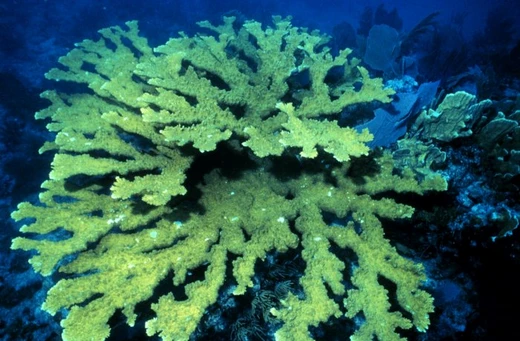
Acropora pharaonis
A vulnerable acroporid coral with flat or twisted branches.

Acropora pharaonis is a coral species belonging to the acroporid group, originally described in 1860 by Milne-Edwards and Haime. Its colonies form either flat, table-like shapes or clusters of twisted branches that can be vertical or horizontal. These structures are orderly and symmetrical, sometimes exceeding two meters in height. The branchlets, which can reach up to 250 millimeters in length and 10 to 25 millimeters in diameter, have pale tips and taper toward the ends. They bear many small branchlets with axial, incipient axial, and radial corallites. The axial corallites are small, with outer diameters of 1.5 to 2.6 millimeters and inner diameters of 0.6 to 1.5 millimeters. Incipient axial corallites give the branchlets a spiky surface, while the radial corallites are closely spaced, featuring small nose-shaped openings and scattered spinules. The coral is brown-grey in color. Its mineralized tissue is made of aragonite.
This species is found in marine tropical environments, on reef slopes sheltered from wave action, at depths between 5 and 25 meters. It resembles Acropora clathrata, Acropora parapharaonis, and Acropora plumosa. Its range is large and includes the Indian Ocean, Red Sea, Persian Gulf, Gulf of Aden, New Caledonia, Fiji, American Samoa, and possibly Cocos-Keeling. It is common across this area. The population is decreasing, and the species is listed as vulnerable on the IUCN Red List and under CITES Appendix II. Threats include climate change, coral disease, rising sea temperatures causing bleaching, reef destruction, predation by Acanthaster planci, and human activity. It may occur within Marine Protected Areas.
Quick Facts
- Taxon
- Acropora pharaonis
Facts from the source article.
Lore & Background
Acropora pharaonis forms colonies of flat table-like structures or clumped vertical or horizontal twisted branches, orderly and symmetrical, with heights over 2 metres. Branchlets reach up to 250 mm long and 10–25 mm in diameter, with smaller branchlets up to 20 mm long and 3–8 mm in diameter. The coral is brown-grey with pale branch tips, and branchlets contain axial, incipient axial, and radial corallites. Axial corallites are small (outer diameter 1.5–2.6 mm, inner 0.6–1.5 mm), incipient axial corallites give a spiky surface, and radial corallites have small nose-shaped openings and randomly placed spinules. It resembles Acropora clathrata, Acropora parapharaonis, and Acropora plumosa. Its mineralised tissue is aragonite.
Reader's Guide
Acropora pharaonis is significant as a common species over a large range, including the Indian Ocean, Red Sea, Persian Gulf, Gulf of Aden, New Caledonia, Fiji, American Samoa, and potentially Cocos-Keeling. It is found on tropical reef slopes sheltered from wave action at depths of 5 to 25 m. Its vulnerable status on the IUCN Red List and listing under CITES Appendix II reflect threats from climate change, coral disease, rising sea temperatures causing bleaching, reef destruction, predation by Acanthaster planci, and human activity. It may occur within Marine Protected Areas. The species was first described in 1860 in the genus Madrepora by Haime and Henri Milne-Edwards. Its decreasing population underscores ongoing environmental pressures on reef ecosystems.
Did You Know?
- Acropora pharaonis was first described by Milne-Edwards and Haime in 1860 in the genus Madrepora.
- Colonies can exceed 2 metres in height and are orderly and symmetrical.
- It is preyed upon by Acanthaster planci.
- Its mineralised tissue is composed of aragonite (calcium carbonate).
More in Acropora Corals, Part 2 1-24
Spotted an error? Know more?
Reader corrections go straight into our review queue. Suggest an edit · How this site is sourced