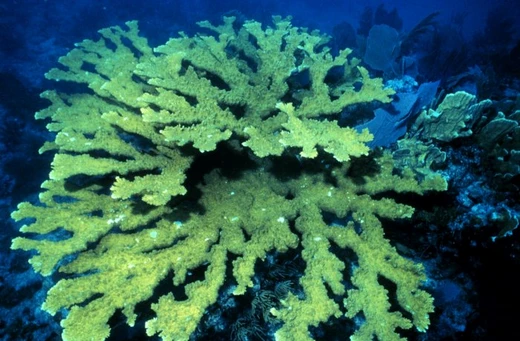
Acropora papillare
Vulnerable acroporid coral found in shallow, wave-exposed tropical reefs.

Acropora papillare is a coral species first identified by Y. Y. Latypov in 1992. It forms colonies made up of clump-like structures and curved branches, which can reach up to 80 millimeters in length and 15 to 30 millimeters in diameter. The coral is blue or brown, with small axial corallites at the branch tips—these have outer diameters of up to 3.4 millimeters and a thick polyp-covering cup. Its radial corallites are uniform in size and feature noticeable lips. This species closely resembles three other Acropora species: A. abrotanoides, A. aspera, and A. robusta.
Found in marine, tropical, shallow reefs that are exposed to strong waves, Acropora papillare lives on reef flats and in very shallow waters, at depths of 1 to 5 meters. It is uncommon but has a wide distribution, occurring in Australia, Japan, three regions of Indonesia, the Indo-Pacific, the East China Sea, and Southeast Asia. It is native to Australia, Vietnam, Cambodia, Thailand, Taiwan, Singapore, Malaysia, Indonesia, Japan, the Cocos Islands, and the Philippines. The population is decreasing, threatened by climate change, coral disease, rising sea temperatures that cause bleaching, reef destruction, predation by Acanthaster planci, and human activity. It is listed as vulnerable on the IUCN Red List and is included in CITES Appendix II. The species may also be found within Marine Protected Areas.
Quick Facts
- Taxon
- Acropora papillare
Facts from the source article.
Lore & Background
Acropora papillare forms colonies composed of clump-like structures with curved branches. Branches grow up to 80 mm long and are 15–30 mm in diameter. The species is blue or brown in color, with axial corallites at branch ends that are small (outer diameters up to 3.4 mm) and have a thick polyp-covering cup. Radial corallites are uniform in size with conspicuous lips. Its features make it look similar to three other Acropora species: A. abrotanoides, A. aspera, and A. robusta.
This species occurs in marine, tropical, shallow reefs in areas exposed to strong waves, on reef flats and very shallow reefs, at depths between 1 and 5 m. It is uncommon but found over a large area, including in three regions of Indonesia, Australia, Japan, the Indo-Pacific, the East China Sea, and Southeast Asia. It is native to Australia, Vietnam, Cambodia, Thailand, Taiwan, Singapore, Malaysia, Indonesia, Japan, the Cocos Islands, and the Philippines.
The population is known to be decreasing. Threats include climate change, coral disease, rising sea temperatures leading to bleaching, reef destruction, predation by Acanthaster planci, and human activity. It is listed on CITES Appendix II and may occur within Marine Protected Areas.
Reader's Guide
Acropora papillare is significant as a vulnerable species with a decreasing population, highlighting the pressures on shallow reef ecosystems. Its occurrence in wave-exposed environments and at very shallow depths makes it particularly susceptible to climate change impacts such as rising sea temperatures and bleaching. The species is also threatened by coral disease, reef destruction, predation by the crown-of-thorns starfish (Acanthaster planci), and human activity. Its listing on CITES Appendix II indicates international concern over trade. Despite being uncommon, its wide distribution across the Indo-Pacific, including multiple regions of Indonesia, Japan, Australia, and Southeast Asia, suggests that conservation efforts in Marine Protected Areas could benefit its persistence. The species' morphological similarity to A. abrotanoides, A. aspera, and A. robusta may complicate field identification. Its description by Latypov in 1992 adds to the taxonomic understanding of acroporid corals in Vietnam and the broader region.
Did You Know?
- Acropora papillare was first described by Latypov in 1992.
- It is found at depths between 1 and 5 meters in wave-exposed shallow reefs.
- The species is blue or brown in color and has branches up to 80 mm long.
- It is threatened by climate change, coral disease, rising sea temperatures, and predation by Acanthaster planci.
More in Acropora Corals, Part 2 1-24
Spotted an error? Know more?
Reader corrections go straight into our review queue. Suggest an edit · How this site is sourced